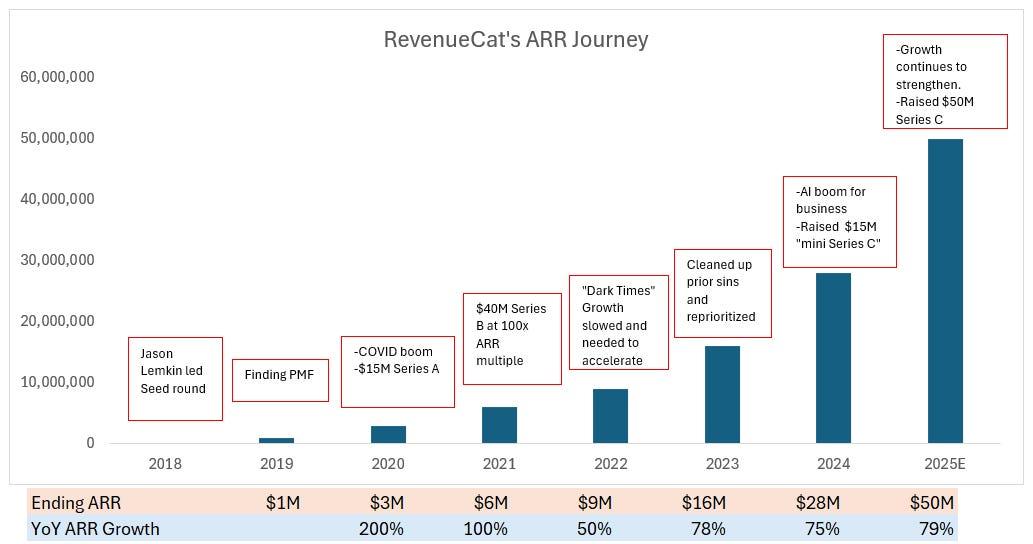
RevenueCat recently drew major attention by turning down a $500 million acquisition offer and instead raising a Series C at the same valuation.
"Turning down a $500 million acquisition offer really messes with your head. That kind of money could have set up my family for generations." — Jacob Eiting, founder/CEO of RevenueCat
Three growth engines RevenueCat gained from the AI boom
- Launches of mobile apps for new AI models
- Most of the latest AI models are launching mobile apps, and when they do, subscription management platforms like RevenueCat become essential.
- OpenAI and Notion are among RevenueCat's customers.
- Existing apps adding AI features and usage-based pricing
- As existing apps add AI features, they need more complex subscription handling, including usage-based billing.
- An explosion in the number of app developers
- As building apps becomes easier for everyone, RevenueCat's customer base grows accordingly.
Key facts from the Series C
- Lead investor: Bain Capital Ventures
- Post-money valuation: $500 million
- Capital raised: $30 million in new funding + $20 million in secondary sales
- ARR: around $30 million, growing 75% year-over-year
- Cash burn: zero, in fact slightly profitable
- ARR multiple: about 16x
"We're only 100 people, and we just happen to be profitable."
Efficient operations and capital management
RevenueCat has raised about $80 million total, but has only burned around $20 million. Even before the Series C, the company was already sitting on $30 million in cash.
"I still don't know how we'll spend the extra money. I guess we'll figure out a way."
Jacob says the company doesn't urgently need cash right now, but wanted dry powder in case it needs to move quickly or retool the business in the future.
Of the $50 million in this round, $20 million was secondary, allowing the founder and existing investors to liquidate part of their holdings. The reasons:
- to reduce the pressure of having rejected the $500 million acquisition offer
- to help both new and existing investors land at the ownership level they wanted
"I live in rural Ohio... I'm not worried about money. I have enough."
"Continuing to build RevenueCat is the most valuable thing I can do in the world."
"I've never seen a founder sell their company and later say it was absolutely the right move."
https://harvest.pub/shared/99f52c14-cad9-4713-b6f1-2e0d5559ac9c