As Palantir's stock price rises, a job called FDE (Forward Deployed Engineer) is being talked about. Engineers who reside at client companies and work together to find, implement, and solve problems. We looked into how they differ from dispatched engineers in the existing SI industry and consultants in the consulting industry.
Palantir describes the world with their trademark concept, Ontology. The beings and concepts of the world are decomposed and connected into entities, relationships (links), actions, etc. to create a type of digital twin. Here, simulations are performed through various statistical/probability/causal approaches and applied to reality to create impact**.
In this process, many products such as Foundry and AIP are mentioned, but I know that it is difficult to make an impact with these alone. (I worked at an SI company called Samsung SDS, which also had a solution division.) A solution is selling the solution to someone who knows what their problem is. If you offer a solution to a place where you don't know what the problem is, you end up adding just one more solution.
That's why Palantir sends dispatched engineers, called FDEs, to customer companies to persistently dig into what problems are truly important and need to be solved. This is why Palantir is compared to existing consulting companies. However, the limitations of consulting companies are that they find a problem, define it, announce it, and then disappear. It is the responsibility of those who remain to solve the problem, but even this is often not done according to the decision-making of company executives.
FDE's role is not only to define problems, but also to solve problems and create impact. SI's dispatched engineers focus on carrying out the proposals made by 'A' as 'B'. So while problem definition is generally not their role, FDEs communicate, find and define problems, implement solutions into the system, and share the impact.
The reason FDE can take the lead in doing this is, paradoxically, through the active use of their abstraction concept called ontology. Ontology, simply put, is semantic data modeling that reflects the work and organizational context through data conversion and causality, such as entity extraction, relationship extraction, and action derivation. However, if you ask all employees to unpack, list, and input the things they do every day, I can't cut my hair, there isn't much they can do. As we communicated with customers, collaborated with production engineers at headquarters, and attempted to build ontology and implement impact smoothly, dispatched engineers and consultants called FDEs became a very important axis.
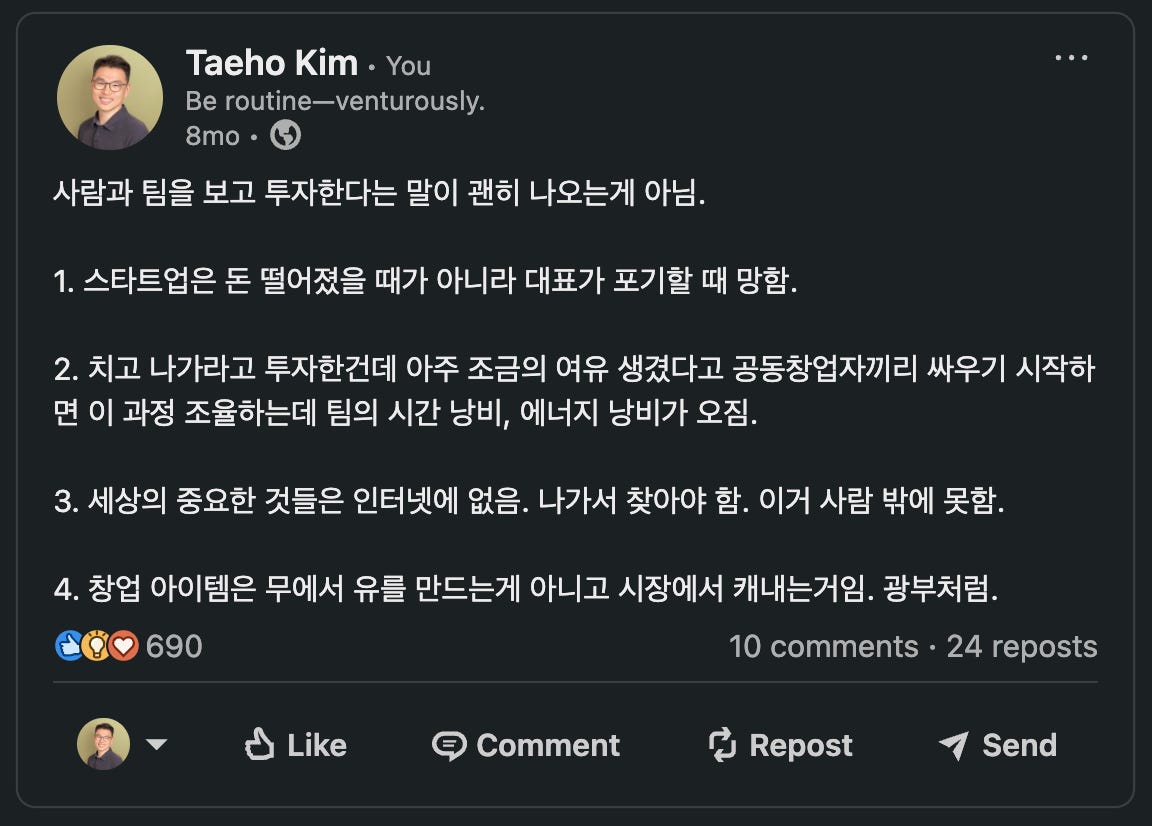
In a situation where development and coding have become easier due to the remarkable development of AI/ML/LLM, FDE shines even more. I once said, "The important things in the world are not on the Internet. You have to go out and look for them. Only people can do this." As coding becomes easier, people need to personally search for important things in the world that are not available on the Internet and **LLM, and put them into the system. This is what Palantir's FDE does by entering customer companies.
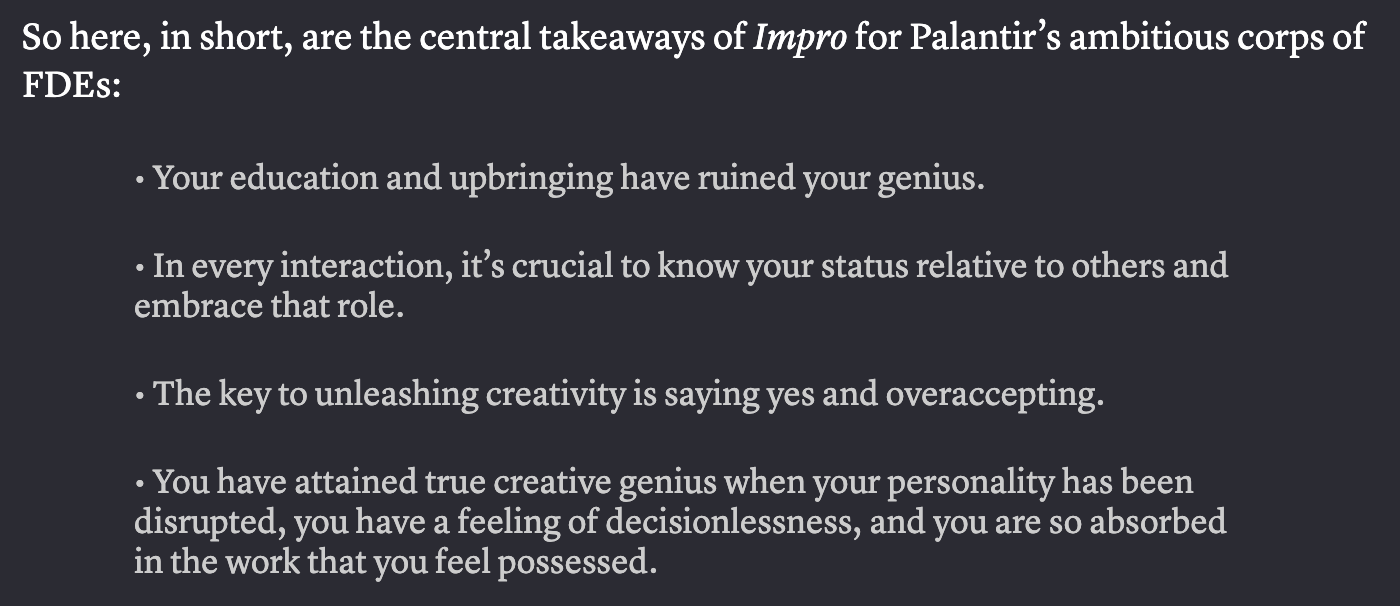
Among the books given to you to read when you join FDE, there is a book called 'Impro'. This is a book written in 1979 by British playwright Keith Johnstone explaining 'improvisation.' Looking at the structure of this book, the chapter called 'Status' talks about how I can implicitly but intentionally postpone my status to be higher or lower than that of the customer. In the chapter called 'Spontaneity', **Why do you not start with No, but with Yes, and…? Explain why positive improvisation can be effective only when you continue with the answer**. This is followed by chapters on 'Narrative Skills' and 'Masks and Trace'.

Each of these is FDE, providing a methodology for navigating stressful situations in client companies, sometimes leading them, sometimes complying with them, sometimes planting seeds for them, and moving toward impact. As an engineer-turned-entrepreneur, it seemed so useful that I wish I had known about it first.
In fact, if you go through Palantir FDE, you are more likely to choose to start a business. I'm good at development, but if I get trained as an FDE and grow through many experiences of winning with customers, I can't help but be the person closest to starting a business.
For example, a bright young man who graduated from a prestigious American university was dispatched to a large company as an FDE, and after successfully and impressively executing a large project, he shed tears at the company dinner on the last day, saying, "I am truly grateful to you all for helping me grow." It was definitely hard and I was beating myself up while running, but it was probably a compressed growth that was more valuable than anything else.
When I was an SVP at Samsung's open recruitment training camp, there was a program where they gave me a few digital cameras and dropped them off in an unknown place by bus and told me to return when I sold them all. I blindly went into nearby schools and sold them to teachers in a logical and persistent manner. But at some point it sold well. This small success experience helped me become an entrepreneur who goes out to meet customers.
In the era of AI, I pledge to live like a new FDE. AI will become increasingly smarter, and the human role is to find problems and provide sufficient appropriate context. A person who goes out and searches for important things in the world that are not available on the Internet. A person who digs for opportunities there like a miner.
Thank you.