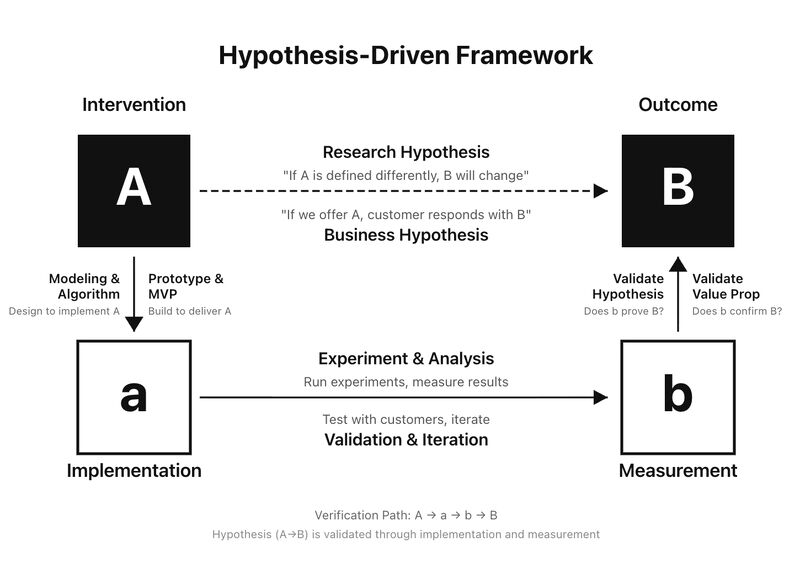
November and December are the season when I, as a professor at KAIST, sit on a number of master's and PhD thesis defenses. I see many different topics and methodologies, but there is one thing I always check first in the evaluation process: what A→B hypothesis this research is making.
What is A, why does the researcher believe that considering A will produce B, and how have they translated that belief into the language of research?
If I lay out the structure of research, it looks like this. First, the researcher proposes a hypothesis: A→B. Then they design models and algorithms to realize the effect of A (A→a). They define what performance metric will be used to observe B (B→b). Finally, through the implemented model (a), they run repeated experiments and analyses (a→b) to verify the hypothesis.
Every stage matters. But if the hypothesis itself, A→B, is unclear or unconvincing, it becomes hard to stay engaged with the rest of the work no matter how sophisticated the implementation is or how many experiments are run. If the starting point is blurry, everything that follows feels like a list of technical efforts rather than a coherent line of inquiry.
- The same structure keeps repeating in business
I keep coming back to this while building companies. Running a startup looks surprisingly similar to doing research.
In startups, the hypothesis is usually defined around the customer. If we offer this product or feature, the customer will respond in this way. The same structure unfolds again. A→a is the process of implementing the product or feature as a prototype. B→b is defining what success means and which metric will be used to measure it. a→b is the process of repeatedly testing with actual customers and validating the response.
The form is different, but research and business sit on the same structure. The only difference is whether the output is a paper or a product. The underlying cognitive frame, hypothesis, implementation, validation, is identical.
- In the AI era, hypotheses matter even more
Recent advances in AI are rapidly accelerating many of the steps that correspond to A→a, B→b, and a→b. Model implementation, experimental iteration, and performance measurement are becoming increasingly automated.
That is exactly why what matters more than ever is which A→B hypothesis you choose to formulate.
In both research and business, the hardest part is not implementation. It is deciding what intervention is a meaningful A, what outcome is a genuinely important B, and why you believe the two are connected. That judgment still belongs to humans.
A hypothesis is not just an idea. It begins with curiosity about how things work and with dissatisfaction with the status quo. "Why have we always done it this way?" That question is the real starting point of a new hypothesis.
- When the research mindset meets industry problems
At Omelet, when we meet customers across different industries, we do not start by accepting the current way of doing things. We start by redefining the problem through a different hypothesis.
What happens if convenience-store ordering is redesigned around future demand forecasting rather than past sales statistics? Is a mathematically optimal solution also the best one in the field? How do you close the gap between algorithmic optimality and what humans actually experience as useful? If you raise forecasting accuracy, does decision quality automatically improve, or are there other properties required before that improvement turns into better performance on the ground? These are the kinds of hypotheses we are testing in practice right now.
Many members of our Problem Solver team have research experience from master's and PhD programs. Because of that, formulating new hypotheses is not something they treat as a special challenge. They see it as the most basic starting point for solving a problem.
Rather than trying to squeeze a bit more efficiency out of existing methods, we first ask what the fundamental limitation of the current approach is and what different B might become possible if we define a new A. This is also why we do not fear the possibility that a hypothesis may fail. Research, by nature, is a process of finding better hypotheses through repeated failure.
- For those I would like to think with
Solving industry problems with a research mindset and accelerating that process with AI is, to me, not just automation. It is a change in the very way problems get solved.
AI makes implementation and experimentation faster. But deciding what to ask and what to validate is still the job of human beings. I believe that, going forward, the more important role for both researchers and engineers will not be precise implementation but formulating meaningful hypotheses.
If this way of thinking resonates with you, if you want to approach industry problems with a research mindset, I would love to think through these questions together. Feel free to reach out any time.