Lately, a lot of founders from Korea have been visiting Silicon Valley, and many of them ask to meet with me. Whenever I meet them, I end up saying roughly the following.
--
For a Korean company to achieve meaningful results in the US, the most important thing is to recognize that "I have been doing business as a Korean, in a very particular environment, in a very particular way."
Korea is a single-ethnicity country where more than 50% of the population lives in the Seoul metro area. And most Korean founders have lived in Korea for decades. It is hard to find a business environment with those conditions anywhere else in the world.
In special environments, special things happen. The customer personas of Korean companies often exist within the founder's immediate circles: family, relatives, seniors, juniors, friends. Even without consciously studying customers, Korean founders accumulate customer understanding naturally by living in Korea for decades. As a result, many Korean founders end up starting companies around problems they personally have, or that people close to them have. That is why intuitive product development can work relatively well there.
Viral loops also happen unusually fast in Korea. You build something, share it with friends and communities, and it can spread quickly through KakaoTalk group chats that nearly everyone belongs to. If the founder comes from a prestigious university and gets even ten thousand users, major media outlets may run feature stories on it.
None of this means building a company in Korea is easy. I know from experience how hard it is because of brutal competition and everything else. The point is that this entire environment is extremely specific.
The problem is that when Korean founders leave Korea and keep building products intuitively, the odds of failure go up. Those mistakes are often rooted in illusion. One common illusion is the unconscious belief that "the reason I did well in Korea is because I have a universal understanding of humans." Another is the habit of applying specifically Korean experiences to the US market: "In Korea we did X and got Y result..." I meet a lot of founders who can't fully escape that mode of thinking.
What about the US? The American market is fragmented across race, language, region, and culture. If you think in terms of the global market, a society with that kind of diversity is actually closer to the general case. Korea is a very specific subset of the broader, more universal global market. I think that perspective matters most.
So how should you approach product development from the perspective of the global market? A Korean founder landing in the US obviously does not know the customer. Once you honestly admit that, the next conclusion is obvious: you have to learn the customer. One reason the Korean startup scene talks less about customer discovery is that it often hasn't been necessary. But if you don't know the customer, discovery comes first.
Meeting customers matters in two ways, and that requires talking about market size. When people say the US market is large, they do not mean you can simply take a Korean product over and multiply revenue by 10. They mean that some sub-segment inside the US can be larger than the entire Korean market.
From that perspective, customer discovery is the process of identifying the segment you should actually target. It is the process of finding patterns among the people or companies that strongly feel the problem you are capable of solving. Once you find those patterns, the market starts to become visible.
The second point is about depth. In Korea, if you want to build a big business, you often need to make something that works for everyone from startups to conglomerates, or something the entire population can use. As a result, products expand horizontally across many features and often lack depth. In the US, you can build a very large company by going deep into a narrow segment. That is why many great companies there are narrow but deep.
As you define and focus on a segment through customer discovery, you develop a deep understanding of your customers' problems. That depth gives founders the ability to create relevant solutions. It also explains why products made in Korea "for everyone" often get feedback that they feel irrelevant in the US.
Because the US is so diverse, it is basically impossible for any one person to deeply understand the whole market. Many founders in the US are immigrants, and even founders born and raised there are still in the same position of "not knowing the customer." In that environment, immigrants and non-immigrants start from a more equal line on customer understanding than they do in Korea. (If a Ukrainian founder tried to build a company in Korea, would that feel equally fair?)
With exceptions, the successful founders I have met all start from customer discovery, regardless of background, and then build their business on deep learned understanding of the customer. They also keep regular contact with customers the way athletes maintain base conditioning.
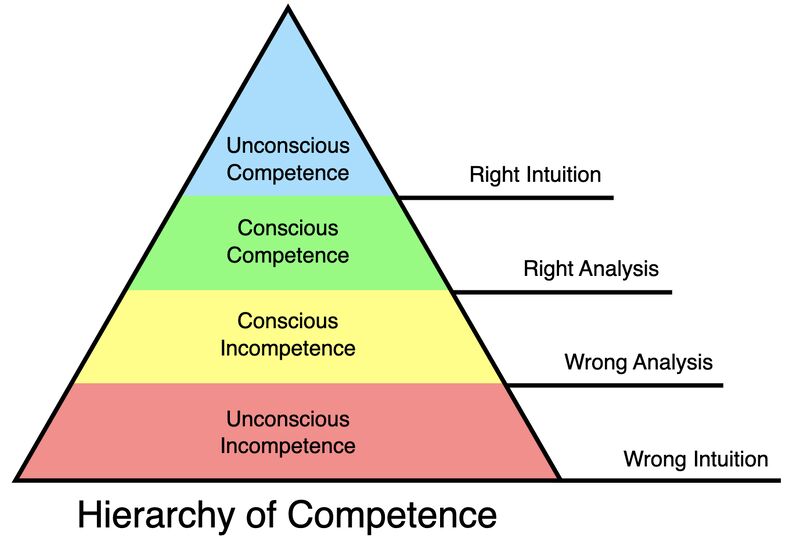
This does not mean intuition is useless. It simply means that only after you build deep understanding through discovery do you earn the right to make good intuitive decisions. Moving from the red zone to the blue zone in the hierarchy of competence model, maybe that is the painful process we have to go through every time we launch something new.
So what is the first thing you should do when you come from Korea to the US? Don't meet investors. Don't meet Koreans who aren't customers. Don't even meet me. Meet customers first.