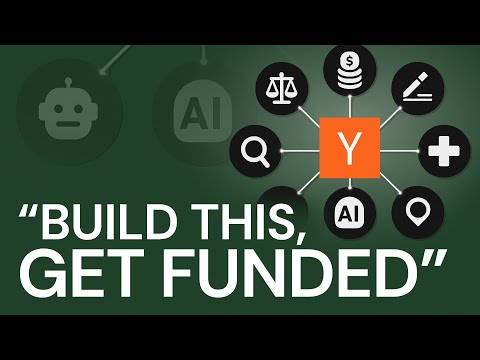
1. What Is Y Combinator's 'Request for Startups'?
- Y Combinator (YC) is the world's top startup accelerator, and it regularly publishes a 'Request for Startups' list.
- This list reveals the areas where YC partners believe more startups should emerge.
- "We will prioritize selecting startups in these areas, because this is where the future is headed."
- This edition includes 14 areas, but the video deep-dives into several key ones.
2. Key Area 1: Full-Stack AI Companies
- Full-stack AI doesn't mean simply selling AI solutions to existing companies — it means using AI to become a direct player in the industry.
- Example:
- "If you believe LLMs can automate legal work, you have two choices:
- Build an AI agent and sell it to law firms.
- Start your own AI-powered law firm and compete directly with traditional ones. That's full-stack."
- "If you believe LLMs can automate legal work, you have two choices:
- "This is the very definition of innovation!"
- "Don't sell software to existing industries — go and transform them."
- "A Silicon Valley-armed new law firm like Acme Co New Law will take down traditional firms."
- "Go out and innovate. I agree 100%."
- Lemonade, Uber, Netflix, Google are all cited as examples of this full-stack innovation.
- "Google initially tried to sell its search engine to Yahoo but was rejected — so it went full-stack and innovated on its own."
3. Key Area 2: More Design Founders
- Designers possess critical skills for founding companies, but technical barriers have often prevented them from leading startups.
- Advances in AI are expanding opportunities for designers to become founders — that's YC's perspective.
- "It's no longer just two engineers starting in a garage — designers, GTM (Go-To-Market) people, and sales leads can now jump into founding companies too."
- However:
- "I still think tech-centric companies will have an advantage."
- "Design is close to product, and product is scale. Great design creates real differentiation — true innovation."
- "A true designer doesn't just make things pretty — they make things work really well. That requires countless iterations and a deep understanding of people."
- "Taste and judgment are real differentiators."
- "The best founder I ever worked with, Stewart Butterfield, was all about making the experience amazing."
4. Key Area 3: Fixing Broken Things with AI
- Many areas are mentioned: voice AI, personal AI assistants, healthcare AI, home security AI, email voice assistants, personal finance AI, and more.
- "If something in the world is important but doesn't work properly, and AI can fix it — that's the opportunity."
- However:
- "Areas where AI physically interacts with the real world (e.g., Uber, Airbnb, labs) will likely have stronger long-term defensibility."
- "Email AI assistants could easily be replicated by Google or Microsoft."
- "Take the word 'AI' out and ask: does this industry genuinely need fundamental innovation? Is the market big enough? Are customers willing to pay?"
- "Focus on solving the problem, not on the tool called AI."
- "AI is just a means — what really matters is the problem itself."
5. Key Area 4: The Future of Education (AI Tutors & Education Innovation)
- AI personal tutors and the future of education (especially reducing teachers' administrative burden) are major themes.
- "Education is a clear area where AI can make a difference, but at the same time, the systemic barriers are enormous."
- "Education startups face difficulties in fundraising, customer acquisition, and monetization — and many founders who try once never come back."
- "American education and healthcare are completely broken. Quality service costs a fortune, and the return on investment is poor."
- "Selling to schools or hospitals is incredibly hard. Instead, consider models that sell directly to students or teachers."
- "What teachers struggle with most is administrative work. Automating that would be a huge help."
- "Education and healthcare are the 'silver bullets' for advancing humanity. Innovate in these two areas and the world gets much better."
6. Key Area 5: Internal Agent Builder
- The prediction is that every employee will be able to build their own agent to automate repetitive tasks.
- "Something every company will soon have in common: every employee builds their own agent to automate their work."
- "Right now, HR and ops teams are leading the effort to automate internal processes with AI, but from an engineer's perspective, it's a bit scary — there aren't enough safeguards."
- "If you solve this properly, an enormous market opens up."
- "Ultimately, building an agent will be as easy as creating a Google Doc or Sheet."
- "But building a truly reliable and scalable internal agent system is really hard."
7. Key Area 6: AI Research Labs
- Like OpenAI, YC actively wants new research labs pursuing fundamental AI research.
- "OpenAI started as an in-house YC research lab. There are still many fundamental AI problems left unsolved, and new labs are needed."
- "GPT is a tremendous advance, but it's still not true general intelligence (AGI). Robotics, new AI architectures, coherence — there's still so much unknown territory."
- "If you build something truly groundbreaking, you'll eventually need to bring it to market. OpenAI is not a pure research lab — it's a deep-tech product company."
- "Like biotech, AI research labs may follow a model where they develop a certain level of technology and then get acquired by larger companies."
- "Remaining a pure research lab isn't realistic — you ultimately need to connect with the market."
8. Closing: What the YC List Means and Advice for Founders
- "YC's startup proposals can sometimes look like 'shiny mirages,' but they reveal the industry's direction well."
- "AI is a massive platform shift, and it could completely reshuffle winners and losers."
- "If you can solve a problem with AI, fundamentally rethink that industry and create real innovation."
- "But don't fixate on AI as a tool — focus on the real problem and the essence of the market."
- "Moving fast and exiting quickly through acquisitions or consolidation when the opportunity arises is also a valid strategy."
Key Takeaways Summary
- Full-Stack AI: Companies that directly innovate industries with AI
- Designer Founders: The era of design-driven entrepreneurship
- Fixing Broken Things with AI: Using AI to repair what's broken in the world
- Education/Healthcare Innovation: Systemic barriers and opportunities
- Internal Agent Builder: Workflow automation for everyone
- AI Research Labs: Balancing fundamental research and commercialization
- Problem-First Thinking: AI is a tool — focus on the real problem
- Fast Execution and Exit: Strategies aligned with market speed
"Go out and innovate. I agree 100%." "Taste and judgment are real differentiators." "AI is just a means — what really matters is the problem itself." "Education and healthcare are the 'silver bullets' for advancing humanity." "Something every company will soon have in common: every employee builds their own agent to automate their work." "OpenAI started as an in-house YC research lab. There are still many fundamental AI problems left unsolved, and new labs are needed."
That wraps up our summary of YC's latest startup list and the insights it holds for founders! Find the real problems, use AI as a tool, and go change the world!