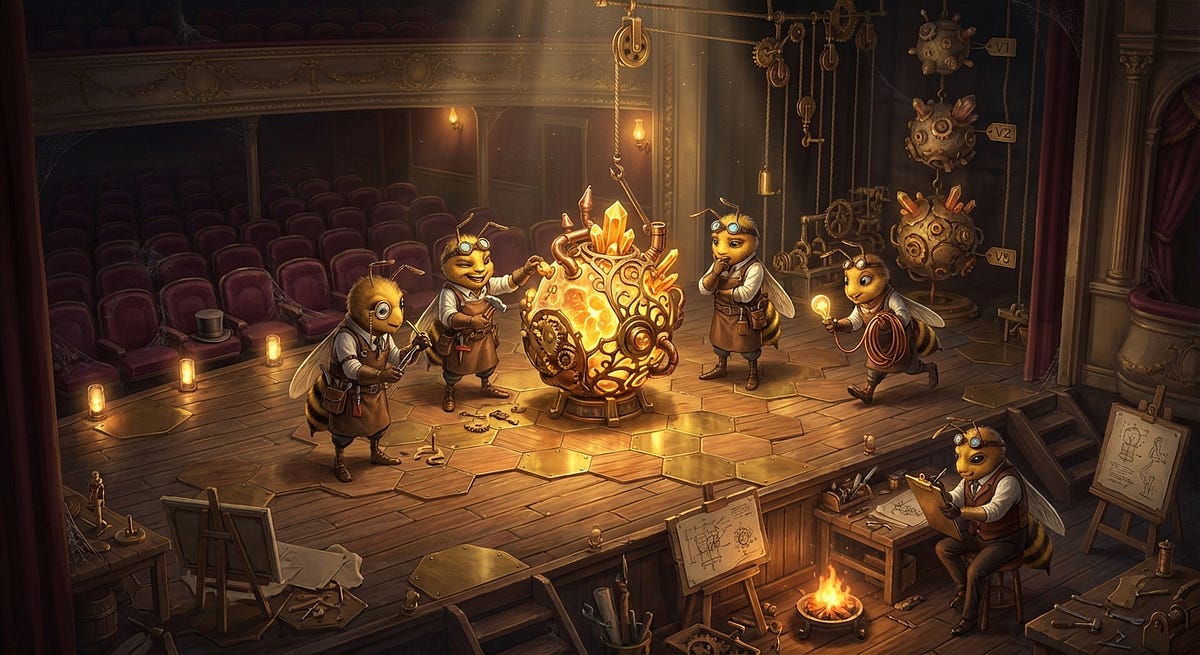
This piece captures the author's personal thoughts and insights on how Anthropic operates and what the future of software development looks like in their hands. The author argues that Anthropic, unlike other companies, runs as a "hive mind" — organically connected like an ant colony, generating innovation at extraordinary speed. He also warns that many companies will face seismic disruption in 2026, and that surviving the AI era requires adapting to this new way of working.
1. Anthropic Is Moving Like Nothing Else 🚀
Something unusual is happening at Anthropic. It feels like a spacecraft on the verge of liftoff, radiating enormous energy. 😮 Based on what the author has directly experienced and observed, getting into Anthropic is as hard as a seasoned professional breaking into the NFL. He notes that Anthropic's employees surpass even Google at its peak — "every Anthropic employee I've met has been the best of the best of the best."
Over the past four months, the author had the opportunity for deep conversations with about 40 people across Anthropic — co-founders, engineering, sales, product, and more. Anthropic is known as a hard company to crack for outsiders, but the author managed to open doors through his characteristic warmth. Through these conversations, he developed a strong intuition that the future of software development will be built around the hive mind model.
2. The Bittersweet Atmosphere at Anthropic 😔
If you painted Anthropic's atmosphere as an impressionist canvas, it would show vibrant happiness coexisting with a quiet sadness. There's an electric charge reminiscent of early Amazon, alongside a solemnity that comes from carrying a weighty civilizational responsibility.
"Every person and team at Anthropic, without exception, has a sweetly, sadly transcendent feel. They carry the unmistakable sense of people entrusted with birthing something of civilization-level importance — excited yet solemn, like ancient elves watching the old world disappear."
The author says Anthropic employees seem to genuinely feel sorry for other companies — because so many of them are not taking this moment seriously enough. 2026 will be a year that shakes countless organizations, and most have no idea what's coming. Anthropic is like someone warning a village that a tsunami is approaching, but when a village hasn't seen a tsunami in a century, the warning simply doesn't land. 🌊
3. A Hive Mind Running on Vibes 🐝
Anthropic appears to operate in a way that looks almost chaotic compared to other large companies. Most organizations become specialized and systematized as they grow — Anthropic hasn't gone through those "boring" processes yet. The production systems are in the hands of world-class SREs, but the real engine of the company is Claude. Claude keeps evolving into new forms, constantly generating new work, and that is what keeps this enormous hive happy and moving.
The author describes Anthropic as running entirely on vibes. Of course, externally-facing functions like production, GTM, and product marketing follow somewhat conventional operating rhythms — but at the core of the company, it's what you'd call a golden age: alive, dynamic, and fully charged.
Employees themselves describe the company as a "hive mind running on vibes" — so this isn't just the author's impression. It clearly reflects an intentional direction set by leadership. If someone tries to disrupt the balance of the hive, they are quietly pushed to the periphery. The author acknowledges this model is delicate and may have scalability limits, but so far it's holding together remarkably well.
4. How Golden Ages End 📉
Here the author shifts to a related but distinct thread that Anthropic makes vivid: how golden ages begin and end.
- A golden age is a period of intense innovation, new category creation, high velocity, and exceptional productivity lasting several years. During this period, the best talent in the industry gravitates in quickly. Anthropic is in exactly that period right now.
The author lived through Amazon's golden age (through 2005) and Google's (through April 2011). After 2011, Google became organizationally rigid and cross-team collaboration broke down, draining its innovation momentum. Amazon, by contrast, kept innovating. Microsoft also had its golden age in the early 2000s, exploring the future of software development around C#/.NET and leaving a major mark on the industry.
For a long time the author wondered why Google's golden age ended. Watching Anthropic, he finally understood.
- The end of Google's golden age: Under Eric Schmidt, Google's motto was "Let a Thousand Flowers Bloom" — encourage many experiments, create luck, let serendipity drive innovation. But when Larry Page took over as CEO in April 2011, the motto became "More Wood Behind Fewer Arrows." Page concluded that the freewheeling 20% projects weren't translating into real outcomes, imposed strict constraints on project funding, and the 20% time gradually vanished. From that point the company grew political, lost its innovative drive, and the golden age was over.
The author is careful to say that killing the 20% projects wasn't the direct cause. Amazon never had 20% time and sustained innovation far longer. So what was the difference between Amazon and Google?
A clue came from his colleague Jakob Gabrielson, who said something around 2015. When the author mentioned that at Google people constantly fought over projects, Jakob said that never happened at Amazon — and added:
"Here, everyone is always a little bit over-employed."
In that line, the author found the key to the golden age.
- In a golden age, there is more work than people.
- When the golden age ends, there are more people than work.
When Larry Page became CEO in 2011, he declared "stop the new things, we're just doing X, Y, and Z." The same engineers stayed, but the volume of work was cut by more than half. People could no longer freely pick problems they cared about. So they started fighting over what was left — and that fighting became empire-building, territorial disputes, and politics. The behavior Microsoft coined as "cookie licking" — claiming ownership of work you have no intention of doing — became rampant. 🍪
But Anthropic right now is in the middle of a golden age. There is far more work than anyone could possibly handle, in every direction. New work keeps emerging like the surface of an expanding sphere.
"At Anthropic we're in the middle of a golden age. There's way more work possible than people to do it, on almost every front. It's like being on the surface of an expanding sphere."
So yes, it's chaotic and there are growing pains — similar to what the author experienced at Amazon's "grow fast and big" phase right after the IPO — but there is absolutely no reason to fight over work. There is infinite work. Every employee gets a chance to pursue their ideas, and the value of those ideas is judged by the hive mind.
5. Hive Mind at Small Scale: The SageOx Story 🧑💻
Beyond Anthropic, the author finds further confirmation that the hive mind model will be a defining success pattern for the future — through the story of a three-person startup called SageOx.
SageOx is run by three of the author's friends — Ajit, Ryan, and Milkana — who have been alternating coding and sleeping for weeks in an apartment about a mile from the author's home. They're the kind of developers who sit at levels 7–8 in the developer evolution model the author has described. Most Anthropic engineers operate at that level too, and the author suspects even half of Anthropic's business-side employees likely do.
The SageOx team mentioned that an external fourth contributor had wasted time acting on information that was two hours old — a sign of just how fast everything is moving. To keep up with that pace, they say full transparency is essential at all times. Without it, no one can see what others are doing, and falling behind becomes unavoidable.
They work as if the entire team is doing pair programming at all times — every step of the work is public. "I'm heading down to grab donuts!" gets an immediate response from someone on the nap couch: "Grab me one too!" "I'm dropping the database!" "Got it." They share their process in real time and correct each other on the fly.
The author recently watched a SageOx demo and was deeply impressed. They record all conversations; transcripts are automatically uploaded and version-controlled. The complete history of every action taken by every human and agent is preserved permanently. This fully transparent way of working is essential to running a hive mind.
Everyone agreed, though, that most developers would be deeply uncomfortable having their entire work process visible. Because this means the death of the ego — every mistake, every wrong turn, every measure of velocity, fully exposed. Nothing hidden, nothing to hide. You just have to be a happy worker bee. 🐝
The author suggested that giving developers a way to work privately at first might ease the transition before they get comfortable with the fishbowl.
Watching SageOx run a hive mind with three people, the author immediately thought of Anthropic. SageOx is also focused on discovery more than profit. They're trying to invent new categories and find PMF (Product-Market Fit), running tight self-reinforcing loops through automated work as a mini hive mind.
The author emphasizes that the only way to increase the odds of a product succeeding in this new world is to build it for yourself — to love it so much you can say with conviction: "Everyone working like this should be doing it this way too."
He's critical of too many AI startup founders today who try to build products by guessing what people will want — enterprise agent workspaces, orchestrators for "general developers" — and end up failing. They're following the wrong side of the "Bitter Lesson." Because they're not building for themselves, they never see the problems.
Just as the inventor of Settlers of Catan, Teuber, spent years playing and testing the game with his own family before finding the winning formula, modern AI developers need to build software the same way.
6. The Campfire Model 🔥
The author describes Anthropic and SageOx as working not through traditional departmental silos, but as if gathered around a campfire together, building. This contrasts sharply with how most people currently think about agent-based development.
The author arrived at this metaphor recently during a Thoughtworks conference in Utah, discussing evolutionary design. They debated "Spec-Driven Development (SDD)," but many people tended to interpret SDD as similar to waterfall or intentional programming — and to the author, it just didn't resonate with how he personally works.
Instead, they realized they prefer Exploratory Development or Evolutionary Development — not grand specs upfront, but everyone gathered around the campfire, building together.
- The center of the campfire is a living prototype. 🏕️
- No waterfall. No spec.
- Just a prototype that evolves through group sculpting, until finally it feels like "this is it."
As evidence of this approach, Anthropic reportedly does not plan operations more than 90 days out. That's their longest planning cycle — which tells you just how fast and short their iterations are. At their scale, they run the shortest possible cycles, with the fastest possible feedback loops, riding the vibe. The result looks a lot like improv.
7. Large-Scale Improv: The "Yes, And…" Model 🎭
Anthropic's hive mind is described by its own employees as "'Yes, and…' style improv." Every idea is welcomed, considered, savored, and evaluated by the hive mind. Everything runs on vibes, with no central decision-making authority. They try everything, and when something magical happens, everyone realizes it simultaneously. ✨
They're using AI to push forward at the frontier of software development and knowledge work through mashups and exploration — navigating like a floodfill search.
This brings to mind purely functional data structures (like append-only logs): in 2026, this pattern is emerging not only at the organizational level but in DevOps as well. Purely functional databases with ledger-style records and versioning — like Datomic and Dolt — will become increasingly important for agent workflows that are prone to mistakes, the author says.
This additive development model is like Anthropic engineers sculpting together in clay. Anthropic has countless "campfires," and people gather around them (the various products in progress), constantly trying new variations and mashups, reshaping the product again and again.
According to one employee, Claude Cowork went from idea to public release in just 10 days. When something magical happens, it moves fast.
They are making their own luck — exactly what Eric Schmidt wanted — but far faster than any Google employee ever did. The author estimates Anthropic engineers are currently 10 to 100 times more productive than engineers using Cursor and chat, and roughly 1,000 times more productive than Google employees in 2005. 🤯
To the author, Anthropic feels like a trembling mass running a multi-armed bandit algorithm on ideas at incredible speed. Everyone gets a shot because anything can be built and people will actually try it.
But the hive mind will push out anyone who doesn't act like a happy worker bee. You must contribute ideas the right way. This means the death of the ego — the exact phrase used by an early employee.
Sound familiar? The author thinks this really is like improv. It's a team sport, and going lone-wolf and charging ahead to make yourself stand out doesn't work here. This is the real power of the "'Yes, and…' model." But most companies got to where they are by learning to say "no" — and that, the author warns, may become a serious problem going forward.
8. The Path Forward: Survival Strategies for the AI Era 💡
The author has much more to say on this topic but acknowledges he's running out of time and space. He already has a backlog of blog posts, and as maintainer of the Gas Town project, his responsibilities are mounting. Actual companies are using Gas Town now, he notes.
If he can convince enough people to adopt the hive mind as an operating model, he may write more about how to convert an existing company into one.
Someone on a sales team told him that every company ultimately asks the same two questions in different forms. They put on a brave face, but they're all scared. Boiled down, the questions are: "Is everything going to be okay?" and "Will we still be here in five years?"
His honest answer is "No" — if you do nothing, you will almost certainly be swept away. If you have an "atom moat" — a physical product or service (brewing beer, in-person human interaction, shipping physical goods) — you may have a little more time to adapt to the AI era. A moat isn't a force field, but atoms make a pretty good one.
But if your product has no physical atoms whatsoever and exists purely as online or SaaS software, then frankly, pivoting is going to be very hard if you don't change direction. There's no clear roadmap for pivoting yet, and everything is moving very fast.
Still, there is a glimmer of hope: spending tokens. ✨ This golden path will gradually move a company in the right direction. In an era where coding is no longer the bottleneck, new bottlenecks will emerge, and organizations will need to learn many new lessons. That customized organizational learning has to start now. The only way to confirm those lessons are actually being internalized is for people to try, make mistakes, and learn. And how much practice they're getting shows up in token spend.
The author is not affiliated with any company and is not selling anything. He has no specific course of action to recommend. He simply says: "Learn AI. Now is the time. Just start."

There's a lot of work ahead. Build a campfire; turn your product into a living prototype. Create a few hives inside your company and give them room to innovate. Then pivot like crazy toward a new PMF. Good luck. It's going to be one truly wild year. May the best… whatever… win!
Closing Thoughts
Anthropic's story has a great deal to teach us as we navigate 2026. Through the lens of the "hive mind" operating model and the secret to sustaining a golden age, the author offers deep insight into how companies can survive and thrive in the coming AI era. Hyper-speed innovation built on vibes, a culture of radical transparency with ego set aside, and a spirit of relentless discovery may no longer be optional — they may be essential. The author's warning that now is the time to start learning AI and charting a new direction for your organization is a message that speaks to all of us. 🚀