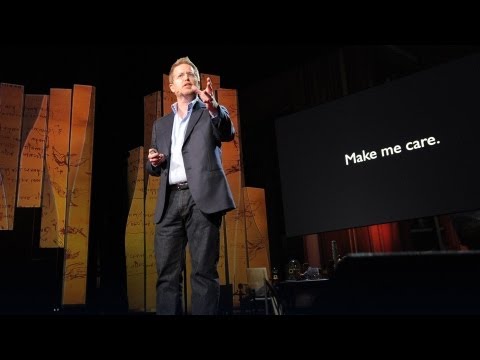
Clues to a Great Story | Andrew Stanton | TED Summary & Analysis
1. Where It Begins: Opening with a Joke
Andrew Stanton opens his talk with a joke set in the Scottish Highlands. The joke is more than a laugh — it's used to illustrate the core elements of storytelling.
"You see this bar? I built this bar with my own two hands, yet they don't call me McGreggor the bar-builder. You see that stone wall? I built it through rain and cold with my bare hands, yet they don't call me McGreggor the wall-builder. But you sleep with one goat…"
This joke offers the first hint at what a story really is. Stanton puts it this way:
"Storytelling is like a joke. You know the punchline, and everything from start to finish has to move toward that single goal."
2. The Essence of Story: "Make Me Care"
Stanton names capturing the audience's attention as the single most important element of a story. He says:
"The greatest rule of storytelling is 'make me care.' Emotionally, intellectually, aesthetically — make me care, one way or another."
He points out that when we flip through TV channels and stop on something, it's not an accident — it's by design. A good story must be engineered to pull the audience in.
3. The Story's Promise: From Beginning to End
Stanton argues that the moment a story begins, it must make a promise to the audience — an implicit guarantee that their time will be well spent.
He uses a scene from his film John Carter as an example. The protagonist is drawn into a mysterious situation, and the audience naturally wonders, "Where is this going?"
"A good story makes a promise from the very start. That promise acts like a slingshot, pulling the audience all the way to the end."
4. Audience Engagement: The "2+2" Rule
Stanton introduces the "2+2 rule" as a technique for keeping audiences engaged — the idea of letting viewers complete the story themselves rather than spelling everything out.
"Don't give the audience 4. Give them 2+2. They want to work it out for themselves. That's the magic of storytelling."
He says working on Finding Nemo helped him understand this principle. Dory's short-term memory loss, for instance, keeps the audience in a constant state of suspense.
5. The Character's Core: The "Spine"
Stanton explains that every great character has an inner drive — a spine — an unconscious goal that motivates all of their actions.
"Michael Corleone's spine was making his father proud. Even after his father died, he was still chasing that same goal."
He gives examples from his own characters:
- WALL-E: searching for beauty
- Marlin (Nemo's father): preventing harm
- Woody (Toy Story): doing what's best for the child
6. Change and Conflict: The Essentials of Story
Stanton insists that a story without change is a dead story. Narrative must progress through conflict and transformation.
Using Finding Nemo, he illustrates short-term tension (Dory's memory loss) and long-term tension (will they find Nemo?), explaining how conflict and uncertainty make a story compelling.
"Drama is a blend of anticipation and uncertainty. In the short term, you want audiences to wonder what happens next; in the long term, you want them to wonder how it all ends."
7. Theme and Message: The Story's Center
Stanton says a powerful theme sits at the heart of every good story. Reflecting on Lawrence of Arabia, he realized the film's theme rests on the question "Who am I?"
"A strong theme is the throughline that connects every element of the story. It gives the narrative depth beyond a mere sequence of events."
8. Wonder: The Magic of Story
Stanton names wonder as storytelling's secret ingredient. Recalling the sense of awe he felt watching Bambi as a child, he says stories should make people feel the beauty of being alive.
"Wonder is honest and pure. It can't be manufactured artificially — it makes people feel the joy of existence."
9. Start from Personal Experience
Stanton stresses how important personal experience is to authentic storytelling. He shares that being born premature and surviving shaped both his life and his work.
"Use what you know. It's not just about plot or facts. Capture the truth of what you've lived, and express it through story."
10. Conclusion: Story Is Human Nature
Stanton closes his talk by connecting storytelling to what it means to be human.
"We all love stories. They affirm who we are and prove that our lives have meaning."
Key Terms
- The story's promise: the implicit assurance to audiences that their time is worth investing
- The 2+2 rule: guiding audiences to complete the story themselves
- Spine: a character's inner, unconscious motivation
- Change and conflict: the driving forces that move a story forward
- Theme: the central message anchoring the story
- Wonder: the near-magical quality every story should carry
- Personal experience: the wellspring of truthful storytelling
Closing
Andrew Stanton's talk goes beyond craft advice — it reminds us why stories matter to our lives. As he says, a good story connects us to one another and helps us rediscover the meaning in our own lives. 😊