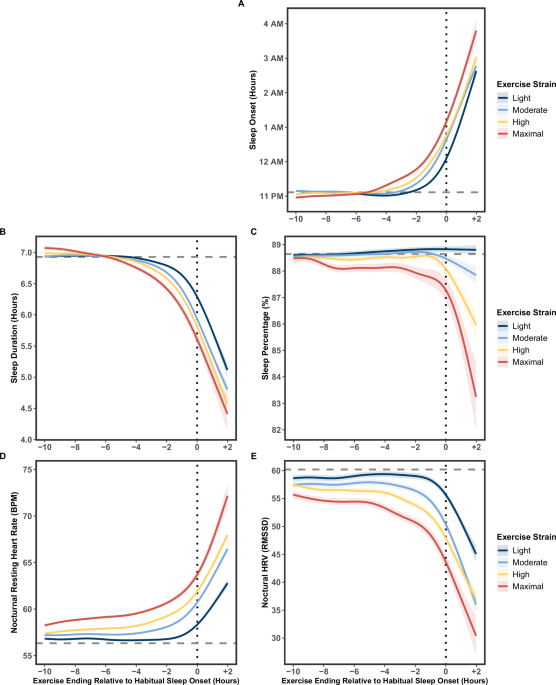
This study used a large multinational cohort to examine how the intensity and timing of evening exercise affect sleep and nighttime autonomic nervous system activity. Higher exercise strain and later exercise timing were associated with negative effects such as delayed sleep onset, shorter sleep duration, lower sleep quality, higher sleeping heart rate, and lower heart-rate variability. The results emphasize that both the ending time and intensity of exercise matter for healthy sleep.
1. Introduction: Exercise, Sleep, and the Conventional Wisdom
Exercise and sleep are closely connected and have major effects on the body's physiological and psychological processes. In general, exercise is known to support healthy sleep through thermoregulation, improved mood, metabolic stimulation, and circadian rhythm regulation. But vigorous exercise right before bed has long raised concerns because it can activate the sympathetic nervous system, increasing heart rate and breathing and potentially disturbing sleep. For that reason, both traditional advice and recent sleep guidelines have recommended avoiding vigorous exercise for several hours before bedtime.
Recent studies, however, have begun to challenge the assumption that evening exercise disrupts sleep. Meta-analyses in particular have found that evening exercise does not necessarily reduce sleep duration or sleep quality. The problem is that those studies usually analyzed exercise intensity or duration separately. They did not fully examine how the combined burden of exercise intensity and duration, or "exercise strain," affects sleep. A hard workout that is both intense and long creates a high metabolic demand and may not leave enough recovery time before bed, which can disturb sleep.
2. Study Purpose and Methods
This study was designed to answer that question. The researchers wanted to know how exercise strain interacts with exercise timing in a large multinational sample of active adults, and how it relates to nighttime autonomic nervous system activity. Their hypothesis was that later, higher-strain exercise would delay sleep onset, shorten sleep duration, lower sleep quality, increase resting heart rate during sleep, and reduce heart-rate variability.
To test this, the team collected one year of data, from September 1, 2021 to August 31, 2022, from 14,689 active adult participants. Participants used a wrist-worn biometric device called WHOOP to measure sleep, heart rate, heart-rate variability, and related data. Compared with electrocardiography and polysomnography, the device showed 99% accuracy for heart rate and 86-89% accuracy for two-stage sleep classification. Participants had to wear the device for at least 350 days and log more than 50 exercise activities.
- Exercise timing: The researchers calculated when exercise ended relative to each participant's usual bedtime, or habitual sleep onset. This allowed them to reflect individual sleep patterns, seasonal change, and weekday/weekend variation. They also analyzed timing relative to the actual bedtime on that day.
- Exercise strain: Using heart-rate data from each exercise activity, the researchers measured time spent in heart-rate zones 0-5 and calculated a total heart-rate-zone score. Based on that score, exercise strain was divided into four categories: light, moderate, high, and maximal.
- Light: Daily activities, easy walking, yoga, and similar movement.
- Moderate: Brisk walking, light jogging, cycling, swimming, dance, and similar exercise.
- High: Running, hiking, intense cycling, HIIT, team sports, and similar exercise.
- Maximal: Very intense running, maximal strength training, intense competitive sports, and similar work.
- Sleep and autonomic measures: The researchers measured sleep onset, total sleep duration, sleep quality, nighttime resting heart rate, and heart-rate variability. Resting heart rate was calculated as average beats per minute, while HRV was measured using RMSSD, the root mean square of successive differences between heartbeats.
3. Key Findings
Here are the main findings from the study.
3.1. Sleep Onset
- When exercise ended six hours before habitual sleep onset, higher exercise strain was actually associated with earlier sleep onset.
- But when exercise occurred from four hours before to two hours after habitual sleep onset, higher exercise strain was associated with progressively later sleep onset. The later the exercise ended, the larger the effect became.
- If maximal exercise ended two hours before habitual sleep onset instead of light exercise, sleep onset was delayed by 36.0 minutes. If the exercise ended two hours after habitual sleep onset, sleep onset was delayed by 80.0 minutes.
3.2. Sleep Duration
- When exercise ended more than six hours before habitual sleep onset, higher exercise strain was associated with longer sleep duration.
- But when exercise occurred from six hours before to two hours after habitual sleep onset, higher exercise strain was associated with progressively shorter sleep duration.
- If maximal exercise ended two hours before habitual sleep onset instead of light exercise, sleep duration was reduced by 5.4%, or 22.2 minutes. If the exercise ended two hours after habitual sleep onset, sleep duration was reduced by 13.9%, or 42.6 minutes.
3.3. Sleep Quality
- When exercise ended within eight hours of habitual sleep onset, higher exercise strain was associated with lower sleep quality.
- This effect was especially strong when exercise occurred from two hours before to two hours after habitual sleep onset.
- If maximal exercise ended two hours before habitual sleep onset instead of light exercise, sleep quality fell by 0.87 percentage points. If the exercise ended two hours after habitual sleep onset, sleep quality fell by 5.6 percentage points.
3.4. Nighttime Resting Heart Rate
- Regardless of exercise end time, higher exercise strain was associated with higher resting heart rate during sleep.
- When exercise occurred from four hours before to two hours after habitual sleep onset, higher exercise strain raised resting heart rate even more.
- If maximal exercise ended two hours before habitual sleep onset instead of light exercise, resting heart rate increased by 6.8%, or 3.9 bpm. If the exercise ended two hours after habitual sleep onset, resting heart rate increased by 15.0%, or 9.4 bpm.
3.5. Nighttime Heart-Rate Variability
- Regardless of exercise end time, higher exercise strain was associated with lower HRV.
- When high or maximal exercise occurred from four hours before to two hours after habitual sleep onset, higher exercise strain lowered HRV even more. Light exercise also tended to lower HRV when performed later.
- If maximal exercise ended two hours before habitual sleep onset instead of light exercise, HRV decreased by 14.1%, or 8.3 units. If the exercise ended two hours after habitual sleep onset, HRV decreased by 32.6%, or 14.6 units.
These patterns did not differ substantially by sex, age, or BMI status. In other words, the same general tendency appeared across groups.
4. Discussion and Conclusion: Exercise Strategies for Healthy Sleep
The study clearly shows that high exercise strain and late evening exercise timing can negatively affect sleep and nighttime autonomic activity. When the body does not have enough time to recover after exercise, the sympathetic nervous system may remain activated and disturb sleep. Before bedtime, the parasympathetic nervous system should become more dominant, but vigorous exercise can delay that transition.
So how should we exercise if we want healthy sleep? The study offers several practical implications.
- It is best to finish exercise at least four hours before sleep onset when possible. In that case, even higher-strain exercise tended to have either a positive effect on sleep or at least no clearly negative effect.
- If evening exercise is unavoidable, choose lower-intensity exercise. Compared with maximal exercise two hours before bedtime, light exercise two hours before bedtime was associated with sleep onset 36 minutes earlier, 5.4% longer sleep duration, 6.8% lower resting heart rate, and 14.1% higher HRV.
- Previous studies suggested that evening exercise did not harm sleep, but those studies mostly focused on light or moderate exercise. This study is one of the first to show that high-strain evening exercise can be harmful to sleep.
- Elite athletes who compete in the evening should be especially careful, because high exercise strain can have a serious impact on sleep and recovery.
The study does have limitations. For example, the researchers did not know exactly when participants tried to fall asleep, the strain measure may have limitations for short and intense activities such as strength training, and factors such as bright-light exposure were not controlled. Even so, the large sample size and long-term real-world data collection are major strengths.
The core message of the study is this:
"To optimize sleep, it is best to finish exercise at least four hours before sleep onset whenever possible. If exercise must occur within four hours of sleep, choosing light-intensity exercise is the wiser way to minimize disruption to sleep and autonomic recovery."
Closing
Exercise is essential for health, but this research shows that the effect on sleep depends on when and how intensely we exercise. That makes the findings both interesting and practically useful. They offer a realistic guide for building healthier sleep habits. When planning evening exercise, it is worth remembering these results and choosing the option that best fits your body and your sleep.