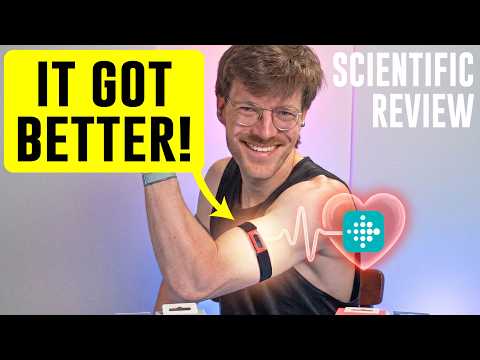
This video compares heart rate, heart-rate variability (HRV), and sleep-stage tracking accuracy when Fitbit Air is worn on the wrist versus the bicep, exploring the benefits of bicep wear. It shows in particular that heart-rate measurement during workouts can improve significantly, and offers the interesting conclusion that better workout results may be possible without degrading sleep-tracking performance. It emphasizes that Fitbit Air offers excellent performance for the price, and that when worn on the bicep it can become a powerful alternative to the premium Whoop strap.
1. Exploring the Possibility of Wearing Fitbit Air on the Bicep 💪
This video starts from the observation that wearable-device signals often tend to be cleaner on the bicep than on the wrist, and analyzes for the first time how Fitbit Air performs when worn on the bicep. The host, Rob, is a biological data-analysis expert. He wore Fitbit Air on both the wrist and the bicep and compared a variety of data.
In the video, he explains the goal of the experiment by saying, "We're going to see whether Fitbit Air performs better on the bicep or whether performance actually gets worse." He was especially concerned that bicep wear might cause problems if the algorithm had been optimized for wrist wear, as with sleep-stage tracking, but he begins with the relatively simpler measurements of heart rate and HRV.
2. Nighttime Heart Rate and HRV: Similar Accuracy on Wrist and Bicep 😴
When measuring heart rate and HRV during sleep, Fitbit Air showed high accuracy on both the wrist and the bicep. Rob used data from a night when he felt sick and had sharp changes in heart rate and HRV, noting that Fitbit Air tracked those changes almost perfectly in line with an ECG chest strap, one of the most accurate reference devices.
"It is almost a perfect match. There are small deviations, but they are very minor. I'm really happy with this result. This is the first evidence that Fitbit Air can track rapid changes in heart rate and heart-rate variability well."
Measurements from other nights also showed similar patterns and accuracy on both wrist and bicep compared with the reference device. Even though the heart-rate range was narrow, Fitbit Air showed trends similar to the reference device. For HRV, some data was missing when worn on the bicep, but the overall pattern match was not very different from wrist wear. Rob concluded that he did not find a clear difference in signal quality between the two wearing positions.
"There is no clear sign of a signal-quality difference between wearing Fitbit Air on the bicep and wearing it on the wrist. Both seem to work almost equally well. I'm really happy because it was already working quite well overnight."
3. Sleep-Stage Tracking Consistency: A Stable Algorithm ✅
For sleep-stage tracking, the focus was on comparing the consistency between two Fitbit Air devices, one worn on the wrist and one on the bicep. Interestingly, even when worn on the bicep, Fitbit Air detected sleep stages almost identically to the device worn on the wrist.
"Deep sleep matches almost perfectly between the two devices. REM sleep is also tracked very consistently."
The sleep-stage agreement rates reached 93% for deep sleep, 94% for light sleep, 96% for REM sleep, and even 95% for awake time. This means Fitbit Air's sleep-tracking algorithm is not strongly affected by wearing position, and suggests there is no reason to worry that bicep wear will degrade sleep-tracking performance.
4. Making a DIY Bicep Band 🛠️
Rob introduced a DIY band he made himself in order to wear Fitbit Air on the bicep. He cut a standard watch strap, then sewed and glued it to fit Fitbit Air, and advised that it is important for the band to have some flexibility.
"If you're wondering how I made this, I just made it myself. I took something that was originally a 42mm or 46mm watch strap, cut it, sewed it, and glued it."
Fortunately, Google is now expected to publish specifications so that third-party manufacturers can make bands for Fitbit Air, and Rob expects official bicep bands to be released within a few months.
5. Workout Heart Rate: The Overwhelming Advantage of Bicep Wear 🏃♀️🏋️♂️
The most dramatic difference appeared in heart-rate measurement during exercise. Rob compared three workouts, indoor cycling, running, and weightlifting, against an ECG chest strap used as the reference device.
- Indoor cycling: Wrist wear showed some deviation, but bicep wear showed an almost perfect match with a correlation of 0.999.
- Running: Wrist wear was fairly good, with a correlation of 0.99, but bicep wear showed fewer deviations and higher accuracy.
- Weightlifting: Wrist wear failed to properly detect heart-rate peaks and performed much worse, with a correlation of 0.89. But when worn on the bicep, it detected almost every heart-rate peak perfectly, recording a very high correlation of 0.98.
Rob was especially surprised by the performance of bicep wear during weightlifting.
"When Fitbit Air was worn on the wrist, it definitely struggled. It missed most of the heart-rate peaks. But when worn on the bicep, it basically worked perfectly. It was as good as anything I've seen from any device in this area."
These results clearly show that wearing Fitbit Air on the bicep provides a significant advantage for workout-performance tracking.
6. Comparison With Other Wearables 📊
When Fitbit Air's workout heart-rate accuracy was compared with other wearable devices, its performance stood out even more.
- When worn on the wrist:
- Indoor cycling: top 29% (better than 71% of devices)
- Running: top 26% (better than 74% of devices)
- Weightlifting: bottom 45% (worse than 55% of devices)
- When worn on the bicep:
- Indoor cycling: top 5% (better than 95% of devices)
- Running: top 8% (better than 92% of devices)
- Weightlifting: top 13% (better than 87% of devices)
These results show that bicep wear dramatically improves Fitbit Air's workout-tracking performance. Rob emphasized, "This shows that wearing it on the bicep is far more valuable than wearing it on the wrist."
7. Final Take: Fitbit Air as a Strong Whoop Strap Competitor 🏆
Rob was very satisfied that Fitbit Air, when worn on the bicep, greatly improves heart-rate tracking accuracy without degrading sleep-tracking performance. He evaluated Fitbit Air as a true competitor to the premium Whoop strap, and even said it surpasses Whoop in heart-rate tracking and sleep-stage tracking.
"Fitbit Air has become a real competitor to the Whoop strap, and it even surpasses the Whoop strap in both heart-rate tracking and sleep-stage tracking."
He did note that the Whoop app still offers a better user experience, but emphasized that the Fitbit app, now the Google Health app, is free. He suggested that unless you are a professional athlete, choosing Fitbit Air instead of an expensive Whoop strap could be a much more reasonable choice.
"If you are not an athlete or you do not do a lot of sports, choosing Fitbit Air over Whoop would be a hard decision. The Fitbit app already provides most of the features you need, and the combination of Fitbit Air and the Google Health app is a really good deal."
Rob is currently subscribed to Whoop, so he plans to keep using it, but added that if he were starting over, he would try Fitbit Air first. He hopes an official bicep band will be released soon and expects more users to enjoy the benefits of bicep wear.
Conclusion
The experiment of wearing Fitbit Air on the bicep suggests a new possibility for maximizing wearable-device performance. The fact that heart-rate tracking accuracy improves dramatically during high-intensity exercise especially increases the value of Fitbit Air. Because it can improve workout efficiency without degrading sleep-tracking performance, Fitbit Air looks like a very attractive alternative for users who want premium-level performance at a lower price. If Google's third-party band support leads to the release of an official bicep band, Fitbit Air's popularity is likely to grow even further.