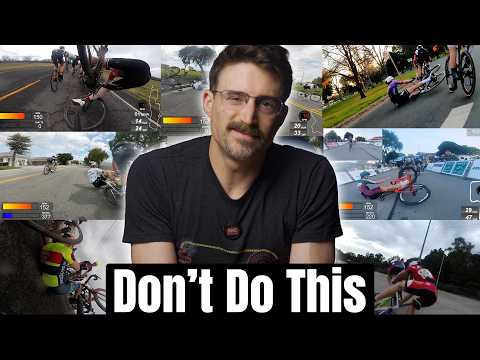
This video argues that 90% of crashes in bike races are not simply a matter of bad luck: they can be prevented. It clearly explains five common causes of crashes and offers practical advice for avoiding each one. 🙋♀️ If you want to reduce your crash risk and enjoy safer rides, this summary will help you grasp the essential lessons.
1. Contact: Stay Relaxed Instead of Panicking 🤝
Bike races often put riders in tightly packed groups. When contact occurs, a rider's instinct to panic and tense up can turn a minor bump into a major crash.
The video shows examples of contact and explains:
0:28 "Usually, the contact itself doesn't cause the crash. The rider panics and stiffens up, and that's what causes it."
In one example, with one kilometer left to the finish, a rider in a dense pack stiffens up, loses a secure grip on the handlebars, and falls. In another, a rider panics after contact, loses direction, and fails to make the corner. 😱 The video particularly emphasizes riding in the drops rather than on the hoods: this lowers your center of gravity and reduces the chance of handlebars getting hooked.
How do professional riders respond? They avoid panicking and keep their bodies supple. They use their shoulders and elbows to absorb impact while maintaining a firm grip on the bars.
1:21 "He doesn't stiffen up. He stays flexible. He uses his shoulder and elbow to absorb the impact."
This skill does not develop on its own, so practice matters. The video recommends doing bump drills with a friend at low speed on grass. Becoming accustomed to body contact in a controlled setting helps you stay calm and respond properly when it happens in a real race.
2. Wheel Overlap: Stay Focused and Keep an Escape Route 🚵♀️
Wheel overlap is especially dangerous. The front wheel is a bicycle's Achilles' heel: if it catches another rider's wheel, you can quickly lose balance and fall.
Most of these crashes happen because of a brief lapse in concentration.
3:30 "Most of the time it happens because of a momentary lapse in concentration—for example, looking behind you when you shouldn't."
The video warns riders with footage of crashes caused by looking back at a critical moment or becoming distracted by something elsewhere.
It offers two important rules for preventing wheel overlap:
- Rule 1: Always stay focused. This is especially important in the chaos at the end of a race.
- Rule 2: Always leave yourself an escape route. Keep a few inches of space on the outside in case of an emergency.
If there is no escape route, keep a finger on the brake and be ready to slow down. Finally, in a truly dangerous situation, be prepared to unclip and put a foot down. The video shows a rider avoiding a serious injury by planting a foot when a fellow rider nearly falls, explaining that this move saved the rider from a broken collarbone. 😉
3. Pedal Strikes: Mind Your Pedals and Practice Cornering ⛰️
A pedal strike happens when a pedal touches the ground while cornering and causes the bike to fall. It often occurs when a rider leans too far and tries to squeeze in one more pedal stroke. The pedal then acts like a lever and lifts the bike off the ground.
5:08 "You can't beat physics. You need to know your lean angle."
The right equipment can also help prevent this type of crash. Shorter cranks, such as 165 mm cranks, provide a few extra degrees of clearance while cornering and reduce the chance of a pedal strike.
The video also suggests a safe way to practice:
- Tape a piece of corrugated cardboard to the underside of your pedal.
- Ride around your neighborhood and corner until you can hear the cardboard scrape the ground.
- Once it scrapes, trim the cardboard slightly and practice again.
- Repeat until only a very small piece of cardboard remains under the pedal.
This drill teaches you the physical limits of your equipment, which can become a major advantage in an actual race. 💪
4. Losing Tire Grip: Brake Properly and Learn Good Cornering Technique 💨
The fourth cause is loss of tire grip. No one likes braking, but it is important to remember that traction is finite.
Motorsports uses the concept of the traction circle. Think of tire grip as a budget that can be spent on acceleration, braking, or steering. If you try to spend it on several things at once, the tire can lose grip and cause a crash. 📉
Use this checklist to maximize grip and prevent crashes in corners:
- Brake in a straight line before entering the corner.
- Enter wide, hit the apex, and exit wide again. Keep your eyes on the corner exit to hold this line.
- Accelerate again only after you have cleared the corner and the bike is beginning to stand upright.
- Weight the outside foot and push down through the outside pedal. Stay light on the saddle, with your chest and body weight over the front wheel.
These techniques maximize grip and control through a corner and minimize the risk of crashing. 💯
5. Faulty Equipment: Inspect Your Bike Before Every Race 🛠️
Even the best technique cannot help if the bike itself does not work properly. The fifth cause is riding faulty or poorly maintained equipment.
The video strongly criticizes showing up to a race with neglected gear.
7:22 "It drives me crazy to see how many people show up with completely worn-out equipment."
Racing on heavily worn training tires is simply creating an opportunity for something to go wrong. 😠 The video therefore stresses the importance of carefully inspecting your bike the night before a race.
Key checks include:
- Check the torque on major bolts: handlebars, stem, saddle, seatpost, and so on.
- Inspect tire wear indicators: look for embedded glass and other debris.
- Check drivetrain wear: inspect worn cassette teeth, a stretched chain, and related components.
Small problems like these can cause a slip that wastes months of effort—or leads to something even worse.
7:58 "Months of work could be ruined, or something even worse could happen, because you didn't inspect your equipment the night before the race."
Closing Thoughts ✨
Bike crashes are not always the result of bad luck. In many cases, riders can prevent them or respond more effectively. Remembering and practicing the solutions to these five causes can help every rider enjoy safer, more rewarding rides. 🚴♂️ Keep the rubber side down, everyone! 😉