
This article explains why decision intelligence, a framework for data-driven decision-making, has become important and how it develops through three stages: support, augmentation, and automation. In particular, hyperautomation is presented as a key driver that will transform how businesses operate and compete by connecting the entire process, from data collection and analysis to decisions and execution. 🤖

1. An Uncertain Business Environment and the Rise of Decision Intelligence
Businesses today must make faster, more accurate decisions amid rapidly changing markets and high uncertainty. Decision intelligence is important in this environment. It goes beyond simply analyzing data: it is a systematic approach to decision-making that uses data to generate insights, translates them into action, and then measures the results.
The article particularly emphasizes the need to move beyond judgments based solely on experience or intuition. The idea is to combine AI, machine learning (ML), and automation technologies to make more objective, actionable judgments.
"Decision intelligence is a data-driven process that enables faster, more accurate, fact-based decisions rather than relying on intuition or gut feelings."
The ultimate goal of decision intelligence is not merely to build AI models. Its essence is improving the quality of human judgment and helping people achieve their desired business outcomes more effectively. This allows businesses to receive immediate recommendations and identify actions they can actually implement.
2. How Google and Gartner Demonstrated Its Importance
The concept of decision intelligence began attracting widespread attention in March 2018, when Google appointed Cassie Kozyrkov as its first Chief Decision Scientist. Google saw decision intelligence as critically important in an AI-centered business environment and assigned this role to help the entire organization understand and apply the concept.
One of the position's main responsibilities was to educate all employees about decision intelligence. In other words, decision-making is not just the work of a few analysts or executives; it is an organizational capability that enables every employee to understand data and make better judgments.
In 2019, Dr. Lorien Pratt's book, Link: How Decision Intelligence Connects Data, Actions, Outcomes for a Better World, introduced the concept to a broader audience.
Then, in October 2021, Gartner named decision intelligence one of its "Strategic Technology Trends for 2022." Gartner defined it as a broad field of technology that combines multiple traditional and advanced disciplines to design, align, execute, monitor, and adjust decision models and processes. Its importance became even clearer when it was also selected as a strategic technology trend in 2024.
3. Connecting Data to Actions and Outcomes
Decision intelligence does not leave data sitting in reports or as numbers. It creates a cycle of data → insights → decisions → execution → performance measurement → feedback, continually improving the quality of decisions.
Through this process, businesses can expect the following benefits:
- Analyze diverse data to uncover hidden problems or opportunities.
- Receive specific business recommendations based on analytical findings.
- Review performance after implementation and incorporate the results into subsequent judgments.
- Respond faster even when data is too vast and complex for people to process on their own.
In short, the key is not possessing large amounts of data, but turning data into better actions and outcomes. 📊
4. The Three-Stage Model of Decision Intelligence
The article divides decision-intelligence-based models into three stages: decision support, decision augmentation, and decision automation. As the stages advance, AI and systems take on larger roles while direct human involvement decreases.
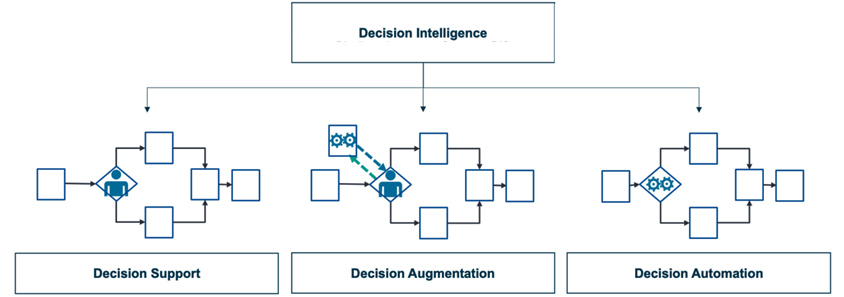
Decision Support: Helping People Make Judgments
In the first stage, decision support, AI provides the evidence people need to make better judgments rather than deciding on their behalf.
AI collects and analyzes evidence and data, identifies and diagnoses problems, proposes possible courses of action, and evaluates them. Users review visualized information through dashboards or business intelligence tools, then make the final decision based on up-to-date data.
"Decision support uses AI technology to assist human decision-makers by collecting and analyzing evidence, identifying and diagnosing problems, proposing possible courses of action, and evaluating the proposed actions."
The final human judgment remains central at this stage. AI acts as an assistant, providing information and analysis to inform decisions.
Decision Augmentation: AI Provides Recommendations and Predictions
In the second stage, decision augmentation, AI and analytical systems go beyond simply providing information to offer recommendations on what to do and predictions about the future.
Integrated with specific business processes, systems connect multiple data sources, identify patterns, and recommend possible courses of action. These recommendations can reach decision-makers through various interfaces, including email, text messages, and voice.
Recommendations can be generated in the following ways:
- Rule-based: Conditional statements such as "If A, do B; otherwise, do C."
- Analytics-based: Analytical findings, such as those from complex pricing models.
- AI- and machine-learning-based: Identifying patterns in large datasets to generate predictions and recommendations.
The strength of this stage lies in discovering hidden meaning in data too vast for people to process.
"Integrating AI and advanced analytics can also enrich information by uncovering hidden insights in enormous datasets that may be difficult or impossible for business users to process."
Decision Automation: Systems Execute Autonomously
In the third stage, decision automation, systems autonomously make decisions and execute actions based on AI, analytics, and business rules.
At this stage, predefined business rules and data enable decisions within a process without direct human intervention. Of course, this does not mean unlimited automation: the premise is that it operates within a safe framework and set of rules.
"Decision automation autonomously carries out decision-making processes and execution based on AI, analytics, and business rules."
This goes beyond automatically handling repetitive tasks to analyzing situations, selecting appropriate actions, and executing them. The article explains that this kind of automation is the path toward hyperautomation and greatly expands the scope of decision intelligence.
5. New Ways of Operating Enabled by Hyperautomation
Hyperautomation is an approach that combines multiple automation technologies and AI to intelligently automate business processes end to end. The article describes hyperautomation as ushering in a new era of decision intelligence.
Its key potential is to drive innovation across every step, from acquiring data and analyzing it to making decisions and executing actions. This can help businesses operate more intelligently, respond more nimbly to change, and improve their chances of gaining a competitive edge.
"Hyperautomation is ushering in a new era of decision intelligence."
"In the business environment ahead, hyperautomation and decision intelligence are expected to become closely integrated, driving continuous business development."
Ultimately, businesses should aim for more than adopting a single AI tool. They should automate and add intelligence to the entire flow of acquiring data, analyzing it, connecting it to judgment and execution, and learning from the results.
6. Conclusion
Decision intelligence helps businesses move from intuition-driven judgments to systematic judgments using data and AI. It begins as a tool for supporting human judgment, progresses through an augmentation stage that provides recommendations and predictions, and develops into automation that makes decisions and executes actions autonomously within safe boundaries.
Hyperautomation accelerates this evolution, helping businesses turn data into tangible results and competitive strength. What matters is not automation itself, but the ability to make better decisions faster and improve them continuously.