This study identifies hyperglycosylation as one of the major drivers of Alzheimer's disease (AD) and shows that regulating N-glycan levels in the brain could become an effective therapeutic strategy for improving cognitive function. In particular, the researchers used spatial multi-omics analysis and stable-isotope tracing to confirm increased glycan biosynthesis in AD brains, and also presented striking clinical evidence that glucosamine supplementation may worsen disease progression in AD patients. The study points to a new direction for developing AD treatments and emphasizes the importance of regulating glycan metabolism.
1. The Relationship Between Alzheimer's Disease and Metabolic Dysfunction 🧠
Alzheimer's disease (AD) is a complex neurodegenerative disease characterized by memory loss, cognitive decline, synaptic dysfunction, neuroinflammation, and widespread neuronal loss. Although a great deal of research has been conducted, effective treatments have still not been found. Recently, metabolic dysfunction has been identified as a core factor in AD pathogenesis, and evidence is increasing that changes in glucose metabolism, mitochondrial function, and lipid homeostasis contribute to disease progression.
In the brains of AD patients, reduced glucose uptake is observed years before clinical symptoms appear, showing that metabolic abnormalities are important from the early stages of the disease. In addition, lipid vesicle accumulation has also been identified as a metabolic feature of AD, suggesting that lipid dysregulation and energy homeostasis are closely linked to neurodegeneration. Animal studies have also shown that restoring glucose metabolism can alleviate AD progression, further highlighting the importance of metabolic regulation in AD research.
However, it is still not clear how complex carbohydrate metabolism, especially glycan biosynthesis and processing, acts in the context of AD. N-linked glycosylation, which is essential for maintaining brain homeostasis, plays important roles in protein stability, intracellular trafficking, receptor-ligand interactions, and more. It is also essential for synaptic plasticity, neurotransmitter receptor function, and neuroimmune signaling in the brain, making it very important for communication and resilience between neurons. Glycan metabolism is closely connected to the availability of glucose and glucosamine, forming an important intersection between cellular energy balance and post-translational modification. When glycosylation goes wrong, protein stability changes and cellular signaling is disrupted, which can trigger neurodegeneration.
Recent AD research has revealed that many pathological processes are intertwined, including the functional diversity of microglial subtypes, tau protein propagation, amyloid-beta/tau interactions, neuroinflammation, and dysregulated lipid metabolism. In this context, abnormal glycosylation can affect multiple aspects of AD progression and interact or synergize with these pathological features. N-linked glycans are essential elements of brain homeostasis: they regulate protein stability, mediate cell-cell communication, modify immune signaling, control intracellular trafficking and receptor-ligand interactions, and regulate the blood-brain barrier. Abnormal glycosylation can affect microglial function, changing inflammatory responses and phagocytic capacity. Glycan modifications may also affect tau protein post-translational modification and aggregation dynamics, thereby regulating tau propagation through neural networks.
Based on these findings, the authors hypothesized that hyperglycosylation is a pathological feature of AD and an active contributor to disease progression. Previous studies had suggested glycosylation changes in AD, but the functional meaning of altered glycan biosynthesis was unclear. In this study, the researchers used an integrated approach combining spatial metabolomics, lipidomics, and glycomics to clarify glycan dynamics in AD mouse models and human postmortem brain tissue. Through pulse-chase labeling, they confirmed increased glycan biosynthesis in AD brains, suggesting a metabolic shift toward hyperglycosylation.
2. Hyperglycosylation in Human AD Samples 📈
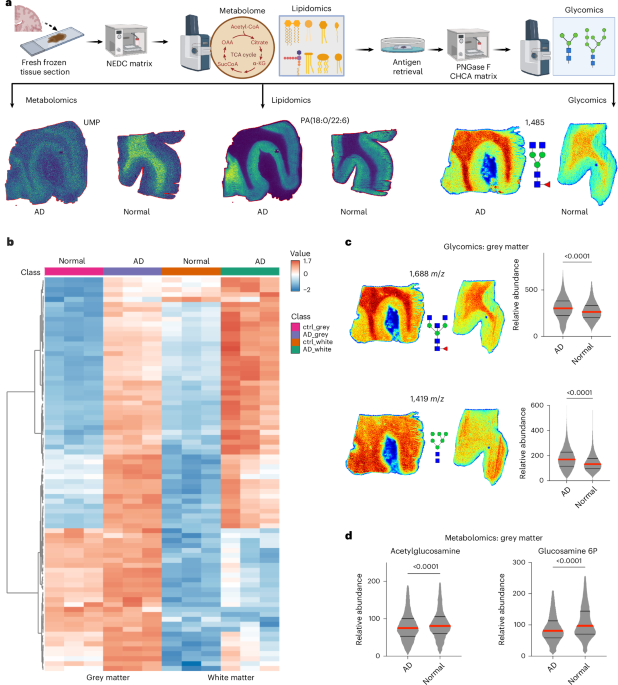
The research team applied a recently developed multiplexed matrix-assisted laser desorption/ionization (MALDI) mass spectrometry imaging (MSI) technique to human AD brain samples. This method is a powerful tool that can spatially analyze metabolites, lipids, and glycans simultaneously in a single brain-tissue section.
First, when comparing normal brain tissue with AD brain tissue, existing methods had the problem of very low glycan signal intensity and poor spatial resolution. In human samples in particular, lipid content remained high even after Carnoy solution treatment, which had been effective for lipid removal in mouse brain tissue. So the team optimized a xylene washing protocol to remove lipids effectively and greatly improve glycan signal intensity. 🤩
Using this improved method, they performed spatial metabolomics, lipidomics, and glycomics analyses on human frontal cortex samples from healthy controls and AD patients. The results showed that in AD samples, glycans were markedly increased in both gray-matter and white-matter regions. In particular, bisecting glycans and high-mannose glycans were elevated in gray-matter regions of AD brains. Interestingly, N-acetylglucosamine and glucosamine-6-phosphate, key precursors for glycan biosynthesis, were significantly decreased in gray-matter regions of AD samples. This unexpected broad increase in glycosylation suggests that further research is needed to understand the biochemical pathways through which glycan changes occur in AD pathology.
<br><br>"Spatial multi-omics analysis reveals hyperglycosylation in human AD brains."
To understand how this phenomenon changes with AD progression, the team further analyzed AD patient samples classified by Braak stage. In gray matter, glycosylation gradually increased as Braak stage advanced, with the clearest changes observed at later stages. This means hyperglycosylation is associated with AD severity. In white matter, by contrast, glycan levels increased at Braak stages 1-2 but did not continue increasing at later stages. This suggests that white-matter hyperglycosylation may be a transient phenomenon appearing only in early stages. These results strongly support the possibility that hyperglycosylation may be a potential cause of AD pathology.
3. Hyperglycosylation and Increased Biosynthesis in AD Mouse Brains 🐭
To confirm whether the hyperglycosylation observed in human AD brains also appears in animal models, the research team studied the brains of the AD mouse models 5xFAD and PS19. As in human AD samples, broad changes in metabolites and lipids were observed in 5xFAD and PS19 mice, consistent with previous findings that AD pathology is related to disrupted energy metabolism and lipid homeostasis.
In particular, N-glycan profiling showed hyperglycosylation in both the 5xFAD mouse model and the PS19 model, similar to human AD samples. 😮 This hyperglycosylation appeared throughout the brain, but was most prominent in regions related to memory, cognitive processing, and neuroinflammation, such as the cortex, hippocampus, and thalamus, and less pronounced in the cerebellum and brainstem. This suggests that hyperglycosylation is a cross-species feature of AD pathology, and that specific brain regions are more vulnerable to this metabolic dysregulation.
To determine whether hyperglycosylation was caused by increased glycan biosynthesis or decreased degradation, the team used stable isotope tracing and a pulse-chase experiment. Mice were fed a liquid diet enriched with 13C-glucose. During the pulse phase, the team measured newly synthesized glycans; during the chase phase, they evaluated glycan turnover and salvage activity.
The results were clear. In 5xFAD mice, glycan enrichment increased significantly, especially in high-mannose glycans. By contrast, there was no major difference in glycan degradation or salvage. This strongly supports the idea that increased glycan biosynthesis is the main cause of hyperglycosylation in AD pathology.
<br><br>"Increased glycan biosynthesis drives hyperglycosylation in the 5xFAD mouse model."
Furthermore, concentrations of UDP-hexoses and UDP-HexNAc, key precursors in the N-glycan biosynthesis pathway, were also increased in 5xFAD mice. In both human AD brains and the 5xFAD mouse model, expression increased for genes involved in ER and Golgi glycan biosynthesis, including Mgat, Man1a2, and B4galt1. All of this evidence shows that glycan biosynthesis is actively occurring in AD.
Interestingly, O-GlcNAcylation and hyaluronan production, which share the same UDP-GlcNAc pool as N-glycan biosynthesis, were instead decreased in the brains of 5xFAD and PS19 mice. This means UDP-GlcNAc metabolism may be reprogrammed in AD so that N-glycan biosynthesis increases while other pathways are restricted.
4. Glycoproteomics and Neuron-Specific Hyperglycosylation 🧪
To determine whether hyperglycosylation was caused by the appearance of newly glycosylated proteins or by increased glycosylation of existing proteins, the team performed glycoproteomics analysis. In normal and AD human frontal cortex tissue, as well as WT and 5xFAD mouse brain samples, they confirmed that glycopeptide abundance was significantly increased in AD samples. This further supported the hyperglycosylation observed through MALDI analysis.
The especially important point is that most glycoproteins were the same in normal and AD samples. This means that hyperglycosylation in AD mainly comes from increased glycosylation modifications of existing glycoproteins, not from the creation of many new glycoproteins.
The team also used cell-type enrichment analysis to predict which neural cell populations were most affected by hyperglycosylation. The results showed that neurons were the major cell population with enhanced hyperglycosylation, suggesting that abnormal glycosylation may play an important role in neuronal dysfunction and AD pathogenesis. In other words, the brain's hyperglycosylation was found to occur mainly in neurons.
5. Relieving and Worsening Neurodegeneration by Regulating Glycosylation 🎯
To find out whether hyperglycosylation is a cause of neurodegeneration or a secondary result of disease, the team conducted experiments that regulated brain N-glycan levels through genetic and dietary interventions.
First, to inhibit glycosylation, they targeted PGM3 (phosphoglucomutase 3), a key enzyme in the hexosamine biosynthesis pathway. When shPGM3 was injected into 8-month-old 5xFAD and PS19 mice to lower glycan levels, social-memory deficits improved significantly.
<br><br>"PGM3 gene suppression reduced N-glycan levels and improved social memory in 5xFAD and PS19 mice."
They also confirmed that when the small-molecule inhibitor NGI-1, which blocks N-glycan synthesis, was administered, brain N-glycan levels decreased and social-recognition ability improved. These results show that reducing excessive N-glycosylation is sufficient to improve cognitive function, and suggest that hyperglycosylation could become a treatable target for dementia-related memory decline.
Conversely, the team hypothesized that glucosamine supplementation could increase hyperglycosylation and worsen AD pathology. Because glucosamine easily crosses the blood-brain barrier and can be incorporated directly into brain glycans, it is an ideal substance for studying the effects of increased glycosylation. When 5xFAD mice were given oral glucosamine, glycosylation increased significantly across the brain, and social-memory deficits worsened further.
<br><br>"Glucosamine supplementation increased brain N-glycans and worsened social-memory deficits in 5xFAD mice."
Interestingly, none of the treatments, PGM3 inhibition, NGI-1, or glucosamine, affected the number of reactive glial cells or the amount of amyloid-beta plaques. This suggests that glycosylation regulation may affect cognitive function independently of neuroinflammation or amyloid clearance, and points to a new approach for AD treatment.
6. Real-World Effects of Glucosamine in Dementia Patient Cohorts 🏥
Based on the finding that glucosamine supplementation worsened cognitive decline in mouse models, the team analyzed electronic health record (EHR) data from the University of Florida Health system to determine whether this effect might also apply to humans. They reviewed records from 2012 to 2024 for more than 50,000 patients with Alzheimer's disease-related dementia (ADRD) and mild cognitive impairment (MCI), identifying patients who had taken glucosamine for at least one year.
The results showed that among ADRD patients, the glucosamine-taking group had a 25% increased risk of death. 😱 This suggests that glucosamine may be harmful for patients whose neurodegeneration is already established. By contrast, in the MCI group, glucosamine use did not have a significant effect on mortality risk. This means the adverse effects of glucosamine may be specific to individuals with established disease.
<br><br>"Glucosamine increases brain N-glycans, worsens social memory in 5xFAD mice, and is associated with adverse outcomes in real-world evidence from dementia cohorts."
In addition, among MCI patients, the glucosamine group had a 25% higher progression rate from MCI to ADRD than the non-use group. This shows that glucosamine supplementation may accelerate disease progression or worsen dementia phenotypes.
Interestingly, when healthy WT mice were given glucosamine, N-glycan levels did not increase and social memory was not impaired. This suggests that normal brains have intrinsic resilience mechanisms against glucosamine-induced metabolic disturbance. In other words, the harmful effects of hyperglycosylation and glucosamine are not universal for everyone, but may specifically worsen metabolic vulnerability in brains where neurodegeneration is already underway.
The study raises the possibility that 6.7 million AD patients and 7 million ADRD patients in the United States may currently be taking glucosamine, and that more than 1 million patients may unknowingly be worsening their disease progression. Therefore, the researchers concluded that a large double-blind clinical trial is urgently needed to systematically evaluate the effect of glucosamine on dementia patients. 🚨
7. Conclusion and Future Outlook 💡
Using MALDI-MSI and spatial multi-omics analysis, this study revealed a previously unknown phenomenon of hyperglycosylation in Alzheimer's disease brains. It provides strong evidence that this is not merely a byproduct of disease, but an important metabolic driver that promotes AD progression.
In particular, the findings that glycan biosynthesis increased in both AD mouse models and human AD brains, that inhibiting glycosylation enzymes improved cognitive function, and that glucosamine supplementation worsened cognitive function clearly show that hyperglycosylation could become a new target for AD treatment. 👏
<br><br>"Our findings establish hyperglycosylation as an important driver of AD progression and suggest that regulating glycan biosynthesis may be a new therapeutic strategy."
The real-world dementia-patient data are also highly important because they show that glucosamine use is associated with increased mortality in AD and related dementia patients and with increased conversion from mild cognitive impairment to dementia. This suggests that glucosamine, widely used as a health supplement, may have unexpectedly harmful effects in certain patient groups.
Future research should investigate in more depth, by cell type, how hyperglycosylation affects multiple brain systems, including neural function, glial responses, the blood-brain barrier, and the glymphatic system. Developing blood-brain-barrier-permeable drugs that target the hexosamine pathway may also become a promising route for AD treatment. Above all, a large double-blind clinical trial must be conducted to clarify the potential risk of glucosamine supplementation suggested by this study. These efforts are expected to contribute greatly to slowing Alzheimer's progression and improving patients' quality of life. ✨