Have you ever struggled to track down the root cause of a bug or performance problem in a complex software system? 😅 In this post, I'll walk through hypothesis-driven debugging — a method for systematically tracing the source of a problem. I'll illustrate it with real-world experience, concrete examples, and memorable quotes to make it easy to follow!
1. Introduction: The Debugging Challenge in Distributed Systems
A few years ago, I spent 18 months at Form3 running performance tests on a distributed payment processing system. During that time, I learned an enormous amount about distributed systems and how to monitor them using tools like Prometheus.
- Scaling the system: We grew from processing fewer than 10 payments per second to nearly 1,000.
- We experimented with various load testing tools and eventually built our own.
The hardest part of it all was debugging failures and bottlenecks in a large-scale distributed system.
"Debugging individual software components can be tricky, but modern debuggers make it manageable. In a large distributed system, however, telemetry — logs, metrics, traces — is the only evidence you have. In the end, all you can do is guess at the cause and see if you're right."
I realized that this guess-and-see approach is actually a lot like the scientific method. And if you treat your guesses as hypotheses — specifically, falsifiable hypotheses — you can diagnose problems far more effectively.
2. What Is a Hypothesis?
So, what exactly is a hypothesis? Simply put, it's a reasoned guess that we make to explain an observed phenomenon. 💡
Seeing It Through an Example
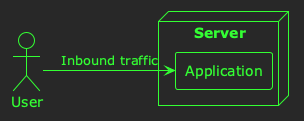
Imagine a simple system like the one below.
Suppose the server's CPU usage is high. A hypothesis you might form is:
"The server's CPU usage is high because there is a large amount of incoming traffic."
That's it — a hypothesis is just your proposed explanation.
3. What Is Falsifiability?
Not all hypotheses are equally useful. A good hypothesis must be falsifiable — that is, there must be a way to prove it wrong.
Understanding It Through an Example
Let's revisit the hypothesis from before:
"The server's CPU usage is high because there is a large amount of incoming traffic."
Here's how you would test it:
"If I increase the incoming traffic further and the CPU usage does not rise, the hypothesis is wrong."
The key point here: The goal of this test is not to prove the hypothesis, but to falsify it. In other words, you can never fully prove a hypothesis true, but you can prove it false.
An Example of an Unfalsifiable Hypothesis
"The server's CPU is high because it hasn't been running long enough yet."
No matter how long you wait, you can always say "maybe just a little longer" — meaning this hypothesis can never be disproved. A hypothesis for which you cannot design a falsifying test is not a good hypothesis!
4. Hypothesis-Driven Debugging in Practice
Now let's walk through a real example showing how to form and test hypotheses.
System Architecture
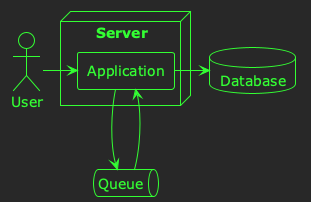
- A user sends an HTTP request to create a resource.
- The application places a job on a queue, which is processed asynchronously.
- The processed result is saved to a database.
When we measured the total end-to-end processing time, the 99th percentile (top 1%) was 10 seconds. Way too slow! Now let's form some hypotheses.
First Hypothesis
"Processing is slow because of latency introduced by the queuing technology."
How to test it:
"If I replace the queue with an in-memory function call and the processing time does not decrease, this hypothesis is wrong."
We actually removed the queue and tested it — but the processing time remained high. 🤔
Second Hypothesis
"Processing is slow because of poor database performance."
How to test it:
"If I replace the database with an in-memory cache and the processing time does not decrease, this hypothesis is wrong."
This time, we temporarily swapped the database for a cache — and the 99th percentile dropped to 5 seconds!
"We hadn't fully solved the problem yet, but we had confirmed that the bottleneck was in the database."
5. The Power of Hypothesis-Driven Debugging
This process — forming a hypothesis, designing a falsifiable test, and progressively narrowing down the cause — is what hypothesis-driven debugging is all about.
"This method isn't new, but it proved enormously helpful for analyzing and investigating large-scale software systems. It gave me insights, helped me learn facts, and ultimately let me trace even elusive root causes."
6. Closing: Give It a Try! 😊
The next time you need to debug a problem in a complex software system, try applying hypothesis-driven debugging.
"I hope this method proves as useful to you as it has to me! 🙂"
⭐️ Key Terms Summary
- Hypothesis: A reasoned guess that explains an observed phenomenon
- Falsifiability: Can it be proven wrong?
- Telemetry: Data collected from a system — logs, metrics, traces, etc.
- Hypothesis-driven debugging: A debugging method that forms hypotheses and narrows down root causes through falsifiable tests
By applying hypothesis-driven debugging, even the most complex problems become something you can approach systematically. I hope this gives your debugging journey a helpful boost! 🚀
