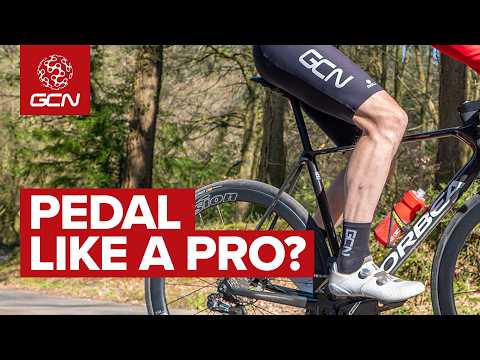
This video provides scientific answers to cycling's age-old questions: what is the most efficient pedaling technique and how to improve it? We compare the differences between pros and amateurs, debunk myths, and go in-depth on the real effectiveness and importance of pedaling technique training. In conclusion, we emphasize that intentionally trying to change your pedaling technique can be ineffective, and that true efficiency comes naturally from consistent training and high power output.
1. The paradox of pedaling efficiency: The difference between a pro and a beginner 🤯
Pedaling skills can be said to be the second most important skill in riding a bicycle after balance. When it comes to bicycle pedaling, we often hear the phrase "pedal in a circle," which means not just pressing the pedals, but using pedal strokes in all directions, 360 degrees. This movement of our legs on the pedals is the process of converting the body's energy into power, or watts, to propel the bike forward. At this time, the ratio of the total energy used by our body that is converted to watts is called gross efficiency. 🚴♀️
But here's a surprising fact! 😮 In other endurance sports, such as swimming or cross-country skiing, there is a clear increase in total efficiency with more training, but in cycling, the evidence is very minimal. Even the famous Mosley study found no significant difference in total efficiency between elite cyclists and completely novice riders. This is a completely different result from what we think of as 'efficient pedaling like a professional athlete', so it's really surprising!
"This was one of the things we thought was the absolute truth in cycling."
2. Misconceptions about 'optimal' pedaling techniqueOn the Peter Aier podcast, Norwegian triathlon coach Olaf Alexander Buu explains that in swimming, technique is important because there is no body support, but in running, technique is less important because the ground acts as support. However, in cycling, technology was seen as having little importance because it was fixed to the saddle, handlebars, and pedals. Of course, that doesn't mean there's no skill in riding a bike, but it does mean that it does in terms of efficiency.
If efficiency is similar for all riders, then the very concept of 'optimal pedaling technique' may be a myth. Early studies compared professional and amateur athletes at identical power outputs, but more recent studies have compared power output to V2 max (maximum oxygen uptake), with professional athletes tested at higher power outputs. The results showed that training can slightly improve total efficiency (1.4% on average), but whether this is directly related to pedaling technique is still questionable. 🤔
3. What is mechanically efficient pedaling? 🤔
So what does mechanically efficient pedaling technique mean? It is generally measured as Force Effectiveness, which is the ratio of the force applied to move the crank to the total force applied to the crank. For example, it was considered ideal to use force evenly throughout all 360 degrees, such as with one leg pressing the pedal and the other leg pulling the rising pedal. If the robot was riding a bicycle, it would pedal by pulling at 9 o'clock, pulling back at 6 o'clock, pushing down at 3 o'clock, and pushing forward at 12 o'clock. 🤖But in reality, humans don't pedal like that. The same goes for elite athletes! When riders were trained to pedal in this 'ideal' way, mechanical efficiency could be improved by about 3%, but at the same time total efficiency actually decreased. In other words, it takes more energy to become more mechanically efficient. 😥
The late Professor Louie Passfield gave an interesting explanation. Our muscles are good at short, repetitive contractions, but weak at sustained Isometric Contractions. Brief contractions give the muscles time to resynthesize the high-energy molecule ATP and stimulate blood circulation, which helps remove byproducts. However, if you try to keep your muscles contracted longer to improve your pedaling technique, your muscles will have less time to recover, creating a much higher metabolic cost. As a result, you will expend more energy than the mechanical gain, making you less efficient. 📉
4. How power output affects pedaling technique 💥
While there is a lot of debate about whether force effectiveness is a useful indicator of pedaling technique, we took professional cyclists as an 'optimal' proxy and looked at how they differed from amateurs. The results showed that while there was no significant difference in total efficiency, there was a difference in pedaling technique between professional and amateur athletes when pedaling hard enough.
A study by Buyod Atal found that at lower power outputs, pro athletes had less force effectiveness, but as intensity increased, pro athletes' pedaling technique became increasingly optimized. It can be inferred that professional athletes are able to produce higher power output and therefore have more efficient pedaling strokes. It's like how weightlifters become more efficient as they lift heavier weights. 💪Professor Bent Ronestad, a renowned Norwegian scholar, discovered that professional athletes show higher peak torque at the beginning of the pedal stroke (3:00 - 3:30 direction) than regular cyclists. This is because applying force earlier than the robotically perfect pedal stroke (4 o'clock) offers a potential mechanical advantage, giving the muscles more time to recover. Professor Ronestad assumed that this pedaling skill is a natural result of high power and long-term, high-intensity training.
5. Improving pedaling technique, is it really effective? 🤷♀️
In conclusion, total efficiency can be improved over time through consistent training, but this is difficult to do through artificially altering pedaling technique. While a rider's pedaling technique varies, it is correlated with higher power output, and the higher the power output, the more efficient the pedal stroke appears. This happens regardless of the rider's experience, and at higher power outputs there is a tendency to pedal earlier and harder.
When asked whether pedal strokes can be improved, Professor Ronestad presented interesting experimental results. He was able to train his riders to have similar pedal strokes to pros like Edval Bosen Haren by adding heavy weight training twice a week to their regular riding training. This training improved the riders' power output overall and showed a tendency to deliver more power early in the pedal stroke. 🏋️♂️But when asked whether it's worth it to make a deliberate effort to improve your pedaling skills, like running or swimming, the answer is a resounding 'no'**. Even among academics and coaches, they could not find any literature showing that artificially improving pedaling technique was possible or beneficial. However, interval training on flat ground or hills and training at various cadences were recommended.
"I understand our desire to find a magic formula, but trying to change your pedaling technique would be a waste of effort and time."
6. Good news! ✨
But all of this brings us two good news.
- Firstly, you don't have to worry about your pedaling technique. It gives you peace of mind! 😌
- Secondly, even if you start cycling late, there is nothing stopping you from reaching your full potential. Because there is no such thing as a special 'secret skill' that can only be gained through countless rides over weeks, months or years. Look at Primos Roglič, Remco Evenepoel and especially Kristian Forner. Forner was a rower until he was 25, but he became a two-time Olympic champion in just seven years. 🥇
In conclusion 🌟
Pedaling technique has been one of cycling's long-debated topics, but scientific research shows our intuition may be different. Rather than trying to force yourself to find the 'ideal' pedaling technique, it is important to develop high power output through consistent training and let your body naturally find the most efficient movement. So take the pressure off your pedaling skills and focus on having fun riding and reaching your full potential! 🚲💨