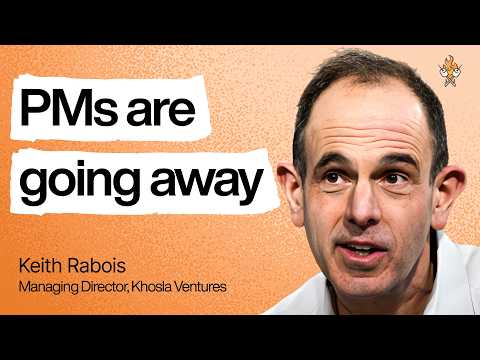
This talk features Keith Rabois — managing director at Khosla Ventures and PayPal Mafia alumnus — delivering candid advice on building companies in the AI era. He shares deep insights on identifying talent, hiring strategy, and a counterintuitive approach to customer feedback, while highlighting how the product manager role is changing and what three traits define successful companies.
1. The Billionaire Who Only Uses an iPad 🤯
Keith Rabois reveals that since September 2010 he has done all his work on only an iPad, iPhone, and Apple Watch — no computer. He explains that this approach greatly helps him maintain focus and increase flexibility, and that he was inspired by Jack Dorsey at Square. He adds that in the AI era engineers are increasingly coding on their phones, and that he has been preparing for this shift for a long time.
"I haven't touched a computer since September 2010. Everything in my life is done on a phone, a watch, or an iPad."
2. "The Team Is the Company" – Why Hiring Matters Most 🎯
Keith names team building as the single most important factor in company success, quoting Vinod Khosla of Khosla Ventures: "The team you build is the company you build." He explains that the exceptional talent density Peter Thiel and Max Levchin assembled at PayPal was decisive for that company's success, and confesses that he was initially poor at evaluating talent himself — he grew by learning to identify and develop people from within.
"If a founder can coldly and accurately assess talent early in their career, they can go very far even without any other skill."
Keith emphasizes rigorous reference checks and strategic interview questions as keys to improving hiring. He cites Tony Xu of DoorDash checking 20 references for every senior hire, and describes asking candidates questions like "If you were CEO, what would you have done differently?" to probe strategic thinking. He recommends a 30-day feedback loop — evaluating the validity of each hiring decision within 30 days — to continuously improve the hiring process.
3. The "Barrels and Ammunition" Framework ⚙️
Keith points out that as companies grow, adding headcount does not necessarily produce more output, and proposes the "barrels and ammunition" framework to address this. A barrel is a high-agency, self-directed key person who can take an idea all the way to a concrete success; ammunition refers to the people who support those barrels. At PayPal, he says, only 12–17 of 254 employees were barrels, and the number of barrels determines how many important initiatives a company can pursue simultaneously.
"A barrel is someone who can make an idea happen. 'There's a hill over there. Let's go take that hill.' And that person will somehow motivate people, gather the resources needed, measure what needs to be measured, and carry the company over that hill. That's a barrel."
Keith says the most important trait for identifying a barrel is agency — not merely following instructions, but the ability to solve problems independently and own outcomes. He illustrates this with the story of Taylor Francis, an intern at Square who solved a smoothie-delivery problem that nobody else had been able to fix.
4. Finding and Developing Hidden Talent ✨
Keith says that to attract top talent you must articulate a clear vision and mission, and persuade candidates that their strengths match the company's hardest challenges. He recalls being persuaded to join Square because people with both financial-services experience and an entrepreneurial mindset were extremely rare. More important still, he argues, is discovering "undiscovered talent": rather than competing for the same people everyone else wants, you should find people with abundant potential who simply haven't been recognized yet.
"I think you have to build a company with hidden talent. I don't want to compete for the people everyone else wants."
He explains that young talent is often underrated by large companies' standardized evaluation systems because there are fewer data points on them — and that is exactly where you can find alpha. It is analogous to investors spotting undervalued startups before the market does.
5. Leadership That Relentlessly Pushes 💪
Keith says leaders of successful companies relentlessly push their teams. The more successful you become, the greater the temptation to coast — so the CEO's job is to counteract that complacency. The better the company is doing, the more critical your lens must be as you identify and address potential problems before they compound.
"The better you're doing, the harder the CEO should push." "Really talented people are like great athletes. They're not happy when things are going well and people are coasting. They instinctively want to build things and create value."
He points to Brian Chesky at Airbnb as an example of someone who continuously pushed his team, and explains that the best people find satisfaction in the act of constant challenge and achievement — so leaders must create an environment where those people keep growing rather than settling.
6. Career Advice for the AI Era and the Changing PM Role 🤖
Amid predictions that AI will reshape many careers, Keith advises that learning new technologies driven by intellectual curiosity is essential. He shares the surprising fact that in top organizations today the person consuming the most "tokens" (units of AI service usage) is the CMO, who is using AI to directly build marketing campaigns, analyze data, and handle work more efficiently.
"I think AI will fundamentally reshape many people's careers. Including mine." "In the best organizations, the person consuming the most tokens is the CMO."
He also predicts that the product manager role will change dramatically. AI has made year-long product roadmaps meaningless, and the middleman function of gathering customer requirements and relaying them to engineering will disappear. Instead, everyone — PM, designer, engineer — will need to operate like a "mini-CEO" focused on "What are we building, and why?" The ability to create value grounded in business acumen and deep market understanding will matter most.
"The PM idea will be meaningless in the future… The core question is: what are we building and why?"
7. A Counterintuitive Take on Customer Feedback 🤫
Keith makes the provocative claim that listening to customer feedback can actually be harmful for consumer products. Customers don't know precisely what they want, and when they try to answer conscious questions about subconscious decisions, they tend to provide misleading information. As an example: if you ask buyers of high-end sports cars why they bought them, most won't tell you the real reason.
"I hate talking to customers. I don't let my colleagues talk to customers." "Customers don't know what they want, and they're very bad at consciously answering questions about subconscious decisions."
For enterprise products, however, he says customer feedback is useful because decision-makers are clearly identified and make utility-based decisions. He cites DoorDash as an example: the company conceived its business idea not from direct customer requests but from the data point that 93% of restaurants in the United States did not offer delivery. Ultimately, the founder's own insight and clear business logic matter most — and an early idea can look like an "ugly baby" and still succeed.
8. Three Traits of Successful Startups 🚀
Keith shares three traits he has observed consistently across the successful startups he has invested in.
- Speed: "Fast execution speed is the operational cadence that successful companies develop very early, and it's enormously impressive." He mentions that at Square, Roloff Boto once told him he hadn't seen that kind of speed since PayPal. He describes the ability to quickly identify problems and execute solutions as critical, and says he decided to lead Ramp's Series A because the company completed a card-issuance process that normally takes 9–12 months in just 3 months.
- Talent Density: Not simply having many people, but having a small number of barrel-level individuals whose exceptional capabilities build the company's competitive advantage.
- Internal Talent Development Philosophy: Rather than recruiting experienced senior hires from outside, successful startups tend to focus on identifying and growing promising people from within — sometimes through roles like Chief of Staff that serve as deliberate talent-development mechanisms.
9. Public Criticism and Psychological Safety 🗣️
Keith offers the somewhat controversial advice to criticize people publicly. Giving feedback privately, he explains, optimizes at the "atomic unit" level, while public criticism optimizes for the whole system: colleagues see that a problem exists and that leadership is addressing it, which drives team-wide alignment and eliminates uncertainty.
"High-performance machines don't have psychological safety. They focus on winning."
He also expresses skepticism about "psychological safety", arguing that high-performance organizations exist to win, and that overemphasizing psychological safety can actually prevent people from setting ambitious goals and make them afraid of failure. The key, he says, is to encourage bold attempts and focus on success rather than dwelling on failure.
10. Failure, Philosophy, and Living by "#NoDaysOff" 🏃♀️
Keith acknowledges that his career has included many failures. He notes that a 30–40% success rate is considered high for investors — failure is an unavoidable part of the process. He stresses the importance of not being too attached to failure, and warns that excessive post-mortems on failure can actually discourage people from making ambitious attempts.
"I don't believe in excuses. 'No days off' is a proxy for not believing in excuses."
His life motto is "#NoDaysOff." He says that whether in exercise or work, showing up every day without exception is what matters — and that it ultimately means refusing to make excuses. He notes that over the past seven years he has missed only 7 days of exercise.
Closing Thoughts 💡
Keith Rabois's insights are a reminder that building and scaling a company in the AI era still comes down to focusing on the fundamentals. The ability to see talent clearly, the strategy to assemble a team, and the mental flexibility to adapt to change are just as critical as the pace of technological progress itself. His candid and sharp advice will be a source of great inspiration for many founders and leaders.