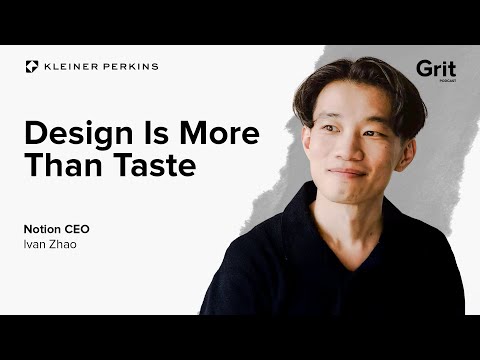
This video features Notion co-founder and CEO Ivan Zhao in conversation with Joubin Mirzadegan, sharing how the company's minimalist design became a strategic advantage in a world of bloated software, why AI agents haven't fully arrived yet, and how Notion's modular approach may come closest to making them a reality. As a deep thinker who elevates technology to the level of art, Ivan Zhao's insights are invaluable for understanding the secret behind Notion's success.
1. Ivan Zhao's "Burrito" Philosophy
The conversation begins with Ivan Zhao's personal style. While he always presents a clean and orderly appearance, he describes himself as "a burrito kind of guy," preferring a simple burrito over an elaborate Michelin five-course meal.
"I'm not fancy. I like fashion, but I'm not fancy. I'm a burrito kind of guy. If someone takes me to a Michelin-style five-course dinner, I'd rather just have a burrito."
He cites "simplicity" and "time" as reasons for preferring burritos -- everything is in one place so there's no need to wait three hours, and he prefers straightforward, intuitive food over overly subtle flavors. He goes on to describe how his wife (an Iranian-American) introduced formal dining culture at home with white tablecloths, which initially felt unfamiliar but he came to accept as "a good evolution." He also jokes that despite his wife and CTO both being Persian, he doesn't like Persian food because "the flavors are too bland." This again illustrates his "burrito" philosophy of preferring "bold and clear flavors."
2. Obsession with Craftsmanship: Notion's Office and Product Design
Ivan Zhao is someone who pays tremendous attention to "detail" in his surroundings and objects. He mentioned that when visiting Slack's new office, he physically touched the table to identify what material it was made of.
"Well, you pay attention to the environment around you, right? I like to touch things. So if it's fabric, I sometimes touch to understand it. And here I can tell, 'Oh, this is laminate. It's a decent table. Not the fanciest, but it could be oak or wood.'"
He makes similar observations about Notion's recently relocated office. Though still under construction and not yet as perfect as he'd like, he emphasizes the importance of "craftsmanship" and explains that paying attention to office details is directly connected to company culture. He prefers spaces that develop a "patina of use" over time rather than overly "shiny" offices, believing this helps employees feel comfortable "using" the space and focusing on their work.
"I prefer things to feel more lived-in, a bit more humble. I think when an office is too nice, the business is doomed. Because you can't focus on the right things."
This obsession with detail is reflected throughout the Notion product as well. He says he immediately notices subtle "bugs" or "lag" in the Notion product, and even just before the interview, he spotted and reported a bug where the page title input was slower to respond than the body text. He explains that these small details have a huge impact on user experience and are the reason Notion is recognized for its design and aesthetics.
"I probably do. I'm good at finding bugs. If something is even slightly off, I can detect it and feel it."
Ivan Zhao discusses the gap between "taste" and "the ability to build," emphasizing that as a software developer, it's important to understand the cause of a bug and know how to fix it. He says Notion values "craft" but finds a balance between business viability and utility rather than pursuing excessive perfection. Notion aims for about 6.5-7 out of 10 in craftsmanship, and is content at that level.
3. Philosophy on Software and Tools: Balancing Simplicity and Extensibility
Among other software products, Ivan Zhao singles out Linear and early Apple OS as examples of standout "craftsmanship." Linear in particular focuses on a specific use case with high attention to detail, but he explains that maintaining a high "craft" level for a product that covers as broad a range as Notion is far more difficult.
"Linear is a good example. It's issue tracking, bug tracking for engineering products -- very specific in terms of use cases, but they put a lot of care into the details. It's fast, it feels good." "Vintage Apple is definitely that. Apple's OS is still one of the most refined and detailed products."
He mentions software "entropy," pointing out that software like Microsoft Word, which has aged and accumulated features, tends to become complex and lose aesthetic value. Notion faces the ongoing challenge of providing complex functionality while maintaining "simplicity" and "high craft." The fact that Notion's conference rooms are named after "physical tools" -- iPhone, BMW 3 Series, Toshiba rice cooker, Sony transistor radio, Singer sewing machine -- reflects Notion's commitment to being a "practical, enduring tool."
4. Ivan Zhao's Journey and the Origin of Notion
Ivan Zhao was born in China and moved to Canada at age 17, where he began an in-depth exploration of language and culture. He learned English through TV shows like SpongeBob and The Simpsons, studied AllMusic.com's music rankings to understand Western culture, and developed his aesthetic eye by watching Criterion Collection films with a film-major friend. These experiences clearly had a major influence on shaping his "aesthetic sensibility."
"Once you get the jokes, you truly understand the language and culture. So language was first. And another realization was that I knew almost nothing about Western culture."
After finishing university in Canada, he moved to the United States about 12 years ago (as of 2025), where he refined Notion's initial concept. He got a job at a company called Inkling to resolve his visa, and with the help of the company's first investor, Matt MacInnis, he went on to found Notion.
"What really inspired me was discovering the early ideas of computing, where this industry came from."
Ivan Zhao emphasizes that Notion's beginnings were inspired by the grand vision of computing from the 1960s-70s hippie generation. At the time, computers were room-sized calculators, but the visionaries saw computers as a "medium" that everyone could manipulate and shape.
"Their intent was that computing is like reading and writing. It's a medium we can learn. Just like you can compose English sentences any way you want. Someone might become a great poet, someone else a novelist, or use it for business. It is a medium you can create with."
However, he points out that when the generation of Steve Jobs and Bill Gates made computers mainstream, software became trapped in "application jails," and only programmers could manipulate software. Notion was born from the original vision of enabling everyone -- beyond the "programmer class" -- to create and use software.
5. A New Transition in the AI Era: The "Brewing Beer" vs. "Building a Bridge" Analogy
Ivan Zhao explains that we are at an interesting point of "medium transition" into the AI era. Initially, people tend to use new media (AI) the same way they used the previous medium (classic computing), but eventually they will discover AI's true potential.
"We're at a point where we're transitioning from one major medium, which is classical computing, to a new medium that's more flexible, language-model-based, and AI-based computing."
He compares AI-era software development to "brewing beer," explaining that it is fundamentally different from the previous approach of "building a bridge."
- Building a bridge (traditional software development): A method of building with clear goals and blueprints, controlling everything perfectly. You can implement what's drawn in a Figma file within 3-6 months.
- Brewing beer (AI software development): A method of creating the environment and guiding the yeast to work on its own. You can't control everything; results vary depending on the model's inherent wisdom and capabilities, so you must constantly experiment. 70-80% is achievable, but the remaining 20% cannot be forced and may never be reached.
"Language models actually work differently. You can't build everything you imagine. Often you can get to 70-80%, but you frequently can never close that remaining 20% gap."
He shares that Notion gained early access to OpenAI's GPT-4 in late 2022 and realized AI's potential, but despite having all the ingredients (Notion's Lego blocks) ready, the language model wasn't mature enough, making it difficult to build a knowledge work agent. This taught him how crucial "model maturity" is to new product development.
6. Notion's AI Strategy: Integrating "Context" and "Tools"
Ivan Zhao emphasizes that Notion is in a strong position for the AI era. Notion's strategy over the past five years has been to consolidate various vertical SaaS products into a single platform. For example, document editing, knowledge management, project management, and recently even calendar and email have been brought into Notion.
"We've been consolidating various vertical SaaS into one tool for the last five to six years. Document editing, knowledge management, project management -- most of the Lego blocks for knowledge work we've been bringing into Notion one by one."
This "integration of context and tools" strategy works very favorably in the AI era. AI needs "context" to perform accurate tasks, and Notion has gathered all of it in one place.
"This is really good for AI. Because AI needs context and tools to be together."
He explains that Notion is focused on building a "knowledge work agent." While AI agents have already emerged in customer support and coding, the reason they haven't yet been activated in "knowledge work" is precisely because "tools and context are too fragmented." Notion has laid the groundwork for knowledge work agents to become a reality by solving this fragmentation.
"Notion is one of the few companies that has been consolidating these contexts and tools for more than five years. So you no longer need to go elsewhere to do other things. All the Lego blocks are in one place. This enables us to build a knowledge work agent."
The three AI products Notion launched last month (enterprise search, research summary and report drafting, and meeting notes automation) are early results of this strategy. Notion was able to develop these products in just two months by integrating AI transcription and summarization capabilities with its existing collaborative document features and calendar features. This demonstrates how powerful Notion's "Lego block" approach is.
"We built the product in two months. Because we already had the building blocks for it. We have one of the best collaborative document workspaces. We have a calendar product so it can tell you when your meetings are and send push notifications. Another building block. Now we can bring in AI transcription and AI summarization as building blocks. Put these four building blocks together and we could ship one of the best AI meeting notes products within two months."
7. Refactoring and a New Beginning
Ivan Zhao discusses the difficult period Notion went through -- 4-5 years of searching for "product-market fit," letting the team go, and then spending two years secluded in a small apartment in Kyoto, Japan with his co-founder, rebuilding the product. Having spent about 10 years building Notion as of 2025, he says AI's arrival has breathed new energy into the company.
"The SaaS era was in some sense very boring and very stable. Figure out product-market fit, figure out go-to-market, hire a sales team, and you're done. The AI era is shrouded in fog, and that makes the game much more fun and exciting."
In particular, when he gained early access to OpenAI's GPT-4 in late 2022, he sensed the world would change dramatically. He locked himself in a hotel room in Cancun, Mexico, and developed the first AI product version in about 10 days, releasing it a month before ChatGPT's launch. For Notion, this represented a "new beginning" similar to the time of reinvention in Kyoto.
"When the ingredients change, the excitement of being able to build something new is enormous. Many things that were previously impossible or unimaginable are now possible. This brings great satisfaction to people who build tools."
He explains that his current role is closer to "managing 5-6 coding agents" rather than focusing on coding as in the past, and that our relationship with information and work is changing. The "scale" of information and work that individuals and companies can handle is becoming much larger.
8. Personal Routine and Values
Ivan Zhao also emphasizes the importance of "regular routines" and "self-reflection" in his personal life. He gets up at 6:30-7 AM, tries to sleep 7 hours, exercises, turns off Slack and email notifications, and focuses on "writing." He says he calms his mind at night through reading.
"It's nothing too special. I'm more on the burrito side than Michelin star. I wake up around 6:30 to 7. Usually go to sleep around 11:30. I sleep 7 hours. I usually try to work out in the morning. I ran this morning."
He shows his love and trust for his wife, whom he married six months ago, and mentions plans to have children. He compares growing a company to "raising a child" -- it requires a lot but is ultimately deeply satisfying.
The interview reveals that he still receives customer support tickets in real-time, demonstrating his "relentless attention to customers and product." He describes this as being like "feeling the environment around you," suggesting that his "craftsmanship" toward the company and product goes beyond aesthetics to connect with real problem-solving.
"It's on my phone. So you can just send a ticket right here. Oh, it actually comes up. Yeah, on the lock screen there's no push notification. But when you open it, something will be up at the top. So I roughly know what's happening. Just like paying attention to the environment around you -- you pay attention to customers. You let everything around you come to you."
9. Notion's Ideal Talent and the Meaning of "Grit"
Ivan Zhao says that in Notion's hiring process, he values "honest conversation" and "reference checks." He encourages candidates to take off their "business jacket" and show their true selves, focusing on finding mutual "fit" rather than simply judging as an interviewer.
"More than anything, it's about having a normal conversation. Usually people come to interviews wearing their 'business jacket.' You have to take off that metaphorical business jacket. Make sure they understand you're human, that you see them as human, and that you're not here to judge or criticize or test them, but to find the right person."
He also shares insights on the spread of technology in the AI era, emphasizing that Silicon Valley is the "epicenter" of technology and a place that rapidly adopts new things. He adds that while technology is unevenly distributed, it will eventually spread, which means it will take time for organizations and individuals to adapt to new tools.
Finally, regarding the word "grit," he defines it as "the quality of accumulating what you believe in over time, and ultimately creating something unique and useful." He says grit enables "compounding," and that compounding creates "something beautiful and useful," concluding the interview on that note.
"I really like the word 'grit.' Because it's a generally positive human trait. Through ups and downs, you compound what you believe in, usually over years, a long time, and create something unique on the other end."