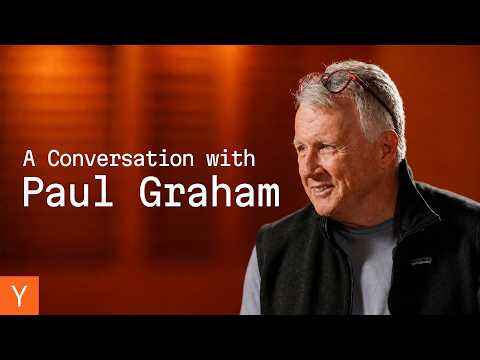
Paul Graham says that even though YC has grown over 21 years, the essence of startups has barely changed. Today there are more teams tackling far bigger problems, like curing cancer or building rockets, but the core of success is still strong ambition, execution, shipping fast, and founders who get what they want. AI is changing product development and cost structures, but it doesn't do the basic work a good founder has to do for them.
1. 21 Years of YC and the Unchanging Principles of Startups
Vivian Shen meets Paul Graham at YC's original office in Mountain View and begins the interview ahead of the talk he gives to the winter batch founders. This batch is no less than YC's 47th batch, and YC is now in its 21st year.
Having given the same talk countless times, Paul Graham could be expected not to get nervous, but he says he prepares it fresh every time. Right before the talk, he opens a text file and rethinks what to say; he may well end up repeating similar things, but he feels he has to put it together himself each time.
"I prepare the talk from scratch every time. I'm probably repeating myself, but I always feel like I have to think it through beforehand."
Asked whether there are entirely new startup principles for the new batch, he answers in the negative. Whether the technology is microprocessors, AI, or the internal combustion engine, the changes are huge, but the basic problems of starting and growing a company stay much the same.
"Most of starting a startup is actually the same. It always has been."
2. Startups Tackling More Serious, Bigger Problems
Paul Graham recalls that people have long been saying "YC is past its prime." Such talk started around 2008, and people wanting to criticize YC would say that YC used to be good but is broken now. But he thinks the companies YC invests in today actually tackle far more serious and ambitious problems than before.
YC in the past did have companies like Reddit that became huge successes, but in Paul Graham's words, that "isn't an ICBM." Recently, by contrast, there are teams working on problems actually involving missiles, curing cancer, and advanced scientific and industrial problems.
He cites as an example the idea of "an intercontinental ballistic missile that lands without exploding," saying that is truly serious ambition.
"There's nothing more serious than an ICBM."
He also explains that this batch includes companies approaching cancer treatment. Cancer treatment can harness the immune system, as with vaccines, or involve developing drugs, and he sees any attempt to fight cancer, whichever route, as worthwhile.
One of these startups takes the approach of conducting research for cancer patients on demand, whenever it's needed. Paul Graham thinks that even if cancer can't be conquered completely in one go, a strategy of chipping away at cancer bit by bit by continually providing patients with the research and treatment they need could be a realistic path to victory.
"Curing cancer in one shot isn't easy. Maybe the answer is to win by chipping away at it."
Here he mentions the cancer experience of GitLab co-founder Sid Sijbrandij. Sid approached his own cancer treatment systematically, as if running a startup, and the startup team in question effectively played the role of his co-founders in that process.
"He treated his cancer like a startup. Those people were effectively the co-founders of that startup."
Paul Graham says he had thought at the time that "someone should build a startup that does for everyone what Sid did for himself," and was delighted to learn that a team doing exactly that already existed. It's an example of how YC is not just an investment network but also a community where founders genuinely help with each other's lives and problems.
3. Frighteningly Ambitious Ideas and the Change in Search
The interviewer brings up "frighteningly ambitious ideas," a phrase Paul Graham used in 2012. Many of the ideas he imagined back then have now come true or are becoming reality.
A prime example is "a new Google." Paul Graham thinks beating a giant company by attacking it head-on is hard. Instead, when the world changes so much that an incumbent's model becomes outdated, a new competitor can emerge on top of that change. To him, OpenAI is exactly an example of such a change.
"The way to make a new Google isn't to attack Google head-on. You have to wait until the world has changed so much that the old model becomes obsolete."
He says that when he first used OpenAI, he realized he no longer searched the old way. What he had wanted from the search box wasn't a list of web pages but the information itself, so it's more natural to just ask AI for the information directly.
"What I wanted from search wasn't web pages. I needed information. So why not just ask AI for the information directly?"
This remark shows that AI may be not just a new app or feature, but a turning point that changes the very habits of how people find information and handle knowledge.
4. It's Not Just the Dream of Getting Rich That Drives Founders
Paul Graham believes founders need not only strong technical skills but also great ambition. Having started companies before YC, he knew well how hard the startup process is. Starting a company involves constant obstacles, and it's hard to push through on a sense of duty alone—"I have to, so I do."
"The obstacles are too big to get over on a sense of duty alone. You need something that keeps pushing you, and you could call that ambition."
That said, he doesn't think founders work every day with the thought "I'm going to be a billionaire someday." The fact that success can bring enormous wealth is certainly a motivation, but what actually drives day-to-day behavior, he says, is rather the fear of failure.
When a server goes down, a founder doesn't calculate future wealth. They jump in out of a sense of crisis that the service is breaking right now, customers are leaving, and they might look like an idiot.
"What drives founders moment to moment is fear of failure. Disaster striking, looking stupid, the server going down."
He likens it to a model train you've been lovingly building that's about to fall off the edge of the table.
"You don't think, 'If I fix this, I'll be a billionaire.' You think, 'Oh my God, the train is falling. I have to save it right now.'"
After long immersion in keeping the product and company alive like this, you might at some point calculate the valuation from the latest funding round and your own stake and realize you've become a billionaire. There are even founders who don't clearly realize it until Paul Graham does the math for them.
"You work with your head down for 10 years, and when you look up you realize, 'If I add up the value of my stake, I'm a billionaire.'"
5. Ambition Is a Trait That Reveals Itself More Than One That Is Built
Asked whether there have been cases of founders who lacked ambition becoming highly ambitious through YC, Paul Graham answers that such cases are rare. A founder's core qualities are generally there from the start and often show from the first meeting.
He gives the example of first meeting Sam Altman. Sam was already an extremely intense person with a strong presence even before he was accepted to YC. For Paul Graham, a case like this isn't the exception but rather the norm.
"Sam Altman was already an incredibly intense person when I first met him, before he was even accepted. That's not the exception—it's normal."
People who seem unambitious may not actually lack ambition; they may have been conditioned while growing up not to show it. In childhood there are many situations where you have to conform to the demands of parents, school, and society, and you may never get used to strongly asserting what you want.
"It's not that they lack ambition. Some were raised not to show it."
He also criticizes the attitude of treating a startup or YC as a "credential" to add to a résumé, or like a degree from a prestigious university. When a startup fails, it doesn't become a nice credential, and when it succeeds, it becomes the biggest achievement of your life in its own right.
Paul Graham explains that if you get into Harvard you could choose a relatively easy major and get the degree, but startups have no such safe path.
"There's no easy major in startups. It's like applying to Harvard and then being required to major in theoretical physics."
In other words, a startup is the most inefficient way to look cool. Chances are nobody will think a founder is cool until they've gone through a long, hard process.
"If you want to look cool, starting a startup is the most inefficient way to do it. You have to struggle for years before people think you're cool."
6. A "Formidable" Founder Is One Who Gets What They Want
Paul Graham explains "formidable," one of the words often used at YC, meaning a person who is tough to reckon with and powerful. It's a word he and Jessica Livingston were using even before they started YC.
The simplest test of formidability, as he sees it, is this:
"Do they get what they want? That's the test."
If someone keeps wanting something but not getting it, it's hard to say they have enough real influence or drive. A formidable founder, by contrast, is someone who can move reality in the direction they want in any situation.
"Formidable people are people who get what they want in any situation."
This is also why investors look for such founders. Investors and founders are linked through equity, and when founders secure customers, talent, capital, and market opportunities, investors get the results they want too. So a founder's drive is also of direct value to investors.
7. The Lean Startup Isn't Over, Even in the AI Era
The interviewer mentions Patrick Collison's remark that "the lean startup era may be over." The argument is that since AI lets you do many tasks in parallel, fundraising has gotten easier, and AI agents let you do far more, starting with little money and a narrow scope may no longer be valid.
Paul Graham first says he's not sure of the exact definition of the term "lean startup." He candidly admits he hasn't read the related book, and thinks the companies YC had already been funding may have resembled the concept.
"Tolkien didn't read all the fantasy novels other people wrote."
But to the core question—"Has starting with little money stopped working?"—he clearly answers no. AI token costs are expensive right now, but that's largely due to temporary factors such as GPU shortages, and technology costs are likely to keep falling over the long run. He thinks the cost of the same level of inference can drop very quickly over time.
"Technology always gets cheaper. I don't think it's become impossible to start a startup with little capital."
The same goes for capital-intensive fields like rockets. If you don't have the money to build an actual rocket from the start, you can make a design, simulate it, show it to experts, and use the results to raise the next stage of funding. The key is to produce the best possible result with the money you have now and reach an important milestone that makes investors willing to put in the next round.
"If you can't build an actual rocket, make a design, simulate it, and show it to experts. Once you reach a convincing milestone, you can raise the next round."
The case of Starcloud is also mentioned: they wrote a paper and booked an actual rocket launch before raising money. Paul Graham jokes that nothing sends a stronger signal to investors than a rocket launch reservation, but adds that what made it possible was the founders' deep expertise and credibility.
8. The Form of AI Paul Graham Didn't Expect
Paul Graham studied AI in the 1980s. AI back then was a completely different kind from today's, and he thought it would ultimately fail. So for a long time he wondered, "What will real AI look like when it arrives?"
The path he imagined back then was simple: first build perfect fly-level intelligence, then gradually move up to a mouse, a cat, a monkey, and a human. At each stage you'd implement that animal's abilities accurately and perfectly.
But the AI that actually arrived was the opposite. From the start it could write and converse in a fairly human way, but at the same time it mixed in bluster, made up facts, and produced plausible-sounding talk. Paul Graham likens early ChatGPT to "a college student trying to pad a paper."
"What we got was basically a whole human, but full of nonsense."
"Early ChatGPT was like a college student trying to pad a paper. Very human, but not accurate."
In other words, AI didn't start from perfect low-level abilities and climb up to human level; it first showed human-like abilities clumsily and then developed toward improving accuracy and reliability. That order is something many people didn't anticipate.
"It didn't go from perfection up to human; it's going from human to perfection. It was the opposite direction."
He also mentions today's AI's uneven abilities—excelling at some very hard math problems while giving off-the-wall answers to mundane questions like a restaurant's opening hours. The interviewer calls this the "jagged frontier."
"You hear about AI solving famous unsolved math problems, yet sometimes it can't answer a question about a restaurant's hours."
9. AGI Is Less a Line Than a Broad Smear
Asked how artificial general intelligence, or AGI, should be defined, Paul Graham rates Alan Turing's Turing test as still a pretty good criterion. He says the very fact that he had to look up the definition of the Turing test again felt like a sign that we were already close to AGI.
"One of the ways I knew we were getting close to AGI was that I had to look up the definition of the Turing test."
In the past, people thought AGI would appear like a clear finish line: a clear before and after crossing it, and the moment you crossed it everyone would recognize it. But now that we've come close, it turns out that finish line was not a single line.
Some of AI's abilities already far surpass human level, while others still fall well short. So AGI is closer to a broad region where many abilities are unevenly distributed than to a single reference point.
"Standing at the finish line, I realized it's wide."
"The finish line is actually a smear. And we're on the smear."
The paradox that AI can't properly tell you a restaurant's hours yet might be able to approach hard math problems like the Riemann hypothesis is also explained by AI being located in different parts of this "smear."
10. Even with AI, Shipping Fast and Good Ideas Still Matter
Paul Graham has long named how quickly a startup ships new products as one of the key predictors of startup success. Asked whether this criterion has changed in the AI era, he answers firmly: "No."
Even though AI tools have become powerful, many startups still don't ship fast enough. The difference in shipping speed isn't simply a matter of being able to produce code faster. It's a difference in the speed of the whole process: first figuring out what to build, making good judgments, and actually putting it in front of real users.
"Even with so many powerful AI tools, there are still a lot of companies in this batch that aren't shipping fast enough."
"It's not just about the speed of building something. First you have to figure out what to build."
He says people ask "What has changed because of AI?", but so far almost everything is still much the same. One unusual change, though, is that startups can now afford very large AI usage fees and GPU costs.
In the past, a startup's biggest cost was generally employee salaries. Laptops and software were relatively cheap, and labor was by far the dominant expense. But now there are companies spending tens of thousands of dollars a day on tokens and GPUs.
"It used to be that salaries were almost everything. But now some spend tens of thousands of dollars a day on GPUs and tokens."
11. The Power of Peers and Early Customers in a YC Batch
Paul Graham describes two advantages of YC. First, starting a company is inherently lonely, but at YC you can gain peers by being alongside people starting companies at the same time.
Founders have to take responsibility for their company's problems themselves, and unlike at a regular job, they don't have many colleagues solving the same problems together. But within a YC batch, even though each runs a different company, they run into similar problems. When you're stuck on a technical or operational problem, someone in the same batch may have already solved it.
"Starting a company is usually very lonely. But YC is like working in an office where everyone is doing their own startup."
"If you have a technical problem, someone in your batch may have run into it too. You can just ask them how they solved it."
The second is an effect he calls "the YC GDP." There are many startups in a batch, and each company can be a potential customer for the others. Whatever kind of product you have, there's a chance of finding early users within the same batch.
They are classic early adopters who try new products quickly and make decisions fast. The fact that they're at least likely to listen to a founder's product pitch is also a big advantage.
"Whatever you're selling, you can sell it to some of the startups in the batch. They're exactly the early users you want."
12. YC's Batch Model, Born by Accident
YC wasn't created from the beginning with the aim of being the batch-style accelerator it is today. The initial idea was to create an angel investment firm that would invest small amounts in early-stage startups.
At the time, there were venture capital firms doing large late-stage rounds and individual angel investors investing their own money, but an "angel investment firm" investing small amounts in early startups in a standardized way was rare. YC wanted to be an organization that used standard contract documents and invested small amounts at the early stage.
But because the founders didn't really know how to be investors, they figured they'd learn by funding many companies at once. Seeing college students doing summer internships at companies like Microsoft, they came up with the idea: "What if they did a startup instead of a summer internship?"
"College students do summer internships at Microsoft. Wouldn't it be better to do a startup? We thought we'd create an alternative to a summer job."
So the first YC program ran in the summer and was originally closer to an experiment for college-student founders. At the time there was also a sense that "it's fine if we're not real investors, since they probably won't be real founders either." But contrary to expectations, YC quickly became a real investor, and the participants quickly grew into real founders.
"We thought we weren't real investors and they wouldn't be real founders. But we became real investors, and they became real founders very quickly."
In particular, the batch system of bringing many teams together at once was discovered by accident, but it proved so effective that YC kept that model from then on.
13. A Bigger YC and Future Trillion-Dollar Companies
Asked what has changed as YC has grown, Paul Graham answers that "it's essentially the same as before—it's just gotten bigger." The problems startups face are still similar, and even at a larger YC, the actual experience happens within small groups.
People often say YC has "gotten too big," but Paul Graham recalls that people made exactly the same complaint when a batch had 40 companies.
"When there were 40 companies in a batch, people said 'the good old days are over.' People always say that."
He thinks that if each founding team operates within a small group of around 70 companies, it won't be very different from the experience of a 2012 batch. In other words, what matters more than the size of the whole organization is the density of the small units in which founders actually build relationships and learn.
Next, the interviewer asks where future trillion-dollar companies will come from. Paul Graham's answer points first to founders rather than to a specific industry or idea. Future giant companies are most likely to come from "the right founders"—the formidable founders described earlier who get what they want.
"The next giant companies will come from the right founders. It's not so much that a particular idea is key; it's that those founders are likely to have good ideas."
He says ideas themselves can change. An unexpectedly huge company could emerge even in a field that looks as ordinary right now as a dog-walking service. But whatever a great founder does, it's likely to have potential.
Finally, asked whether future founders will be very different from those of the past, he jokingly answers "they'll be robots," then immediately takes it back. YC now has 20 years of data, and his conclusion is that founders are not fundamentally much different from 20 years ago.
"We now have 20 years of data. Founders still look the same as they did 20 years ago. Why would they be different 20 years from now?"
14. Wrap-Up
However fast technology changes, Paul Graham's message is clear. Even with AI, the core of a startup is good founders and relentless execution, and the ambition to tackle big problems is still the most powerful driving force. In the end, great companies don't come from trendy technology alone; they come from founders who turn what they want into reality.