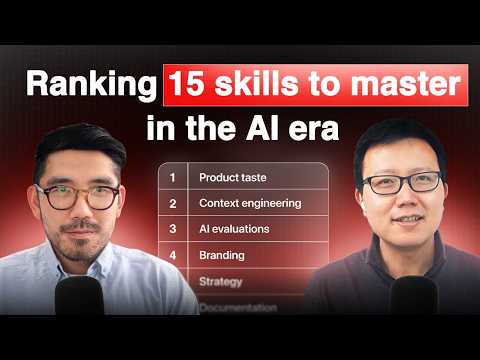
Brief Summary: In this video, Linear's Head of Product Nan Yu explores how AI is transforming the core competencies of product managers (PMs), which skills remain important, and what new capabilities PMs must develop going forward. Through Linear's real-world cases and the latest AI feature demos, it concretely examines the practical turning points and direction of future product development where AI and humans collaborate. This is essential viewing for anyone interested in PM, startups, or AI trends.
1. How Did Linear Become a Trillion-Won Company with Only 2 PMs?
Linear serves over 15,000 companies (including OpenAI, Ramp, etc.) with just two PMs while recording rapid growth. This was possible because engineers, designers, and other team members were skilled enough to naturally absorb parts of the traditional PM role. Additionally, they deliberately slowed PM hiring based on the judgment that "hiring more people for repetitive, mechanical work that AI can already replace is actually inefficient."
"We predicted three years ago that AI would replace a significant portion of this work. So we didn't hire more PMs just to manage and update multiple PRDs. Instead, we wanted to hire people with areas where they could grow independently."
Linear clearly demonstrates designing the organization around capabilities that will be essential in the future while proactively avoiding roles that will become unnecessary in the AI era.
2. Five PM Skills Still Important in the AI Era
While AI is replacing many tasks, there are still "human-only PM capabilities that AI cannot easily match." The speakers identify five, explaining each from personal experience.
1) Product Taste
Product taste is an intuitive ability to evaluate and improve user experience — a "sense" that cannot be explained by numbers or logic alone.
"People with good product taste instinctively know what's mediocre and what's great. And they can reverse-engineer the logic behind that instinct."
This intuition, developed through extensive product experience, stems from "emotional insight" that AI still struggles to replicate.
2) Branding
Both product branding and personal branding have become important. The ability to compress messaging into every small touchpoint, starting with the name is essential. The era where a PM's personal brand directly influences company fit is also emphasized.
"Even a service I've never used can be on everyone's lips because of good branding."
3) Ownership & Risk Appetite
PMs must take full responsibility for their outcomes while being willing to take risks to achieve the best results.
"You have to face failure, get back up — that kind of cycle. It's harder within an organization, but someone has to do it."
4) Stakeholder Management
At larger companies, you must constantly collaborate across departments, secure budgets and resources, and calculate "how far you can push your opinion."
"How much can you disregard others' opinions, yet when results are good, gather together for drinks and laughs — that calculation is the PM's job."
5) Emotional Intelligence (EQ)
Whether with customers or internal colleagues, the ability to truly understand and empathize with others' motivations, fears, and expectations is essential. Unlike AI, which only follows logic, this remains a uniquely human capability.
"If I were the customer, what would move me most? Emotional intelligence starts from genuinely feeling that."
3. PM Skills Being Disrupted by AI
The five PM tasks that AI will most rapidly consume are clearly outlined.
1) Strategy & Prioritization
Surprisingly, this is identified as the area AI will most disruptively replace. Traditional tasks like "drawing 2x2 grids and logically prioritizing" can be done faster and more broadly by AI.
"The old practice of locking yourself in a room to develop strategy is over. It's more efficient to feed data to AI and get strategic advice."
2) Data Analysis & Synthesis
Repetitive queries and data insight extraction — boilerplate work — are things AI does far better and learns quickly.
"In the past, being good at SQL alone was a huge differentiator. That gap is almost gone now."
3) Market Research
Surface-level research using non-primary sources that everyone already knows is much faster when delegated to AI.
"Even if a college consulting club offered to do research, nowadays it's just better to use AI."
However, deeply human relationships (long-term networking, inner-circle interviews, etc.) remain a differentiator.
4) Project Management
Granular task tracking, document updates, backlog management — detail-obsessed work is essentially "what computers can do."
"We used to praise the best PMs as detail-obsessed types, but now that description really fits AI better."
5) Summarizing & Documentation
Summarization, document consolidation, updates, and other repetitive diligence work is an area where automation is nearly complete.
"When receiving feedback and documenting it, just ask AI, bold the changes, and review — that's it."
4. Essential New Skills for Future PMs
PMs must now develop entirely new capabilities to "properly leverage AI and maintain expertise in an AI-human hybrid environment."
1) Context Engineering
It's not about simple prompt writing but about knowing "what information to provide, when, and how to get the best results from AI."
"When writing a document now, you need to assume the first reader is AI, not a person. For automation to work properly, AI needs to receive all key information without gaps."
2) AI Workflow Design & Agent Management
The ability to design workflows so AI works exactly as intended, managing AI agents like 'multiple assistants' is now required.
"PRDs and prompts are blending together now. Instead of people, AI reads documents and takes action. In practice, you can delegate dozens of tasks to agents at once."
The know-how of balancing "excessive detailed commands" versus "minimal instructions" for AI, and managing multiple agents simultaneously, has become an important real-world skill.
5. Linear's 'Product Craftsmanship' and Speed Rules
Linear, contrary to the common misconception that "Apple-style craftsmanship = polishing for a year before releasing something perfectly complete," follows its own "10% Rule."
"For every project, we create a working version within 10% of the total timeline and continuously improve through maximum real-user feedback. Data from the real market is far more meaningful than internal reviews."
Their Russian Doll structure of staged deployment — internal → selective beta → full beta → release — is also a major characteristic. This approach is revealed to be the secret to achieving both quality and speed with a small team.
6. Real-World AI Application and Automation Demos (Linear)
The live demos showing how Linear and AI tools like Claude are actually transforming work are the highlight of the video.
1) Customer Feedback Analysis Automation via MCP
Simply connecting MCP allows AI to directly find all customer requests and issues and automatically summarize analysis results.
"Anyone can do this with two clicks. Grab a coffee, and dozens of issues and feedback items are organized at a glance."
2) AI-Powered Ticket/Backlog Management and Issue Deduplication
AI agents suggest duplicate tickets, appropriate assignees, and automatic team assignments. "Backlog pruning," long considered PM busywork, is dramatically simplified.
"Now you don't have to wonder who to ask on Slack. AI recommends automatically."
3) Codebase Reading and Code Writing Automation
With simple commands to a separate AI coding agent, it reads actual code, searches documentation, and even adds features. Instead of reading code yourself or asking colleagues, AI systematically analyzes the codebase and generates Pull Requests (PRs).
"We used to ask engineers to 'check if this feature exists,' but now it's faster and more efficient to just ask AI."
4) Bulk Backlog Delegation
Selecting dozens of issues at once and delegating to AI creates a division of labor almost like "having a hundred PMs."
"You can Ctrl+A to select everything and delegate it all to AI at once. All results are recorded, and only one person needs to oversee it."
7. Linear's Future: An Operating System Where Humans and AI Work Together
Finally, Linear emphasizes that its goal is to become "the work operating system for the human-agent hybrid era."
"A system that unifies how employees work and how AI agents behave — that operating system is Linear's next step."
There is also a strong conviction that a "hybrid collaboration structure" — with sufficiently trustworthy automation and continued human accountability — will become the standard for the new work environment.
Conclusion
This video broadly covers the changing role of PMs in the AI era, future response strategies, and real automation case studies, delivering tremendous insight for "everyone interested in PMs, startups, and AI right now." To survive as a PM, one must develop emotional intelligence, insight, context utilization, AI utilization design, and agent management capabilities. "Repetitive mechanical work" will be handled by AI, while uniquely human sensibility and accountable leadership emerge as true value. Linear's case vividly demonstrates how AI adoption can practically transform the way we work, so it's recommended to start designing your own transformation strategy right now.