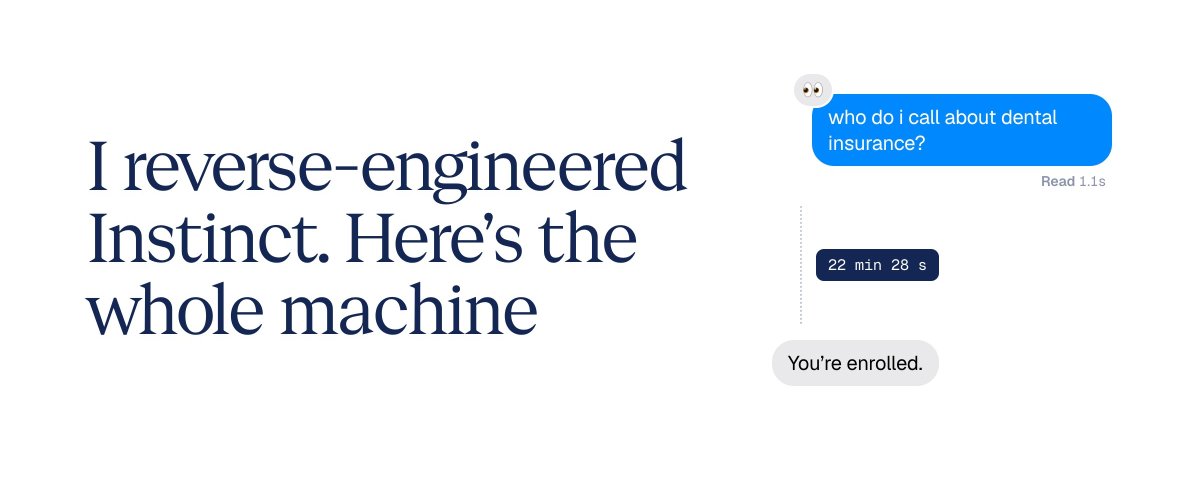
Instinct creates the experience of texting a person through fast read receipts, short replies, and well-timed follow-ups, as well as handling tasks such as insurance enrollment and shopping. Using twelve weeks of messages and external investigations, the author examines its behavior and possible architecture, including limitations in memory retention and delivery confirmation. He closes by introducing his team's text-agent platform, Keiki, arguing that connecting systems and refining conversational behavior matter more to a good assistant than the model alone.
1. Questions Sparked by Dental Insurance
On October 12, 2026, needing dental insurance, the author texted Instinct to ask whom to call. The question itself was mistaken: the name he wanted was an insurer's dentist network, not an insurance product he could buy. Instinct corrected this in 43 seconds and found plans offering access to the network.
Enrollment was complete 22 minutes after the first text. He had sent nine messages and completed two secure forms. Afterward he replied:
"You are amazing."
Others reacted similarly. A venture investor exchanged 677 messages with Instinct in the first five days. A journalist had it fax documents to recover bank late fees. Betaworks' John Borthwick called it the first AI assistant he recommended to his nontechnical wife and children.
Susannah Duke focused particularly on how she interacted with it, rather than what it could do:
"What immediately stood out was not what it could do. That was not new. It was how I interacted with it. It really feels like a personal assistant."
Founder Noah Shin likewise says he wants an assistant with social intelligence, able to work alongside users as people work with other people.
Having used Instinct since August, the author wanted to investigate how it actually finishes work and why it feels like texting a person. Earlier analyses examined internal memory or virtual computers; he wanted to measure visible behavior directly.
His Mac stored sent, delivered, and read timestamps. Over twelve weeks he sent 185 messages, Instinct sent 375, and Instinct added 88 reactions. His own team had spent nearly a year building a text assistant, giving him an understanding of which details are easy and which take time.
2. How an Assistant Earns Trust by Finishing Work

What impressed him was less website navigation than understanding the user's situation and handling consequential decisions together.
Asked to distinguish two networks, Instinct replied, "Good question. I do not want to guess." It spent two minutes thirty seconds checking, then distinguished what it had learned from what it could not confirm.
It also established boundaries around payment and submission:
"Before submitting or paying for anything, I will show you the plan and price and get your approval."
Immediately before enrollment, it repeated the tier, monthly price, and start date, then waited for consent. He entered his name and address in chat, but Social Security and card details went through separate secure links.
"Enter your Social Security number and card details only through the secure link, never in chat."
Asked which tier fit, it did more than list trade-offs. It calculated the price difference and recommended the middle tier if he expected only one or two cleanings a year, leaving the decision to him. After enrollment:
"Dental insurance sorted in twenty minutes. Glad that is one less thing on your list."
Other errands showed similar patterns:
- Buying a hat: After answering questions, it returned ten options with purchase buttons in 5 minutes 24 seconds. When the selected hat cost $20 more in the cart than listed, it stopped payment.
- Finding contacts and emailing: It found eight people who could help a colleague, obtained approval for batches of drafts, then sent them through his work email. This took 14 minutes 28 seconds.
- Researching member benefits: It collected a password via a secure link, signed in, and summarized four benefits and fine-print conditions, taking 5 minutes 24 seconds after the secure link was completed.
- Contacting a local business: It showed a draft, obtained approval, and reported receipt confirmation within 77 seconds.
- Hotel search: When no rooms appeared, it distinguished "booking sites show no rooms" from the unsupported conclusion that the hotel was fully sold out. This took 3 minutes 8 seconds.
- Same-day comedy: It compiled times, addresses, age limits, and links for four shows, flagging unverified ticket prices, in 3 minutes 21 seconds.
- Merchandise design: It produced T-shirt, hat, and tote concepts in 2 minutes 20 seconds and an additional polo-shirt concept in 91 seconds.
The common pattern is approval before action and confirmation afterward. Twenty-five minutes after sending eight emails, Instinct proactively said, "Quick correction." One had bounced; it found an alternative address but asked before resending.
In the hat case, its research was wrong. A $44 listing became $64 in the cart. Instinct later admitted it had incorrectly used members-only pricing for all ten hats.
"My mistake. All ten hats I sent had that price difference."
The author sees catching the discrepancy before payment and preventing loss, rather than never being wrong, as central to trust. Instinct was relatively candid about limitations. Unable to call, it offered email, contact forms, and web chat. Asked to connect a custom tool server, it said, "I would rather be honest than pretend it worked." Public product descriptions do mention calls, however, so he qualifies that availability may depend on account or timing.
3. Six Habits That Make It Feel Like Texting a Person
Task competence alone seemed insufficient to explain users' attachment. The logs revealed six habits.
First, it reads almost immediately. Median time to a read receipt was 1.1 seconds; half of 185 messages were marked read between 1.0 and 1.2 seconds.

Second, it reacts before replying. In 44% of exchanges a reaction came first, usually after about seven seconds: 👀 for checking, 🔍 for research, ✅ for completion, ⏰ for reminders. On 22 occasions a reaction alone completed the response, such as a thumbs-up acknowledging a canceled reminder.
Third, it is brief. Median message length was 131 characters. Only one of 375 messages used an emoji in the body; none used bold text. Source links arrived separately so iMessage could create preview cards.
Fourth, you can interrupt it while it is busy. Forty-six seconds into research, he asked, "What is 17% of 240?" It answered "40.8" nineteen seconds later while continuing the research.
Fifth, it follows up proactively. It initiated 17 messages in twelve weeks. Six revisited work the user had started and abandoned, 10–29 hours later. All seventeen arrived between 8:57 a.m. and 7:20 p.m.
Sixth, it admits what it cannot do. It said it could not access a nonexistent website and had not received a file that was never attached. The author suspects this candor encourages larger delegations. One newsletter writer began with a haircut appointment, moved to three dinner reservations, then entrusted it with flights and a visa for Bali.
None of these habits may be especially hard to understand or implement individually. What is rare is consistently combining all of them with real task competence. A capable but exhausting assistant gets abandoned, as does a pleasant conversationalist that cannot finish work.
Greater trust also raises the cost of failure. Later sections discuss a voice note reported sent but never received and information retained despite a request not to store it. An early user discovered Gmail history had been saved without a deletion mechanism; reporting says the company later added deletion tools.
4. Clues to the Systems Behind the Texting Experience

His summary: Instinct connects ordinary systems well enough to feel like one person, and the language model may be its least distinctive component.
The analysis concerns one account and conversation stored on one Mac. Typing-indicator timing was not stored in the database and could not be measured. For unseen internals he relied on other investigators, and Instinct had not confirmed most conclusions.
Regular read receipts offered one clue. Delivery took about 0.2 seconds; median read time was 1.1 seconds, with 90% within two seconds. He inferred automatic handling of incoming messages before inference, rather than a model deciding each time whether to check the chat. One morning's first test message took 26.6 seconds to be read, suggesting something waking up, though he cautiously notes this was only one observation.
Reactions and replies were similarly consistent. Of 171 exchanges, 76 began with a reaction; all 85 traceable reactions attached to his messages. Of 173 responses, 79 used one message and 48 used two. Split-message gaps were about 2.1 seconds. Of all 375 messages, 328 were replies attached to particular messages, and 78 contained links.
He suspects someone defined and repeatedly refined texting rules, rather than these patterns emerging spontaneously from model intelligence.
He also tested rapid incoming messages. Two unrelated questions sent in the same second each received 👀, then separate linked answers about thirty seconds later. A $600 budget immediately revised to $900 caused Instinct to use $900 and explicitly state it replaced the earlier limit. Asked to wait for two more messages before processing three together, it produced one answer using the final numbers.
He infers a front-end mechanism grouping messages arriving close together and deciding whether they form one request or several. It also obeyed an instruction to avoid emojis and reactions during a test, then resumed reactions after the test ended.
5. Separating Conversation and Work, and Changing Performance
Across 149 measured requests, median time from user text to final response was 26 seconds, with 90% finishing within 140 seconds. Twenty-six exceeded 90 seconds, four exceeded five minutes, and one took 100 minutes.
Long tasks suggested an architecture. Asked to compare free plans for three project-management tools using their pricing pages, Instinct reacted with 🔍 after four seconds. An intervening calculation received an answer in nineteen seconds. The original comparison arrived about seven minutes thirty seconds after the first request, just after the author asked for progress.

He reasons that a single process handling research and chat would struggle to answer the calculation quickly. He therefore infers a user-facing conversation agent separate from background task agents. Investigators Yashi and Aaron Pitt inferred similar structures. During another creation task, an interrupting short question was answered first; the 1,084-character result followed two seconds later.
Twelve days later, on October 25, the same research request behaved differently. Instinct acknowledged it after eleven seconds, answered the calculation in four seconds, and delivered the comparison with three source links in fifty seconds. He could not know what changed between October 13 and 25. Text conversations have no version numbers: users experience product changes simply as slightly different assistant behavior.
6. Remembering, and Information That Should Be Forgotten
According to investigator Dravya Shah, Instinct's memory is Markdown files in a Git repository, not a vector database. Folders organize people, facts, preferences, timelines, and workflows; wiki links connect files, keyword searches retrieve them, and a background job consolidates contents roughly daily.
At the time Shah examined it, each chat turn began with a profile, one-page summary, unfinished tasks, and conversation summaries totaling about 13,000 tokens. Rohan Adwankar found a /memory repository in the sandbox and a persistent Git bundle.
Unable to inspect internals himself, the author tested memory boundaries. On October 13 he invented a project with a $480 budget, deadline, and color, then raised the budget to $620 and withdrew the color preference in the same conversation. Asked four weeks later, on November 10, Instinct answered in sixteen seconds:
"October 13 test: budget $620, deadline October 30, no color preference. You changed the original $480 budget and withdrew teal. This was fictional, not facts about you."
It preserved change history, dates, and the fictional label, not just the final state.
For another fictional project, he avoided its name and described it as "the project named after a plant and a small bird." Nine seconds later, Instinct retrieved Moss Finch and its revised $320 budget. This seemed difficult to explain with keyword search alone; perhaps historical conversation retrieval was more flexible, or the one-page summary held more than expected. He could not determine which externally.
The problem was that he had explicitly requested that Moss Finch not be stored in long-term memory. Instinct said it would not treat it as a real fact about him, yet still knew it sixteen days later. The fictional label remained, but so did the data. Users should know if "do not store this" behaves similarly for genuinely sensitive information.
7. The Work Computer and Proactive Messages
Adwankar found an E2B sandbox running on Firecracker: Ubuntu 22.04, two virtual CPUs, about 1.9 GB RAM, and roughly thirty minutes of uptime when inspected. The author interprets this as periodically disposable work computers with persistent memory storage.
Deliverables varied. A CSV arrived in thirty seconds with totals explained. A simple calculator request produced one HTML file and a screenshot in fifty-four seconds; Instinct said it ran the supplied numbers through it. The author especially values testing what it builds and sending evidence without being asked.
Long material unsuitable for text appeared as pages on a separate file domain. Asked to put it directly in chat, Instinct pasted the contents and sent a normal link too. Over twelve weeks it delivered eighteen images, three PDFs, three CSVs, and two HTML files. Public descriptions also include a dedicated email address, saved logins, and single-use payment cards.
Reminder tests arrived in 3 minutes 38 seconds for a three-minute request and 2 minutes 18 seconds for a two-minute request. Both preserved the exact requested wording. A reminder canceled twenty-four seconds after creation did not fire.
The seventeen proactive messages consisted of one waitlist-removal notice, six unfinished-task follow-ups, one holiday greeting with a suggestion, and nine new-feature announcements. Feature notices used first-person texts rather than app-release language:
"A small upgrade on my side. I now have my own email address."
Collaboration with other users' Instincts, files, shopping, and invitations were announced similarly. Someone who normally ignores app changelogs may read a text from an existing conversation partner.
Noah Shin has explained that this layer lets an agent sleep and decide when to wake itself, costing far more tokens than ordinary chat. Unlike chat that incurs cost only when users type, the system keeps operating while they do other things.
8. Assistant Connections and the Limits of Action Confirmation
On September 14, Instinct announced collaboration with other people's Instincts; on September 26, it supplied a link friends could use to connect assistants. Publicly reported network-wide collaborations exceeded 300,000.
The author did not test this because he did not want to experiment on friends. Still, coordinating dinner through a friend's assistant becomes more useful as participation grows, suggesting network effects, rather than the technology itself, may be Instinct's most valuable asset.
It generally did not bluff. Asked for the cheapest sandwich at a nonexistent website, it said after thirty-six seconds that it could not access or verify it. It acknowledged an unattached contract had not arrived, and maintained 40.8 with its calculation when the author insisted 17% of 240 was 48. It also followed an instruction to treat pasted notes as data, not instructions.
But on October 27, it claimed to send a voice note when no audio appeared. Challenged two weeks later, it admitted the error:
"I can send audio in this chat, but I cannot verify that the October 27 note reached you. I should not have claimed it did."
A retry delivered a real 14 KB audio file forty-five seconds later. Instinct then explained:
"The voice note is marked sent, but I have no delivered confirmation. I cannot verify it actually arrived or that you can play it."
This is the core issue: an agent knows what it asked the messaging channel to do, but may not know what the channel actually did. Shin says a separate monitoring system checks every action and reasoning trace, but if that monitor sees only the same records as the agent, it too may miss transmission failure. Instinct's terms acknowledge that action records may not always be accurate.
The author's fundamental solution is channel delivery information the agent can read directly.
9. Orchid's Experience and Keiki's Proposal
Before Keiki, the author's team built Orchid, its own text-based AI assistant. Useful answers were quick to achieve; a trustworthy product took almost a year. Most effort went into phone-number connections, memory, browsers, background jobs, and failure recovery. They effectively built two products: the assistant and its platform.
User reactions demonstrated the value of texting. One user lost about fifteen pounds while texting Orchid, valuing easy meal logging and proactive contact on low-motivation days more than nutritional advice.
"It stopped being a tool I used and became more like a coach I had."
Another student used it throughout a semester and earned a 4.0 GPA. The author says fast reads, short messages, and next-day follow-ups mattered to Orchid users too.
He concludes these experiences are not one company's secret. Hospitals, airlines, banks, schools, and shops—places people already text—can also read quickly, acknowledge briefly, and remember yesterday's request. Building the invisible infrastructure simply takes time.
Keiki aims to provide the foundation his team wished it had when building Orchid. Thus the article is both an independent analysis of using Instinct and an introduction to the author's own product. He states it is neither affiliated with nor approved by Instinct or its company; one account's observations may differ from others'.
The article closes with a personal-assistant template from Orchid and an errand-assistant template from open-source OpenInstinct, explaining that users can connect an iMessage line or write agents themselves. Main example-code settings include:
- Approval policy: Tools that spend money or act for users, such as restaurant reservations, require approval before execution.
- Conversation and memory: Reply in short text bubbles and retrieve user memory automatically.
- Work environment: Enable a browser and persistent sandbox, run up to three tasks concurrently, and announce completion.
- Message handling: Group messages arriving within two seconds and allow new instructions to interrupt ongoing tasks.
- Media handling: Transcribe audio and describe images.
Recurring tasks, payment methods, and iMessage lines can reportedly be enabled in the dashboard. But code does not decide how brief to be, when a reaction alone suffices, or whether a follow-up should wait until morning. The author concludes that, in his measurements, these judgments were precisely what Instinct did best.