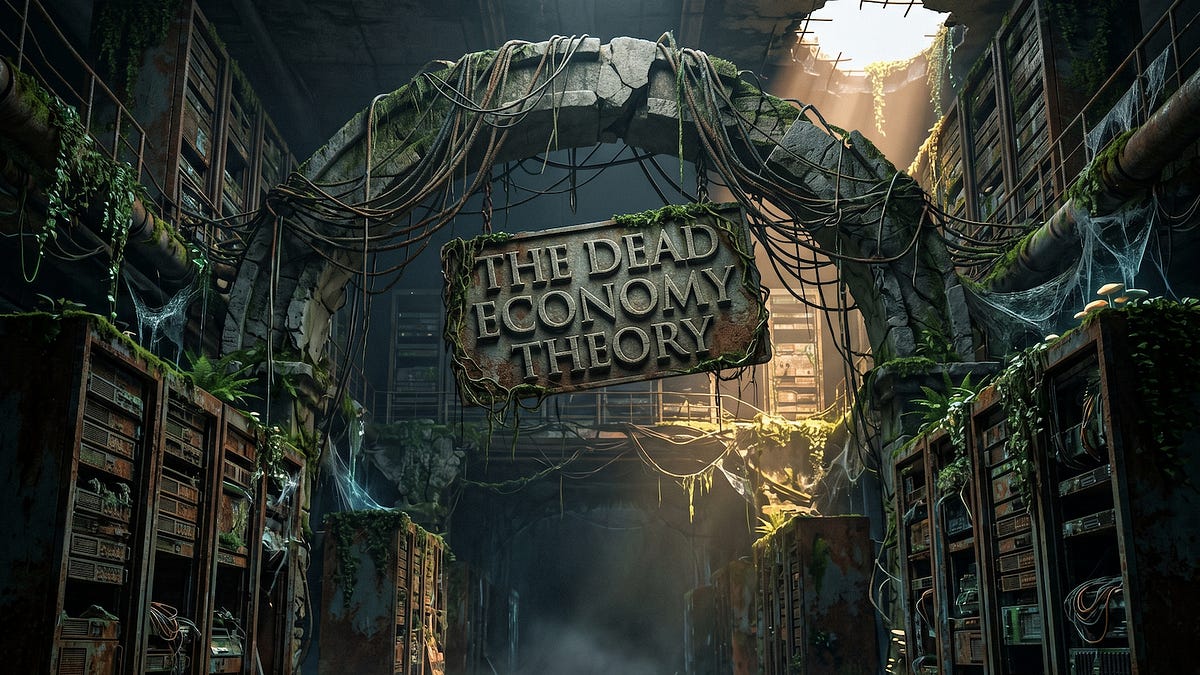
This essay carries a serious warning about the socioeconomic fallout that the rapid advance of artificial intelligence (AI) will bring. Following the "dead internet theory," it proposes the concept of a "dead economy theory," emphasizing that AI may replace the labor market, shake the foundations of democracy, and cause social instability. It examines in depth the bleak future that could result from the massive investments of AI companies, the large-scale layoffs they cause, and the absence of any social response.
1. The Rise of the Dead Internet Theory and the Dead Economy Theory 🤖
Have you ever heard of the "dead internet theory"? It's the theory that most of the content we encounter online is now generated by bots, and that humans have been reduced to a small audience consuming machine-made noise. Last year, in 2026, more than half of the new content posted to the internet was reportedly made by AI. We're still scrolling, but what we're looking at is a performance the machines put on for themselves, and we fail to realize that we are not the real audience of that performance. 😥
This alone is serious enough, but the author wants to talk about something worse: the "dead economy theory." He offers a critical view that we were duped by the promise of a hyper-connected age into letting physical spaces decay, and that in the end the digital public square became a giant billboard—a world read and made by bots.
2. The AI Industry's Numbers Problem and Labor Displacement 💰
Enormous investment is currently being poured into the AI industry. Investments in major AI companies such as OpenAI, Anthropic, Google DeepMind, Meta AI, and Microsoft already amount to hundreds of billions of dollars and are expected to reach trillions within the next decade. OpenAI alone is valued at over $800 billion, and Anthropic, which has yet to turn a profit, is said to hold a similar level of value. To justify such enormous value you need a correspondingly huge market, and the author says only one market is large enough to bear that scale.
"The only market that big is the entire global labor market."
At AI industry investor presentations, AI agents are promoted as "doing the work of 10 analysts," which means labor displacement. Soft language like "copilot," "assistant," and "augmentation" is just marketing; the financial model underneath demands the elimination of human cost centers at civilizational scale. The author strongly argues that if AI can't perform these roles, these companies will become the most overvalued assets in the history of capitalism.
AI companies are creating their own benchmarks to back up their claims. OpenAI's GDPVal benchmark measures model performance across 44 occupations, and the AI Productivity Index evaluates AI models on four professions: investment bankers, management consultants, lawyers, and primary-care physicians. This can be seen as a clear targeting of the professions. One OpenAI evaluator even told The New York Times that AI models show "a win rate of over 80% against human experts" on tasks they couldn't handle just months earlier.
3. The AI Layoff Trap in Three Stages 💸
Assuming AI can replace human labor cheaply, as advertised, what happens? The author explains the "AI layoff trap" through the following three stages.
-
First stage: A company adopts AI and replaces a significant portion of its workforce. Costs fall, margins widen, and the stock price rises. 📈 For example, when Block's Jack Dorsey laid off nearly half his staff in March 2026, citing AI coding agents, investors pushed the stock up 25% in after-hours trading. The market rewarded the elimination of human labor as an immediate transfer of value.
-
Second stage: Laid-off workers lose their income. They cut spending, and the businesses they used to patronize experience falling revenue. Some businesses also adopt AI to cut costs, deepening this labor displacement. Consumer demand across the economy ends up contracting. 📉
-
Third stage: The company that saved money by laying off workers realizes that its customers were, in fact, other companies' workers. Revenue growth stalls, and the AI subscription it thought was an efficiency investment ends up destroying its own market. 🤯
Wharton professors Brett Hemenway Falk and Gary Tsoukalas named this the "AI layoff trap." In a competitive market, a firm that automates fully enjoys the cost savings from labor displacement but bears only part of the impact of falling demand. As a result, firms are driven to automate beyond the socially optimal level, leading to a prisoner's dilemma that ends in collective ruin.
What's interesting is that layoffs sometimes happen even when it isn't yet certain AI can do the job properly. Former OpenAI economist Zoe Hitzig pointed out that "when CEOs say they're cutting jobs because of AI, others feel they have to do the same. These dynamics can drive change faster than efficiency dictates." This can be seen as a kind of collective action carried out in the name of innovation.
In the past, Henry Ford understood that workers had to earn enough to buy his cars. But the AI economy expects cars to keep selling even as it eliminates workers. Yet because software has near-zero marginal cost, AI's entire value proposition lies in the elimination of human cost centers. In other words, the product is the elimination of the customer base. 🤦♀️
4. The Productivity Debate and the Difference from Past Industrial Revolutions 📊
Optimists say AI is just a productivity gain. There has been automation before too—agricultural employment fell from 90% to 2%, yet civilization carried on. MIT professor David Autor points out that about 60% of today's jobs didn't exist in 1940, arguing that new technology creates new jobs.
But the author warns that we must not confuse observations of the past with laws of nature. The agricultural transition took 140 years, and it took 70 years for wages and employment to recover after the Industrial Revolution, as Oxford professor Carl Benedikt Frey points out. During that period wages stagnated, the labor share of income fell, profits surged, and inequality deepened, provoking social turmoil such as the Chartist movement.
"Most economists would concede that technological progress can cause adjustment problems in the short run. But it's rarely mentioned that the short run can become a lifetime."
The AI industry's timeline is far faster than this. Bharat Ramamurti, former deputy director of the National Economic Council, warns that while the "China Shock" that caused US manufacturing job losses unfolded over several years, AI-driven change could happen in just two years.
Past automation replaced individual tasks within specific jobs, but general-purpose AI threatens cognitive labor as a whole, across every industry, all at once. In 1983, economist Wassily Leontief foresaw this situation by comparing human labor to the horse. Just as the US horse population fell 88% within 60 years of the internal combustion engine's arrival, human labor too could meet the same fate once it becomes economically inefficient. 🐎
Daron Acemoglu, winner of the 2024 Nobel Prize in Economics, found that from 1987 to 2017 the "displacement effect of new technology far outweighed its productivity and reinstatement effects." New jobs were not created as fast as new technology displaced jobs. He criticizes AI as "excessive automation," noting that it eliminates jobs and imposes enormous social costs without greatly reducing production costs.
"If the customer is exactly the one you eliminated, who becomes the customer?"
5. The Political Crisis of the AI Era and the Dissolution of Democracy 🗳️
An economy that doesn't need human labor will trigger a kind of political crisis that democratic systems have never faced. Democratic governance rests on a long-standing bargain in which the governed provide the rulers with what they need (labor, taxes, military service, consumption). This dependency was the source of democratic leverage.
But what happens when you remove labor from this equation? Value is created by AI systems owned by a handful of companies, and because these companies are skilled at tax optimization, all the fiscal mechanisms of democratic governance will dry up. The tax base weakens, collective bargaining loses meaning (an employer that doesn't need employees won't negotiate with them), and consumption that depends on labor income contracts.
By severing the last link between capital accumulation and the need for human labor, AI will accelerate Piketty's 'r > g' (the phenomenon where the return on capital exceeds the growth rate of the economy). Some analyses say that without redistribution, almost everything will accrue to today's wealthiest people.
Moreover, the transformer architecture, large-scale training methods, and semiconductor advances that made AI possible were all research outcomes funded by public or quasi-public money—universities, DARPA, national labs. The public took the risk, but private companies took the reward. As professor Mariana Mazzucato pointed out, "AI risks becoming yet another engine of rent-seeking rather than value creation." 😱
Anthropic CEO Dario Amodei said publicly that "the balance of power in democracy rests on the premise that the average person has leverage by creating economic value. If that's gone, things could get a little scary." Even an AI company's CEO admits that the technology he's building will undermine the material foundation of democratic governance.
In 2009, Peter Thiel argued that freedom and democracy are incompatible, because he saw democratic systems creating friction for the ability of "exceptional people" to change the world through regulation, redistribution, and accountability. For those who regard AI technology as the most transformative technology in human history, democratic oversight is seen as an obstacle.
This view is spreading further. AI companies support Trump and the MAGA (Make America Great Again) movement, judging that authoritarian governments are better customers for this technology than democracies. A democratic government that uses worker-replacing AI faces electoral consequences, but an authoritarian government has no such constraints and can even gain the added benefits of surveillance and control on top of economic efficiency. 🇸🇦🇦🇪🇸🇬
6. Social Instability and "Deaths of Despair" 💔
Every proposed solution to mass AI unemployment treats it as a resource-distribution problem—universal basic income, retraining programs, a leisure economy, and so on. The assumption is that if you give people money, they'll find meaning in hobbies and community. They'll paint, garden, and finally write that novel.
But the author dismisses this as "ahistorical nonsense." We already know what happens when economic function disappears from a community. Anne Case and Angus Deaton's "deaths of despair" research shows rising death rates from suicide, drug overdose, and alcoholic liver disease among less-educated populations that previously depended on manufacturing. This is not merely a poverty problem—it's tied to the loss of a sense of economic purpose, and the loss of social status and hope for the future.
Molly Kinder of the Brookings Institution warns that the losers of the AI era will be no different from the workers of past manufacturing cities. She told The New York Times, "The economy grew enormously and prices fell, but there were clear losers," and that this time the losers won't be confined to manufacturing cities in the Midwest.
"I interviewed many college students who are terrified about what the future means, and their stories are exactly the same as the blue-collar workers of the Midwest."
Guy Standing's concept of the "precariat" shows how an unstable economic situation weakens social cohesion. Forty years of neoliberal policy and digital acceleration already created this class, and AI acceleration will now include even highly educated professionals who thought they were safe.
Piketty argues that basic income doesn't solve the fundamental structural problem. People don't simply want money—they want work and purpose.
Anthropic's own research reported a phenomenon more serious than simple AI job displacement: "deskilling." Junior engineers who relied on AI coding agents didn't even finish tasks much faster, and when later asked, they understood the work less well. The technology is degrading the expertise of the next generation of workers while simultaneously threatening their jobs. 😟
This situation could cause social instability so vast it would dwarf the current populism era. Tens of millions of people are of productive age with no economic function and no clear path, and they know full well that the people who made them this way are the wealthiest in human history. Professor Joseph Stiglitz noted that AI will hit "repetitive white-collar jobs" such as accountants, analysts, junior lawyers, radiologists, and software developers. These belong to the professional class that forms the backbone of political stability in advanced democracies.
7. A Critique of the Philosophical Foundations of AI Technology 🧐
Silicon Valley's mindset often takes philosophical concepts like Nietzsche, effective altruism, and longtermism seriously and believes itself to be at the frontier of human thought. But the author bitingly criticizes them as operating "at the level of a sophomore intro-to-philosophy class, with enormous confidence and no awareness of counterarguments."
He points out that Nietzsche's concept of the Übermensch is being misused to justify exceptional founders. Nietzsche was diagnosing a crisis of meaning after the collapse of metaphysical certainty—he wasn't writing a management philosophy for people who got rich off ad tech.
Effective altruism, he says, is nothing more than a reinterpretation of utilitarianism by people who never properly understood Bernard Williams or Derek Parfit. It overlooks the fact that applying naive expected-value calculations without constraining principles can lead to terrible outcomes. He cites the Sam Bankman-Fried affair as an example of how such a moral framework fails.
Longtermism, the philosophical engine of AI acceleration, is likewise dismissed as Parfit rehashed without rigor. The claim that we must optimize the welfare of trillions of hypothetical future beings justifies present costs, but because it has no constraining principle, it is easily dismantled. In the end, the author criticizes it as merely a tool to justify concentrating power in the hands of a few who have decided for themselves that they are best suited to manage the future of the future species. 😒
The rationalist community rediscovers Bayesian epistemology and treats it like a revelation, but seems unaware that the philosophy of science has dealt with these issues since the 1920s. They build epistemology from first principles without reading philosophers like Kuhn, Lakatos, and Feyerabend, and then use it as the intellectual building block for decisions affecting billions of people. This can be seen as the Dunning-Kruger effect at scale.
The economic poverty is the same. Acemoglu estimated that only 4.6% of tasks in the current economy are cost-effective to automate with AI, and that AI's total productivity impact over the next decade is only 0.66%. This differs greatly from the forecasts of institutions like Goldman Sachs and McKinsey. According to a 2025 survey, more than 90% of companies reported no measurable effect on employment or productivity despite $250 billion in AI investment.
"AI is everywhere, except in the incoming macroeconomic data."
This is a criticism that they are deciding what the future looks like and spending other people's money to make it real.
8. Silicon Valley's Hypocrisy and Its Disconnect from the Public
In April 2026, OpenAI published a white paper titled "Industrial Policy for the Age of Intelligence," putting forward radically progressive proposals such as a 32-hour workweek, higher taxes on corporate and capital gains, and a "public wealth fund" that would give every citizen an equity stake in AI companies. 😮
But at the same time, OpenAI's president backed a super PAC that spent more than $2 million on an ad campaign against Alex Bores, a New York legislative candidate who proposed introducing safety regulations on large AI developers and imposing an AI tax to pay Americans directly. They acted one way in public and another in private.
OpenAI also removed the profit cap that limited investor returns to 100x the initial investment, and OpenAI's chief lobbyist Chris Lehane systematically deprioritized research that could produce internally unfavorable results.
"When someone wrote a paper on the negative aspects of AI, he said, 'We won't present a problem until we have a solution.'"
"We want to do applied physics, not theoretical physics." (Lehane's words)
This means they tell not the truth but the story that favors them. An undergraduate who misreads Nietzsche gets a bad report and a C, but a billionaire who misreads Nietzsche builds a political philosophy on that misunderstanding and funds it with money equivalent to a small country's GDP.
The author flatly states that these people "are not serious people." They are serious only about accumulation and winning—not about the important questions, such as "what we owe one another, what makes life worth living, and what becomes of civilization once you remove the material foundation of human autonomy." 🧐
9. Present Sacrifice and Future Benefit: Albert Camus's Warning ⚠️
Albert Camus broke with Jean-Paul Sartre and the French Left over the question "Can people alive today be reasonable sacrifices for a better future?" Sartre and the Marxists said history has direction and revolution demands sacrifice, but Camus said it does not. His argument was that any system of thought that subordinates living people to a hypothetical future commits a fundamental moral error.
The structure of the AI-acceleration argument is the same. The technology will ultimately benefit humanity (trillions of future humans, lives of unimaginable abundance and meaning), and therefore present chaos can be endured. The logic holds that the unemployed, the devastated communities, the erosion of democratic leverage, and the concentration of power in a few private actors who exempted themselves from the consequences of their own project are "regrettable but necessary." 😩
A startup called Mechanize set out to achieve "the complete automation of the economy," arguing that "the only real choice is whether we rush this technological revolution ourselves, or wait for others to start it without us." It uses technological determinism as moral absolution. The future is fixed, and our only choice is who builds it first—so nothing we do in the process needs justification. The author criticizes this as the same argument made by the Marxists who sent their opponents to the gulag.
Camus argued that the person in front of you is not an input to a utility function. Their suffering is not redeemed by a future state they will never see. Their dignity is not something to be negotiated against expected outcomes. The person who exists now—the one about to lose their job, the one supporting a family, the community that depends on a functioning local economy—is the unit of accounting. Not abstract humanity, nor the trillions of future beings that longtermists invent for their calculations.
The moment this conviction is abandoned, the door opens to every form of rationalized cruelty that the 20th century, through hundreds of millions of lives, taught us to reject. The entire AI-acceleration project is premised on abandoning precisely this conviction. It demands that present-day people bear the cost for future benefits to be distributed to people who don't even exist. And all of this is managed by a few self-appointed elites who have insulated themselves from the consequences of their own project.
Sam Altman's "universal basic compute" proposal admits that the future he's building requires a new distribution mechanism, but it is also a proposal that he himself become the one in charge of that distribution. The author criticizes this as feudalism with better branding.
10. The Danger of "Mediocre AI" and Social Responsibility 🚨
Rather than digging deep into whether AI can do everything companies claim, the author emphasizes that even if AI isn't revolutionary, it can be destructive. Acemoglu's key finding is that "so-so automation" can cause large-scale labor displacement while delivering productivity gains that fall short of expectations. In other words, it's only mediocre at replacing workers, but cheap enough that companies can aggressively adopt it to push up their stock price.
The worst outcome may not be superintelligent AI. Rather, it may be "mediocre" AI that companies aggressively deploy to chase stock prices because of quarterly incentives. This can result in eliminating even jobs that AI can't do properly.
"Among the people with the power to shape this transition, has anyone seriously considered what it means for people alive today? Hell, no."
The opportunity to change the answer to these questions is not infinite. Regulatory capture is already underway. In the first three quarters of 2025, AI-related investment accounted for 39% of US economic growth, so the federal government acquired a vested interest in sustaining the AI boom. Regulators and the regulated are converging on a single set of interests.
The interventions that could change this situation are already known. Examples include public ownership of AI infrastructure, vigorous antitrust enforcement, and a genuine tax system for automated labor. Professor Branko Milanović has directly proposed spreading capital ownership more broadly and taxing top capital income more aggressively.
These solutions are not technically difficult. All that's needed is functioning democratic institutions with the will to challenge the wealthiest companies in human history. But the companies that ought to be taxed are spending millions of dollars to bring down the politicians who make such proposals.
A dead economy is not an economy where nothing happens. A great deal will happen. Even GDP can rise, since AI-related investment is already propping it up. A dead economy is one where a great deal happens, but none of it needs you. It's an economy where civilization's productive capacity is captured by a system in which you have no equity, no leverage, and no vote, and the people who built it tell you that you shouldn't have a say. In private they warn of the consequences and in public they preach optimism, publishing white papers demanding radical redistribution while funding super PACs to destroy the politicians who propose it. It's a bitter reality indeed. 😔
Conclusion 🚀
This essay warns that AI can bring fundamental change to social, economic, and political systems, beyond mere technological progress, and expresses deep concern especially about the large-scale displacement of human labor and the resulting potential for social and political instability. It delivers a powerful message that, rather than passively accepting the future AI will bring, we need serious discussion and policy responses starting now. This is a moment that calls for all of us to reflect on how to protect human dignity and social value.