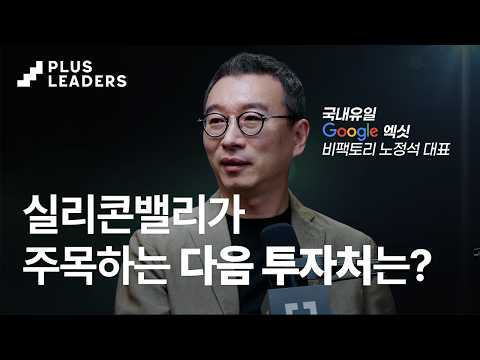
This video is an interview with Jungseok Roh, CEO of B Factory, who is often called "the serial entrepreneur Silicon Valley loves." Having founded seven companies, sold the first Korean startup ever acquired by Google, and later sold another company to Tapjoy, Roh defines business as the process of placing points of success on a line of failure. In this interview, he shares deep insight into the essence of business, changes in organizational structure, and the future of the bio industry in the fast-changing AI era. He also explains his investment philosophy and his view of the most important asset in life.
1. Jungseok Roh's Serial Founder Journey 🚀
The video begins with Roh recalling decisive moments he has experienced in business. He says that when running a business, there are moments when you face the desperate feeling that "somehow, I have to keep this company alive." He compares it to a war movie where, even though you know you might die, you pick up a weapon and step forward with your teammates. In such moments, everything secondary disappears and only the essence of the business remains. He describes it as a desperate bell ringing: "We have to get this done."
"Business is placing points of success on a line of failure. That is because every single day is a continuation of failure."
Roh introduces himself as a "startup master" and "serial entrepreneur." He explains that while most founders experience only one or two of IPO, M&A, and failure, he is one of the few people who has experienced all three. 😃 In 2008, he sold Tatter & Company, founded in 2005, to Google for hundreds of billions of won, making it the first Korean startup acquired by Google. He recalls that Google wanted to expand its search share in Korea and break through the fortress of Naver and Daum, and it judged that Tattertools and Tistory, the blog software created by Tatter & Company, were important for securing high-quality content. Later, he also had consecutive successes by selling 5Rocks to the U.S. mobile advertising platform Tapjoy.
His current company, B Factory, manufactures and sells cosmetics. Roh explains his own know-how for finding business models in entirely different fields such as search, advertising, and cosmetics. He basically sees himself as a software entrepreneur, and says he creates strong differentiation by multiplying software capability with other fields. He has combined software with content, games, VR, and various technologies, and this time he combined it with cosmetics. He says he started the cosmetics business after noticing that not only cosmetics but also the food we eat, health supplements, and medicine are mostly hydrocarbon compounds, which led him to think he should connect his work with health-related businesses.
He says he has developed a habit of digging into, researching, and learning any topic that interests him. Because his first job was founding a company, instead of digging deeply into just one specialty, he repeatedly became a "universal executive" who had to learn, understand, execute, and experiment quickly across roles such as CFO, marketer, product developer, and engineer. In the past, he may have been criticized as scattered and unable to focus on one well, but in an era changing as rapidly as today's, he emphasizes that the most suitable kind of person is one who adapts quickly, experiments quickly, builds quickly, and sees the world quickly.
2. The Decisive Moments That Separate Success and Failure in Business 🎢
When asked about decisive moments that separate business success from failure, Roh answers that business is a series of days when you think, "If this goes wrong, it is over."
"Business is placing points of success on a line of failure. Every single day is a continuation of failure."
He says founders face countless problems every day and keep solving them, until for one very brief moment they place a point of success such as selling the company, going public, landing a major contract, or seeing revenue explode. After feeling the reward of that moment and returning to everyday life, the line of failure begins again.
Roh emphasizes that the decisive moment in business is when you feel, "We have truly reached the end. There is nothing more we can do. If this goes wrong here, we may really fail." He recalls an example from 5Rocks, when all the businesses he had tried for the first two or three years failed and the company had only two months of cash left. At that time, he and his colleagues talked about how it would be okay to quit, but he held on with the feeling that he had to keep the company alive somehow. It felt like stepping onto a battlefield with teammates even while knowing you might die.
At the time, it was truly bleak. But he thought, "If this does not work, it will remain a failure for me, but it will also remain a trajectory of failure for the colleagues who trusted me and staked their lives on it." He did not want the time they had sacrificed to become meaningless. In that desperate moment, he says, everything secondary disappears and only the essence remains.
"Who is the customer? We have to do this within the given time. If we do this, it might work, and even if it does not, we will have no regrets."
He says he handed the CEO role to Changsoo Lee, who had been CTO at the time, and took charge of sales himself while changing the business item. The process of changing the item also involved reviewing countless ideas through daily discussion and argument over a short period of one month. It was an exhausting process then, but now he can talk about it with a sense of fun.
Once the item was decided, the team immersed itself intensely and built the product. At that time, they used a pre-sales strategy: first creating product mockups in Photoshop as if the product already existed, then asking acquaintances to purchase in advance. The trust and reputation they had built worked, and because people were willing to buy a product that did not yet exist, they could decorate the website as though some of Korea's most famous companies were already using it. Behind the scenes, engineers worked overnight to actually build the product. After holding on like that for several months, Roh says you begin to feel, "This is interesting. Luck really does exist."
Roh says it is impossible to know exactly what decisive moment separates success from failure. Only after time passes do you realize, "It was right not to give up then, and it was right to pour sincerity into it." If you make that effort with no regrets, luck and opportunity unfold like dominos.
After going through this process many times, he admits that he feels the most fun when a company is in a do-or-die moment. When investment money is abundant and everything is going smoothly, it is actually less interesting. But when resources are scarce and risks must be taken, all secondary things disappear and only the essence remains. That is when he feels, "This business is this, beyond money. It has succeeded."
Roh explains why he describes failure as a line and success as a point: the line is the daily process, and the point is the result. Results end in an instant, and the process is our everyday life. Even when a company is sold, the day of the sale and perhaps a week of vacation are enjoyable, but afterward a sense of emptiness returns. He cites Krafton chairman Chang Byung-gyu and says it is important to adopt the mindset of doing everything a human being can do, and then leaving the rest to heaven. Here, "heaven" means market flows, moves by big tech companies, and help from people who see you favorably. All of that is luck.
And this luck does not come simply by building a strategy or planning things in PowerPoint. He says there is a context in which luck-like moments arrive while you keep making steady effort. Roh emphasizes that it is important to find fun inside the process of business, where you must keep enduring an unpredictable line of failure. People who have experienced cycles of receiving rewards for pain can adapt well to this cycle of business, and he describes it as a small form of training.
It is important to set a goal and endure in various ways to reach it. Roh says he intentionally creates an environment where he has no choice but to endure. He often thinks, "I want to quit and go home," but he cannot do so because of promises he has already made.
"I go on media and say, 'I am going to do this.' Then I have to do it. Because there is a record."
By publicly talking about his goals, he forces himself to act. He believes that keeping large and small promises becomes his life philosophy, brand, and reputation, and that is how he approaches business.
3. The AI Era, Organizational Structure, and Changes in the Bio Industry 🤖🔬
Roh presents an interesting view of how AI will change organizational structure and the labor environment amid rapidly changing global industry trends.
"In three years, people may become useless. Every intellectual task humans do may be solved by AGI, something like GPT 7.0."
He says we should plan the future through backward looking, not forward looking. In other words, we should assume a future where AI perfectly implements everything, then work backward from that future to decide what we should do today. He says it is meaningless to worry from the present point of view that AI will eliminate our jobs, or to think only about using AI to make apps more convenient. That is because the app functions themselves may disappear.
Roh says he is reorganizing B Factory into a structure where one leader completes an entire project while treating AI as a colleague. If AI handles all the miscellaneous work, people must be able to move into work with much higher added value. But he also points to the uncomfortable truth that not everyone wants to move into such high-value work.
"Seventy to eighty percent of what knowledge workers do today is information processing needed in order to do the work, and only 10 to 20 percent creates final value."
When AI removes that 80% of miscellaneous work, productivity in the remaining 20% explodes. Therefore, employees must stop doing the miscellaneous work and perform higher-value tasks, but many people cannot accept this. They have grown accustomed to information-processing work and have rested in the comfort of repetitive tasks. When a company suddenly removes that work and asks for something new, they feel that their work-life balance has been broken. But from a company's standpoint, Roh adds, companies will naturally want to move toward this kind of system.
On B Factory's expansion into bio through software capability, Roh argues that the boundary between software and bio, which would have been hard to imagine in the past, has already disappeared.
"Pharma is a very difficult field, and people used to think only doctors or PhDs could work in it. But now areas that depended on experts are increasingly moving into consumers' hands."
He compares it to how people once asked questions on Naver Knowledge iN but now ask ChatGPT. He says that even when it comes to cancer treatment, consulting with AI can provide far more information than a doctor. In this context, he introduces the case of GitLab founder Sid Sijbrandij. Sijbrandij was diagnosed with stage 4 osteosarcoma and was told by the hospital that there was nothing more it could do, but he treated his cancer as a startup idea to solve and used every possible method.
Roh points out that in the current medical system, doctors try to minimize responsibility while patients try to maximize survival. If those two incentives do not meet, the patient has no choice but to die. Sijbrandij believed he was exactly such a case where the intersection did not exist, so he began searching for a solution himself.
In the past, cancer and disease were studied in an industry of many machines, beakers, and laboratories called wet labs. Now, he explains, AI has greatly changed that process. Drug development is the process of finding a substance that blocks a pathogen protein. In the past, this was found through experiments, but now AI can handle the entire process.
"AI can experiment by itself and produce results without going into a wet lab."
Roh compares cancer to a software bug. Our DNA is a program like Windows or macOS, and cancer is that program operating in an unwanted way. Recently, whole genome sequencing has made it possible to compare one's DNA program with the cancer program and find the diff, or what has changed. Sijbrandij found that his cancer was related to overexpression of the FAP protein. He then discovered that a German pharmaceutical company was researching a substance that binds to that protein, attached a radioactive isotope to that substance, injected it into the body, and treated the cancer that way.
Through this case, Roh emphasizes that the boundary between software companies and bio companies has already disappeared. Cancer can now be understood as a software failure, and the era has arrived when it can be solved as an information business.
4. Longevity and the Competitiveness of K-Bio 🧬
After cancer, Roh names immortality, or longevity technology, as the bio keyword he is watching most closely. He even compares life itself to a machine, hospitals to auto repair shops, and humans to machines, showing his deep interest in the field.
He explains that the process by which life begins, where one fertilized egg divides and becomes a human, is an interesting development process, and that stem cells, which can differentiate into all kinds of cells, play an important role. In 2006, Japanese professor Shinya Yamanaka discovered the four OSKM factors, for which he won the Nobel Prize in 2012. By activating these factors, already differentiated somatic cells can be returned to stem cells. This technology is known as induced pluripotent stem cells, or iPSCs.
Over the past roughly 20 years, active research has used this technology to turn back the clock of aging. If OSKM factors can be weakly injected into a specific area under controlled conditions to reverse aging, skin cells, for example, could be made younger. That could lead to a revolutionary change where laser treatments and similar procedures are no longer necessary.
As a leading figure in the field, Roh mentions Harvard professor David Sinclair. Sinclair is famous for the book Lifespan, and Life Biosciences, the company he founded, received FDA approval in January this year to conduct a Phase 1 clinical trial that returns human optic nerve cells to a younger state.
Sinclair defines aging not as deformation of DNA itself, but as a problem where the body can no longer properly read DNA information. He compares it to a CD containing music information, where scratches from rough handling make the information impossible to read correctly. This aging process is deeply related to a field beyond DNA called epigenetics, and he explains that the key to uncovering this secret is AlphaGenome.
Putting all of this together, Roh is convinced that the next-generation industry attracting Silicon Valley big tech will be extending human lifespan and longevity. Before AI appeared, many app-based software industries such as Coupang, Baedal Minjok, and Uber were huge. But as AI models become more capable, models are absorbing existing app-based businesses, and talent in those areas is losing jobs.
"Smart people have spent the past two years intensely thinking about where they should go to survive, and as a result, truly outstanding people in Silicon Valley are moving into bio."
In other words, because AI is reducing places to work, smart talent is moving into bio in a large-scale human migration. 😮
On how Korea can strengthen competitiveness in bio, Roh agrees with criticism that Korea is centered on generic drugs and contract manufacturing. But he also sees AI as a core variable for Korea's bio industry. By defining the customer differently and redefining the value that must be delivered to the customer, the bio industry can become highly software-driven.
"I think Korea is a blessed country with truly smart and high-level consumers. There is no other country with consumers this intellectually advanced and willing to try new things."
Roh expects that because Korean consumers are highly receptive to new technologies and services, they will quickly follow new models in bio as well. He sees Korea's extreme global nature as coming from pure Korean locality, and he plans to use those elements as business opportunities. Ultimately, he predicts that the landscape of the bio industry will change depending on who uses AI intelligence faster and more effectively.
5. A Serial Entrepreneur's Investment Philosophy and Greatest Asset 💰✨
Roh says that to invest well, you have to develop an eye.
"A business opportunity or investment opportunity, to me, is something that is so obviously a yes, while everyone else says no."
Quoting Peter Thiel, he explains that investors who hold strong conviction about a future that has not yet arrived usually have deep knowledge of history. If you understand what happened in the 1500s, or during the Great Depression in the 1930s, and how human incentives worked, you realize that today's tools have changed but the way humans respond has not.
When GPT-2 appeared in 2019, he thought, "It is interesting, but what can it be used for?" Yet he judged that autonomous driving would be possible and changed all his cars to Teslas. As an engineer, he understood how AI models worked and what level of computational capacity was possible, so he could have the conviction that "this seems possible."
To develop good investment judgment, he emphasizes direct experience alongside extensive study. He relies on his own knowledge system while also asking smart people around him for advice. For example, last summer he learned through acquaintances about a semiconductor shortage and used that to understand market flows.
"I try not to watch the daily ups and downs. I set a few assumptions: this much is right, this kind of world will come, and at least this much will happen. If my peer network around me says, 'Yes, that is right,' I just forget about it."
Roh says that when he sees dreamers, he tries to buy a "ticket" that lets him somehow participate in the businesses they create, and he also makes many angel investments in startups.
He emphasizes that in startup investing, people are almost everything.
"The environment keeps changing, and no one knows what will happen tomorrow. When you do not know what will happen tomorrow, the best portfolio is a person with the capability to keep changing in response."
The most important thing he looks for in people is intellectual ability. They must be smart enough to read the market. The second is attitude. Being smart alone is not a sufficient condition for success. Business is a process of managing uncertainty, and in decisive moments a founder needs leadership that can reveal human qualities and push through uncertainty.
Roh describes his angel investing by saying, "For me, all of them are successful." His angel investment theme is to become the first person who believes what that entrepreneur says, and in most of his portfolio he says he is the first investor. To him, successful companies, growing companies, and failed companies all have their own grand epics. Because he has indirectly experienced their pain and hardship, he says he respects every founder.
Finally, Roh defines the greatest asset this way:
"Ultimately, an entrepreneur is a merchant of opportunity. The future that others cannot see is my basic asset, and I sell that basic asset at a discount."
He says the ability to see the opportunity called the future is the greatest asset of this era. In an age when we still do not know what will happen, we need to create our own frame for seeing that opportunity, or find investment assets that can ride on top of such a frame.
He believes AI is another starting point that will completely change the world, and that it has not even truly begun yet. Just as people became familiar with new experiences when smartphones first appeared through apps like Angry Birds, he compares today's AI to having just entered the Angry Birds stage.
"I think today's AI is exactly at the Angry Birds stage. People say, 'Hey, is everything over because of ChatGPT? Is there nothing for us to do?' But no. We have only just shown Angry Birds."
He predicts that AI like ChatGPT will permeate every industry and change all of our workflows. He emphasizes that now is the time to open our eyes wide, think about what this opportunity will become, and jump in. Whether through investing or founding a company directly, he closes the interview with the message that when the wind blows, even pigs can fly, so we should seize the chance to fly with it. 🚀
Closing
Jungseok Roh's story reminds us how important it is to adapt quickly to change and keep challenging ourselves in a rapidly changing world. In his journey from software to the bio market, there is a consistent philosophy of using technology as leverage to realize human aspirations. What stands out especially is his deep insight into the future AI will bring, and his definition of the essence of business as points of success on a line of failure. Even in moments of frustration, he focuses on the essence and moves forward with unyielding will. In today's era of uncertainty, his perspective offers compass-like wisdom for finding direction.