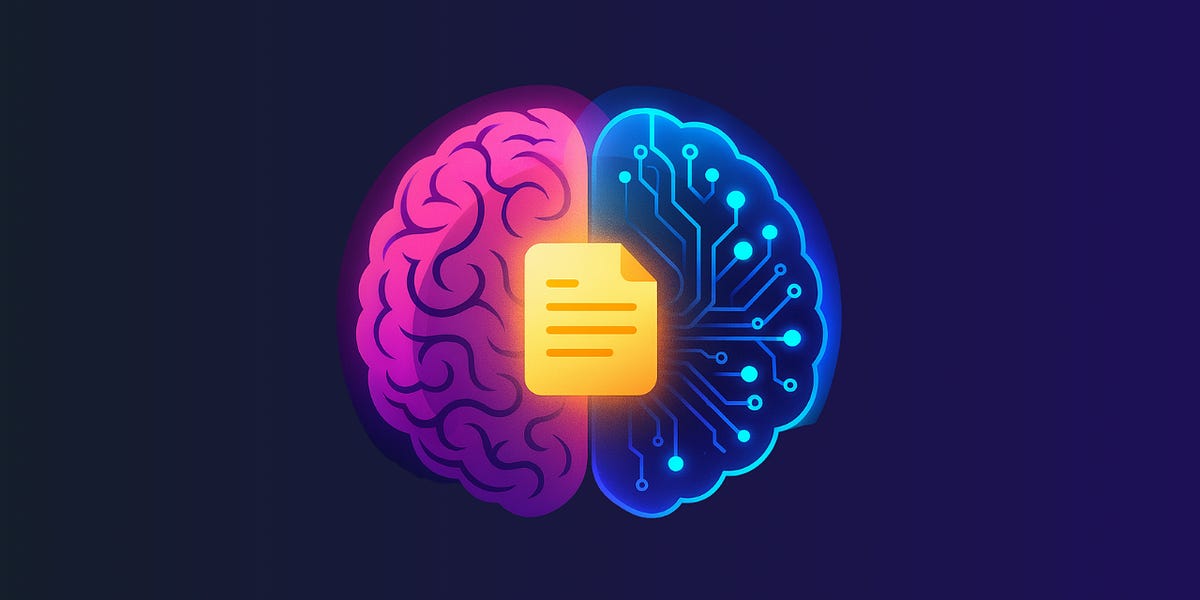
This article explains the 'Expert's Paradox'--how AI can actually make experts' work harder--and presents concrete methods for building systems to overcome it. To effectively leverage AI, you need to go beyond simply accepting AI outputs and systematically teach your expertise to AI. This ultimately contributes not only to personal productivity gains but also to creating a new form of 'hybrid intelligence.'
1. The Expert's Paradox: Why AI Makes Your Job Harder
Many people assume that the more expertise you have, the easier it should be to leverage AI. But reality is different. When using AI in areas you're unfamiliar with, you tend to accept the output without much skepticism. However, in your area of expertise, you review and revise AI's output much more, ultimately spending more time and effort. This is the 'Expert's Paradox.'
The author initially wondered whether they were simply failing to use AI properly. Others seemed to breeze through work with AI, while they endlessly revised, questioned, and dug deeper into AI outputs. But over time, the author realized this slower approach wasn't wrong--it was actually evidence of pursuing higher-quality results based on their expertise.
"Expertise is fundamentally the ability to see what others cannot. Not just facts or skills, but patterns, exceptions, and the points where general knowledge breaks down."
Expert knowledge is accumulated through countless small failures and adjustments, embodied in ways that are difficult to articulate. Because this knowledge doesn't transfer easily to AI, even when AI delivers confident and comprehensive answers, experts can clearly see errors or omissions. At this point, experts aren't simply delegating work to AI--they're placed in the situation of "teaching an eager student who doesn't know what they don't know."
2. The Limits and Potential of AI Use
Many experts feel frustrated when collaborating with AI, thinking "this is useless" and giving up. The author's programmer friend also stopped using AI because the code it generated felt messier than what they'd write themselves.
Of course, AI isn't perfect or a solution to every problem. But the author points out that we have a tendency to give up too easily after one or two failures. Effectively leveraging AI requires time to experiment, adjust, and refine the tool to your standards.
The author compares using AI to "getting a driver's license and learning to drive." It requires an initial investment, but once you learn, you gain significant advantages every time you handle a similar task. Building a system for AI is an upfront investment that can create enormous long-term value.
"When you learn how to translate your hard-won judgment, patterns, and intuition into prompts and workflows, you're not just accelerating your own work--you're encoding years of experience into a form that machines can use and reuse."
When you build these systems well, you go beyond boosting personal efficiency--you can elevate the entire team's work level, or even develop your expertise into products or resources that serve others. The author confesses that the reason they spent hours revising AI outputs and repeatedly explaining requirements was simply "because they didn't have a system."
3. How to Document Your Expertise for AI
The key to improving AI collaboration is documenting your expertise. It's like creating the knowledge you wish you'd had when you were learning--clear, practical, and immediately applicable. These knowledge packets not only improve AI collaboration but become valuable assets in their own right. They can help onboard new team members, systematize your approach, and even serve as the foundation for courses, consulting frameworks, or other ways to monetize your expertise.
The time you invest in making your knowledge accessible to AI ultimately makes your knowledge more accessible to humans too.
3.1. Define Your Core Principles
Before diving into specific tasks, identify the fundamental principles that guide all your work--your core professional philosophy. This becomes the foundation for everything.
Ask yourself questions like:
- What are the 3-5 principles that guide me when approaching any problem in my field?
- What questions do I always ask regardless of the specific situation?
- What do I know about my audience/market/domain that shapes all my decisions?
- What are the universal warning signs I watch for closely?
Store this foundational knowledge in your AI tool's memory, or create a master document you can reference. This prevents starting from scratch with every new prompt and maintains consistency across all AI interactions.
3.2. Catalog Your Recurring Task Types
List the task types you perform repeatedly. Don't try to include everything--focus on tasks that occur regularly and matter most to outcomes.
For example, a marketing manager might identify campaign strategy development, content creation, performance analysis, stakeholder presentations, and competitor research. A consultant might map client discovery, problem diagnosis, solution design, implementation planning, and progress reviews. This list becomes your roadmap for which knowledge packets to build first.
3.3. Create Knowledge Packets for Each Task
For each recurring task type, create a focused knowledge packet that includes:
- What excellence looks like: Specific examples of your best work in this area and clear explanations of why they were effective.
- Common failure modes: Common ways this task goes wrong, why, and how to avoid them.
- Your diagnostic process: The questions you ask, the warning signs you look for, and the sequence of thinking that guides your approach.
- Quality standards: How to recognize whether work meets your standards or needs further development.
- Context dependencies: How your approach changes based on audience, timing, resources, or other variables.
3.4. Convert to Conversational Prompts
Convert your knowledge packets into conversational prompts that feel natural. You can use them in general conversation or create a separate project within your preferred AI model and add them as instructions. The key is to write as if you're briefing a smart colleague.
Simple social media hook writing example:
My hook approach: After analyzing thousands of posts, I've found that our audience stops scrolling for three things: surprising specific numbers, contrarian takes that challenge conventional wisdom, or personal stories that reveal universal truths. Generic inspirational quotes and obvious advice get ignored. What works in our space: Starting with counterintuitive statements, using specific time frames ("in 3 months, not 3 years"), mentioning failure before success, asking questions people think but don't say out loud. What kills engagement: Starting with "Here's why you should...," using buzzwords like "game changer" or "revolutionary," making claims without evidence, or sounding like every other post in the feed. My quality bar: A good hook makes someone think "Wait, that can't be right" or "Finally someone said it" within the first few words. It should work even if someone only reads the first line. Create 30 different hook approaches. Use a different psychological trigger for each. Explain why each hook should work for this audience, and flag any that might feel too generic or salesy. Post topic: [insert specific topic] Target audience: [insert specific audience]
You can share supporting documentation, past examples, performance data from previous hooks or campaigns--any materials you'd use to train a new team member (case studies, annotated drafts, performance metrics)--with the AI.
By providing this context to the LLM, the AI will remember your standards and apply them consistently, helping generate work at the quality level you expect.
3.5. Integrate Evaluation Prompts
Your evaluation prompt should sound like the internal monologue you have when reviewing work.
Simple content evaluation example:
Here are my criteria for reviewing written content [content type - e.g., blog post, email campaign, etc.]. My quality framework: Good content in our space passes three tests:
- Expertise test (Does this demonstrate real knowledge that only comes from experience?)
- Action test (Can someone implement something specific after reading this?)
- Trust test (Does this increase the likelihood someone would want to work with us?) What I look closely at: Opening paragraphs that take too long to get to the point, claims without specific examples, advice that sounds like it came from a textbook rather than real experience, conclusions that don't follow from the evidence presented. Red flags meaning a rewrite is needed: Generic advice anyone could write, no specific examples or stories, tone too casual or too formal for our audience, missing the "so what?" factor that makes people care. Content to review: [paste content here] Evaluate this according to my framework:
- Does it pass the three tests I mentioned?
- Where is it most credible or least credible, and why?
- What would I strengthen before considering it ready to publish?
- What are the strongest elements that should be kept unchanged?
This evaluation section can be used as a standalone prompt when you want to review AI-generated work, but it's far more effective when integrated into the initial instructions.
For example, you can first ask AI to create content or complete a task, then immediately ask it to evaluate its own output according to your standards. Building the evaluation process in this way brings the final result much closer to what you actually need, saving revision time and improving output quality.
4. Continuous Improvement and the Evolution of Hybrid Intelligence
Building these systems is not a one-time setup but an ongoing process. As you start applying templates and prompts to your most common and important tasks, you'll discover areas where AI still falls short or misses nuances you care about. This is when you need to adjust, add new examples, or clarify instructions--just as you would when training a new team member.
Over time, you'll begin recognizing patterns in your own thinking and expectations. Translating your expertise for AI forces you to examine your own assumptions and make your standards explicit--not just for the machine, but for yourself.
The more you refine the system, the more you'll discover that teaching AI to operate at your level sharpens your own thinking. What started as a set of prompts becomes a living playbook that makes both you and the AI more effective with every iteration.
5. Research Findings and Conclusion
According to a recent Microsoft study surveying 319 knowledge workers on their AI usage patterns, expertise was found to influence how people use AI.
- Novices using AI for unfamiliar tasks essentially say "I don't know what good looks like, so I'll trust your judgment." They don't notice what's missing, so they take AI's confident claims at face value. As a result, they tend to spend less time reviewing or refining outputs.
- But experts are different. They immediately spot missing details, oversimplifications, and confident statements that aren't actually true. They notice not just what's wrong but what's missing--necessary caveats, context-dependent exceptions, and insights that can only come from experience. Consequently, they invest significantly more time and effort in the process, but produce high-quality work.
In conclusion, the goal of using AI is not to make work "easy" but to make it "effective." This is precisely why true expertise becomes a powerful advantage when collaborating with AI.
When experts choose to engage in this more demanding form of AI collaboration, we're doing something bigger than just improving individual productivity. We're creating a new form of intelligence--not artificial intelligence replacing human intelligence, but hybrid intelligence that combines the best of both humans and AI.
Your expertise becomes part of AI's extended knowledge base, your standards become AI's quality benchmarks, and your judgment guides AI's decision-making. In return, AI amplifies your knowledge, helping you apply your expertise at a scale and speed that was previously impossible.
This is why the difficulty matters. This is why the extra effort is worthwhile. You're not just completing tasks--you're building capability. You're not just generating outputs--you're developing a partnership. You're not just using a tool--you're contributing to the evolution of how intelligent work gets done.
The future belongs to those who learn to work with this difficulty. Those who discover that the friction between human expertise and artificial capability is where the most interesting work happens. Not because it's easy, but because it's hard in the right way. And that's exactly how it should be.