In this video, MIT professor and entrepreneur Bill Ollett shares deep insights into entrepreneurship. He emphasizes that successful entrepreneurship is not just about inventing, but also about solving market problems, commercializing innovations, and having 'antifragility' to adapt to a constantly changing world. In particular, it introduces the importance of entrepreneurial education and MIT's successful education example, 'Biobot Analytics,' and urges future leaders to have an obsession with problem solving and a practical approach.
1. What is entrepreneurship? 🤔
Professor Bill Ollett begins his talk with a clear definition of what entrepreneurship is. He describes an entrepreneur as "a person who creates a new organization from scratch and makes that organization economically sustainable." The key is to create value and build a sustainable business through market dynamics, not just products or features.
"An entrepreneur is a person who creates a new organization that did not exist from scratch and makes that organization economically sustainable."
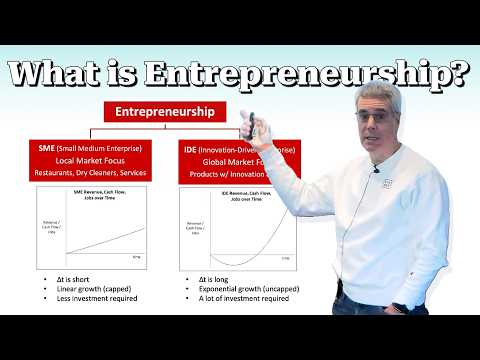
Professor Ollett divides entrepreneurship into two major types.
- Small/Medium Enterprise (SME) Entrepreneurship: Businesses targeting local markets, such as dentists, restaurants, and dry cleaners, where growth is linear and primarily service-based. These businesses are important to the economy, and governments can see results quickly if they invest in these businesses.
- Innovation-Driven Entrepreneurship (IDE): Plays a critical role in solving today's world's problems and stabilizing the economy. IDEs require more investment of time and resources initially, but can achieve exponential growth if successful. For example, you can create value in global markets beyond local markets, such as 'pillow money' that generates profits even while you sleep.
2. The importance of innovation and commercialization 🛠️💰
The professor defines innovation as "making people money" and emphasizes that invention and innovation should not be confused. Inventions cost money, but innovation makes money. He points out that patents can be 'fool's gold' and says that commercialization is more important than technological superiority. Through the examples of Apple and Google, the secret to their success is explained by 'laterally innovating' existing ideas and successfully establishing them in the market.
"Innovation is what makes you money, and invention is what costs money." "Steve Jobs said, 'Good artists create, great artists steal.' Even that quote was said by Pablo Picasso, so he even revolutionized motivational phrases!"
Successful innovation requires both invention and commercialization capabilities, but a 'fast clock speed' that quickly connects the two is essential. Citing the example of IBM's failure, it shows that no matter how great the technology and commercialization ability, if the speed of bringing ideas to market is slow, you can fall behind the competition.
"This is not a two-dimensional problem. It is a three-dimensional problem in that it requires invention and commercialization. The two have to be connected, and that connective tissue has to be able to bleed very quickly."
3. Anti-vulnerability: The power to become stronger amidst change 💪
Professor Bill Ollett emphasizes the importance of 'Antifragility' in today's corporate environment. This means the ability to become stronger in the face of change and uncertainty, as opposed to typical management approaches that focus on mitigating risks and optimizing systems. He explains that as the world becomes more rapidly changing and unpredictable, it is important to adapt to this environment and use it as an opportunity.
"The world will never slow down the way it does today. Think back to a year ago when you thought, 'It's not going to get any more crazy,' and then a year ago." "You must be a 'positive condition.' In change there is opportunity. We do not endure change, we thrive in change."
This anti-vulnerability is closely linked to entrepreneurial mindset, skillset, and operating style. Entrepreneurs are people who become better in the face of change, and these leaders will lead the future.
4. Misconceptions and truths about entrepreneurship 🧐
The professor clears up several misconceptions about entrepreneurship.
- Not an individual sport: Stories of individual heroism like Elon Musk's on social media are not the essence of entrepreneurship. Entrepreneurship is a collaborative team sport.
- It is not an intelligence test: It is not the smartest people who succeed, but those with the tenacity and dedication to problem solving. Bad entrepreneurs are only obsessed with technology and products, while good entrepreneurs are obsessed with solving customer problems.
- You're not born with it, you can learn it: Entrepreneurship is not a genetic trait, but a skill that can be acquired through education. It's not about taking risks, it's about taking informed risks and reducing risks by focusing on your strengths.
- Charisma doesn't matter: Charisma can dazzle people for a while, but if you don't provide real value, you'll lose customers. Getting customers to voluntarily promote your product through true value is the key to sustainable success.
- It's not luck: It's important to anticipate opportunities and prepare.
- Not disorganized: Startups are much more disciplined than large corporations. The urgency to pay salaries is what motivates them.
- No high failure rate: If you learn the right rules and approach, your chances of success are much higher.
- Ideas are not important: Early ideas are usually wrong. What matters is Knowing your customers, executing, and building a great team.
He emphasizes that entrepreneurship is a 'craft', not a science, and is best learned through apprenticeship training with a master craftsman. Additionally, you can create a sustainable organization not just to make money, but to have an ethical goal of making the world a better place.
"Good entrepreneurs are obsessed with solving problems, bad entrepreneurs are obsessed with their technology and products." "Entrepreneurship is not a science. There are no algorithms. But it can be taught. It should not be taught like an art. It should be taught like craftsmanship." "If all the fish swim in one direction, do you find it interesting to swim in a different direction? You don't have to do it every time, but that's the mindset. The pirate spirit." "If you do it to make money, it won't last long. It's not business, it's closer to exploitation."
5. MIT's Entrepreneurial Education Model 🎓
MIT emphasizes four key elements for entrepreneurship education:
- Mindset (Heart): The spirit of a pirate that can swim in a different direction than other fish.
- Knowledge (Head): Rigorously developed toolbox and 24-step systematic process. We use proven methodologies that integrate design thinking, customer-centered design, and more.
- Hands: Gaining practical experience through an apprenticeship model such as a boot camp.
- Community (Home): A collaborative ecosystem where technology, networks, and expertise are exchanged.
Through this model, MIT focuses on nurturing leaders who can bring in 'infinite ideas' to create 'new and economically sustainable' results, and thereby have a positive impact on society. In particular, MIT says it should focus on providing the best content and educational processes rather than building buildings or raising venture funds.
6. MIT's Amazing Success Story: Biobot Analytics 🧪📊
Professor Ollett introduces the case of Biobot Analytics, which was created through MIT's 'Delta V' program, and demonstrates the practical impact of entrepreneurial education. Founded by Mariana Matisse, a female doctor from Mexico, the company initially started with the idea of a 'smart toilet' but failed. But this experience helped her channel her 'anti-vulnerability' into an obsession with problem solving.
"They were so obsessed with technology that they didn't see a path to commercialization."
She leveraged sewage dynamics to build a much simpler system to analyze patterns of drug use in specific areas. In particular, during the COVID-19 pandemic, wastewater analysis helped predict the spread of the virus and helped save millions of lives.
The success of Biobot Analytics teaches us these important lessons:
- Focus on solving customer problems, not technology: At first, we failed because we only focused on technology, but we succeeded when we focused on solving problems.
- Quick pivot to market and opportunity: From our focus on solving the opioid crisis, we quickly pivoted to the opportunity of the COVID-19 pandemic.
- Importance of a disciplined and balanced team: It was important to follow a disciplined process of 24 steps, including market segmentation and Beachhead Market, and to build a balanced team.
- Strong Company Culture: The company's 'Raison d'etre', the ethical goal of making the world a better place, has created a great culture.
- Anti-Vulnerability: Even after success, you must constantly adapt to change in the face of threats from large corporations.
Teams participating in the Delta V program have a survival rate of nearly 70% after five years and have raised more than $3 billion in external funding. Additionally, 89% of participating companies have businesses aligned with the UN's Sustainable Development Goals, and more than 50% of CEOs were women. This demonstrates the achievements of an MIT education that values diversity and ethical values.
"More than 50% of our CEOs were women last year." "When we talk about entrepreneurship, we're talking about a 'raison d'être' - a reason for being. Because if it doesn't make the world a better place, it's not ethical."
7. The future of entrepreneurial education and new books 📚
The professor introduces his new book **『Disciplined Entrepreneurship Expanded and Updated』 and explains that it contains important content that was not covered in the previous book. In particular, we emphasize the importance of reducing customer acquisition costs, managing intellectual property (IP), and 'channel-market fit'. In the past, product-market fit was important, but now that it's easier to build a product, **how you reach customers, or your 'go-to-market strategy'**, has become key.
"The most interesting thing is that the game has changed from product-market fit to channel-market fit."
He focuses on different ways to generate revenue and says that rather than simply relying on 'sales', you should leverage various channels such as Product-Led Growth (PLG), community, AI tools, etc. Additionally, MIT has completely revamped its curriculum to accommodate these changes, and mentions that sales strategies are being taught by engineers rather than psychology or sociology majors.
8. Q&A: Scaling and Diversity 🗣️
During the Q&A session, questions were asked about scaling and diversity of entrepreneurial education.
- Scaling up entrepreneurial education: MIT plans to expand its training programs to other universities through a 'train the trainers' model to reach millions of people around the world. This will not be a simple copy and paste, but an 'imitation' method of imitating and modifying to suit the characteristics of each region.
- Secret to achieving 50% female entrepreneur rate: The professor emphasizes the principle of 'see one, be one'. It is important to bring in female leaders or entrepreneurs from diverse backgrounds as mentors to show students that people like them can also become entrepreneurs. In addition, MIT helps diverse talents grow by creating a 'merit-based environment' where students are evaluated solely on ability and effort, not on pedigree or background.
"They see and follow. If they don't see one, they can't be one. There has to be female entrepreneurs." "This is a success-based system."
Conclusion 🌈
Professor Bill Ollett's lecture clearly shows that entrepreneurship is not simply a 'genius idea' or 'personal heroism'. Instead, it emphasizes that it is a persistent commitment to solving market problems, continuous learning and adaptation, and a process of sustainable value creation based on ethical values. MIT's educational philosophy and success stories provide inspiration for future entrepreneurs on how to ride the waves of change and make a positive impact on the world.