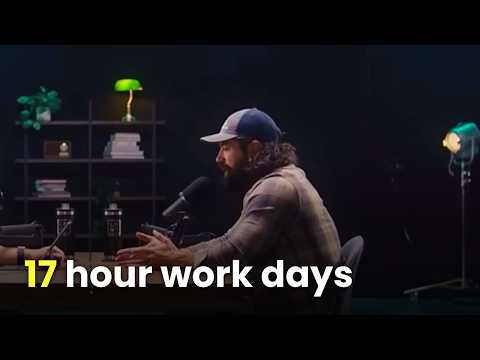
This video argues that the key to higher productivity isn't perfect preparation but starting immediately. Alex Hormozi explains that not delaying the start of work, facing what needs to be done head-on, and immersing yourself deeply in work you believe is worthwhile are what ultimately build the life you want. What stands out in particular is the message that a good life doesn't come from special days, but from a daily routine you can be satisfied with even on an ordinary Tuesday.
1. The Most Powerful Productivity Secret Is Simply Starting
The conversation opens with a very simple but powerful piece of productivity advice: don't wait until you feel like working, and don't spend time trying to create the perfect environment. Rather, the very act of starting work creates the best conditions for focus.
"Instead of spending time waiting until you feel like working, just start working. Face the work head-on."
People often think they can only work well once conditions like a quiet space, a perfect plan, good energy, and motivation are all in place. But the core point of the video is the opposite: starting is what creates the perfect conditions.
"People think they need perfect conditions to start, but in reality, starting is the perfect condition."
Hormozi confesses that he, too, used to be captivated by long morning routines, supplement rituals, and all kinds of optimization methods. That's not to say these things are meaningless, but until you actually do the work, most of them can remain mere "preparation surrounding the work." If two hours pass and you have nothing to show for it, that preparation has ultimately become a substitute for the work.
"I was indulging in mental self-gratification around the work I had to do. But when I looked back two hours later, nothing had actually gotten done."
He says your output per hour rises the moment you start working. In other words, the greatest productivity hack isn't some grand system, but not delaying the first action.
"The moment you start working, your output per hour goes up. That's why starting is the greatest hack there is for everything about work."
People are especially prone to feeling overwhelmed before writing, making a big piece of content, or tackling a task that requires deep thinking. But Hormozi explains that once you actually get into the work, what you need is usually just the first five minutes or so. If you spend those five minutes looking at the structure of the task and getting a sense of where to begin, you naturally become absorbed afterward.
"Even for big tasks that take real mental effort, once you actually get in and spend five minutes there, you start to see the terrain."
He says that in the past he would put off starting those first five minutes for hours, but now he dives in the moment he thinks, "I should do this." This is what he calls compressing the time between thought and action. 💡
2. The Power of the "Open Loop": Deliberately Leaving Work Unfinished
Hormozi says that instead of always wrapping things up neatly when he stops working, he sometimes stops in the middle of a sentence. It may seem strange at first, but it's a strategy that makes it easier to start again the next day.
"Stop in the middle of a sentence. It'll drive you crazy."
The host explains that this connects directly to what psychology calls the Zeigarnik effect. The Zeigarnik effect refers to the tendency of the human brain to remember unfinished tasks better than finished ones and to keep thinking about them.
The effect first became known through a study that observed restaurant servers. Servers remembered the detailed requests of tables whose orders were still open surprisingly well. For example, information like "Table 16 wants extra rice instead of peas" stayed vivid in their minds. But once a table's order was done and the bill was paid, they could barely remember anything about it.
"While a table's order was open, they remembered it exactly, but once the table was closed out, they remembered nothing."
This is because the brain dislikes open loops, that is, unfinished states. It's the same reason Netflix puts a scene at the end of each episode that makes you watch the next one. Unfinished stories and unresolved conflicts linger in people's minds.
"The brain hates open loops. That's why the cliffhanger at the end of each episode makes you watch the next one."
Some romance novels even print "Guaranteed no cliffhanger" on the cover as a selling point. That shows just how much readers dislike the tension and frustration of something left unfinished.
So it helps to deliberately stop not right before you finish, but at a point where the next action is clearly visible. The next day, you'll spend less time opening a new document and wondering, "Where do I start?" because the sentence to continue or the next task is already in your head.
"Ending mid-sentence lowers the energy needed to start that sentence the next day. And it keeps the work in your head overnight."
In short, the habit of finishing everything perfectly isn't always the answer. Sometimes deliberately leaving an unfinished loop to make the next start easier is an excellent execution strategy.
3. Don't Look for Shortcuts; Do "What It Takes"
The conversation moves on to a more fundamental attitude toward work. The host says he especially loves this line from Hormozi:
"What it takes is work. A lot of work. Every time you try to dress up the work or find a shortcut, you're harshly reminded that the work simply has to be done."
"The work doesn't care who you are. It just wants to be done."
Hormozi quotes David Goggins and says he repeats lines like this to himself:
"There are no shortcuts for you."
The important point here isn't the claim that "shortcuts don't exist in the world at all." The attitude Hormozi takes is that he won't allow himself any shortcuts. It's a mental device to cut down the moments spent waiting for some secret trick or lucky break, and to return immediately to the actual work that needs to be done.
"You assume you can't use shortcuts. Then the path to the work you need to do gets shorter."
He says that while preparing for an important presentation recently, he rehearsed the same presentation eleven times. He kept refining it at 11 p.m. and was working a more intense "triple shift" than usual. His normal day starts at 6 or 7 a.m. and runs until around 6 p.m., 10 to 12 hours of focused work. He keeps this up about six and a half days a week, and takes Saturday afternoons off to rest and recover.
But in periods when he really has to push hard, he comes back after dinner and works until 11:30 p.m., sometimes until 1 a.m. At those times, his actual productive working hours reach 16 to 17 hours a day.
In the process, the same temptation that comes to everyone comes to him too.
"This is good enough. It probably doesn't matter much. It's fine."
But Hormozi says he hates exactly that thought. He has two powerful internal phrases:
"I will do what it takes."
"This has to get done."
This is the stance of looking at work that no one else is going to solve for you. The work is right in front of you, and nobody is going to do it in your place. That's why it's important to look squarely at what needs to be done rather than being swayed by excuses or emotions.
"When I face the work squarely, it's as if the work is smiling back at me, saying, 'Nobody is going to do this for you.'"
He also mentions that in his early days of content creation, he had to film 100 short videos in a single shoot. It was hard because he had to juggle it with his investment portfolio work, but even then, one sentence kept him moving:
"I will do what it takes."
4. The Standard of "Others May Not Know, but I Will"
The second line Hormozi repeats to himself is more personal and more demanding.
"But I'll know."
On the outside, things might look successful. The output might turn out well, and people around you might praise it as excellent. But you yourself know when you didn't give it your best. And that feeling keeps you from fully enjoying the achievement.
"Even if everything goes well and other people say it's great, I'll know. I'll know I could have done better."
This standard doesn't mean ignoring others' opinions. Rather, it's closer to an attitude of putting your own standard ahead of the outcome: checking for yourself whether you did as much as you could.
Hormozi states flatly that he has never once regretted working hard.
"I've never once regretted working harder."
To the reaction that he might regret working so much when he's on his deathbed, he responds that he has lived every moment of his days in a way he chose because he wanted to. In other words, for him working hard isn't missing out on life; it's a way of actively living the life he considers worthwhile.
He has long remembered something a boss told him at his first job after college. He hated that job, but that one piece of advice became the blueprint for his life.
"I think happiness is stringing together as many good days in a row as possible."
In the life Hormozi wants, his birthday, a Tuesday, and a Sunday don't need to be completely different kinds of days. Rather than enduring weekdays while waiting for special days, he wants to build a life in which ordinary days are satisfying in themselves.
"My birthday looks like a Tuesday, and a Tuesday looks like a Sunday."
5. Design a Good Tuesday Rather Than an Extraordinary Life
The host shares that when he was naming his podcast, one of the candidates was "Crushing It Tuesday." It's an expression borrowed from something Tim Ferriss said: what you should aim for in life isn't a glamorous once-in-a-lifetime moment, but what your average Tuesday looks like.
"What you should aim for in life is an ordinary Tuesday."
A day flying on a private jet with friends, or a glamorous party full of celebrities, can feel special to anyone. But days like that are rare. Most of life is made up of ordinary Tuesdays, Wednesdays, and Thursdays. So a truly good life comes from those everyday days getting closer to what you want them to be.
"Your average Tuesday should look like the way you want to spend most of your life."
Hormozi sums up that the days when he ends the day feeling "today was a good day" almost always have the same three elements:
- He worked very hard on something he felt was worthwhile.
- He exercised.
- He spent time with the people he wants to be with.
"If I do these three things, I've had a good day."
This simple standard is more realistic than flashy goals or complicated self-improvement plans. Every day, immerse yourself in worthwhile work, move your body, and connect with the people you love. That is the personal "blueprint for a good life" Hormozi offers. 🙂
6. Redefining Work as Worthwhile Immersion, Not Suffering
Finally, the video talks about how differently people take the word "work." For many people, work sounds like suffering, something you're forced to do, something that takes away your freedom. That's why they find it hard to understand people who work hard or become absorbed in their work.
"One person says 'work,' and the other hears 'suffering.'"
Hormozi says that to understand the language of successful people, you need to recognize that their definition of "work" may be different. The reason they seem addicted to work isn't that they are superhumans who endure pain no matter what. In many cases, they have chosen work that's worth doing, and in that work they experience immersion so deep they lose track of time.
"People who are addicted to work make it easy to get addicted, because they do worthwhile work."
Here, work isn't necessarily just easy or fun. In fact, if it's too easy, it becomes boring. It's a challenge precisely because you can't be sure it will work, there are difficulties to solve, and the outcome is uncertain. But if it's meaningful to you, you can become deeply absorbed even amid that uncertainty and difficulty.
"If there's something you enjoy so much you lose track of time, it's usually challenging. If it were too easy, it'd be boring."
The video ends by urging us to choose carefully what to spend our short and precious time on. In the end, what matters isn't simply living a busy life. It's spending your time on the few things worth doing for the rest of your life.
"What matters is spending the precious few seconds we're given on the few things worth doing for the rest of our lives."
Wrapping Up
The video's message is clear: Don't wait; start. Don't hope for shortcuts; do what it takes. And push through to the end by a standard you won't be ashamed of. And if you want to change your life, rather than dreaming of special events, you should focus on filling ordinary days like today with the shape you love.
A good life isn't a reward that arrives someday. It's made from how you spend today's Tuesday.