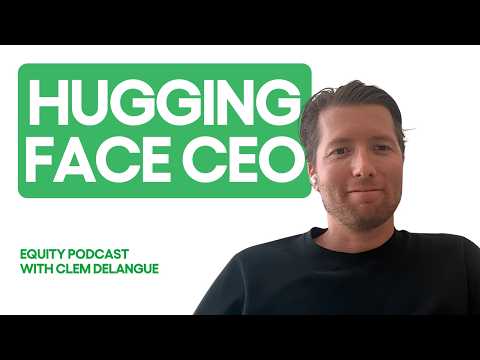
In this video, Clem DeLong, CEO of Hugging Face, talks about the growth and importance of open source AI. He explains that companies initially use Frontier APIs, but as they grow in size, they tend to switch to an open-source model due to cost issues. It also emphasizes that open source AI is more transparent and safer than closed AI, and can prevent a small number of large corporations from monopolizing the AI market. Clem DeLong argues that open source AI is an essential element for the development and innovation of artificial intelligence, and urges the US government to actively support the development of open source AI.
1. The rapid rise of open source AI: the growth of the hugging face 🚀
Clem DeLong, as co-founder and CEO of Hugging Face, highlighted the remarkable growth of open source AI. In recent years, Hugging Face explains that AI developers have evolved into a platform where AI developers can share and download datasets, which is playing a role like GitHub in the field of AI. 😮
He presented some data showing the growth of open source AI.
Amazing sharing speed: Now, on the Hugging Face platform, a new repository is created every 7 seconds, so models and datasets are being shared. * Extreme Resources: Approximately 3 million public models and 1 million public datasets are registered on this platform, showing that only one model does not dominate everything, but a variety of models exist. Aggressive use of companies: What is particularly impressive is the fact that about half of the Fortune 500 companies are using open-source models or their own private models through a hugging face. This suggests that open-source AI is more active in real-world business environments beyond just the experimental stage.
Delon predicted that this trend would continue in the future. 🧐 Initially, companies experiment and implement new features using the frontier API, but as they enter the production stage and grow in size, they often switch to an open source model because of the huge cost. "Maybe in a few years, the Frontier model will be used only for experimentation or very high value work, and most production workloads will be driven by private or open source models within the company." 😲
2. Reasons why companies choose open source: control and sustainability 🛡️
Delon cited control and transparency as the biggest reasons companies choose open source AI.
He mentioned that Palantir's CEO Alex Karp criticized the token infrastructure used by large laboratories such as OpenAI and Anthropic, and companies that companies use You explained that you want more control and transparency in your system. 🗣️
"Companies don't want to outsource their core competencies to other companies through the Blackbox API that can't control their core capabilities."
This can be seen as a move beyond simply cost savings, as a company seeks to secure the initiative of AI technology and pursue sustainable development. It's like companies writing their own code and building a software stack in software development. 💻
In addition, the use of an open source model also has the advantage of being able to respond on its own without being greatly affected when the use of certain AI models is restricted due to government regulations or external factors. These controls can ensure technical independence and stability in the long term. 💪
3. How to secure AI talent and use open source 🛠️
Delon gave an optimistic outlook to the question of whether the open source model was sufficient for the company to apply it to the company.
Emphasizes that the number of users of the Hugging Face has exploded from hundreds of thousands to 16 to 17 million AI developers in just 3-4 years, and with the development of agents technology, software They explained that training, execution, and optimization of models is becoming much easier. 🧑💻
It is said that the way companies use their hugging faces varies depending on the team's skill level and goals.
Initial Stage: Most users start by distributing open source-based models such as GLM-5.2 or Open GPT directly to the infrastructure to run workloads. 🚀 * *Poptimization phase**: As time passes, when constraints such as computing, cost, speed, etc. arise, teams focus on model optimization. Advanced Phase: Finally, by post-training the model, it is said that it moves on to a method of increasing **accuracy for specific use cases**.
Delon emphasized that this process is a key factor that makes companies differentiate themselves from their competitors.
"Evolving technology to build better AI systems than competitors will differentiate you in the long run."
4. China's open source AI leadership and American challenges 🇨🇳🇺🇸
According to a recent Hugging Face's 2026 report, Chinese model took the first place with a share of 41%, beating out US models in monthly and full downloads. 😲 This means that American companies are actively using Chinese open source models, and Delon sees this as an important **challenge in the US AI industry.
Delon said he hoped that most of the open source models used in the US would be shared by American companies under the ideal situation. He emphasizes that although American companies such as NVIDIA share powerful models and datasets such as Nemotron, they are active in open source AI, they still need more effort.
He described the open source as the based and accelerated factor of the AI stack, and argued that it is important that each country have a sovereignty for every part of the AI stack.
"It would be much better in a world where many open sources used in the US are actually made by American institutions."
To the claim that the Chinese model's performance was simply because of 'Distillation Attacks', Delon refuted "a very reducing and simple thought". 🙅♂️ He explained that it was successful because there are many great AI developers and research teams in China, and because they are taking a more open and collaborative AI approach than the US. If this trend continues, it has warned that China may outperform the United States in the overall AI sector next year or the year after. ⚠️
5. The safety of open source AI: the importance of transparency and responsibility ⚖️
In response to concerns that open models may be more difficult to control and may be more vulnerable to cybersecurity attacks, Delon argued that the transparency of open sources is rather a factor in increasing safety.
Historically, open source is less risky than a closed private initiative, which is because the open source is more transparent. 🕵️♀️
"Because open source is more transparent, it's easier to understand its capabilities and come up with a mitigation. For example, it's easier for defenders to patch the cybersecurity risks that open source models can do."
He also pointed out that the 'guardrails' of closed AI models can be superficial and inefficient. Many closed models have already used unauthorized use of copyright material on the web, which could be a much bigger problem than the open source model.
Open Source is said to provide information about the model to both attackers and defenders Leveling up the playing fields, and help more people participate in safety issues and find solutions.
Delon emphasized that the biggest risk in the AI sector is concentration of power rather than technology itself. If a small number of large corporations monopolize AI, they will have unprecedented wealth and power, which is a very dangerous scenario. 🚨
"I think the greatest danger of AI is the concentration of power. If a few companies have completely dominated AI, they will gain a positive amount of power and wealth that was never seen before."
This is why the US government should support open source AI development. Delon urged the government to strengthen the open source AI ecosystem by actively supporting open source projects and sharing open data in the public sector, although skepticism about open source is rampant in the United States. 🤝
6. The unique business model and vision of the Hugging Face ✨
It is said that the Hugging Face has not attracted new investments over the past three years, and has rejected Nvidia's large-scale investment offer. This is far from the typical "Unconditional Funding" method of Silicon Valley. Delon explained that the hugging face is building a platform** for the community and is pursuing long-term sustainability.
"We are focusing on long-term sustainability rather than maximizing long-term profits."
It is said that the Hugging Face does not require enormous computing resources because it has higher capital efficiency than other AI startups. 💰 It is said that they are so close** to the profitability to the extent that they started to use the funds they had raised 3 years ago.
He believes that this unique approach puts the hugging face in exclusive position in the fiercely competitive AI market. By continuing to provide value to communities and AI developers, in the long run, we believe that we can grow based on powerful network effects. 📈
7. Undervalued AI Opportunities: Local AI, Bio, Robotics 🤖🔬
Delon pointed out that in the field of AI, capital is concentrated only on certain areas, and there are many undervalued opportunities**. He argues that the current AI market is just a 'large-scale language model (LLM) API bubble', and that the entire AI market is not a bubble.
In particular, I saw the following sectors as having great potential compared to capital investment.
*Local AI (Local AI): Ability to run AI directly in smartphones, laptops, and its own data centers. Unlike cloud-based AI, AI that runs in a local environment is said to be a field that is still under investment. Delon analyzed that investors tend to focus only on certain 'hot' topics. Biology & Chemistry: It is said that the potential of AI is limitless as it has been significantly less investment than in the text LLM API field over the past two years. Robotics: Delon stated that Robotics has several characteristics that are different from AI. _ The importance of data: Robot datasets are much larger and more complex than text, such as video or image datasets, so they often reach the unit of petabytes. 😮 _ Trust Problem: When robots interact with the environment, family, and privacy, we emphasize that transparent open source model, not the black box system, becomes much more important. It is essential to know exactly who controls the robot, what data it collects, and when it turns off. 🤖
Delon explained that the reason open source plays an important role in the field of robots is that no one company can collect all physical data. And the more essentially transparency and open source are, the more essential the AI system, like robots, is, the more essentially it comes into our lives.
"Robotics requires a lot more transparency and open source than the rest of AI. That way many other companies can compete, how they work, and why they work that way."
Finish 🤝
In this interview, Hugging Face CEO Clem DeLong emphasized that open source AI is an essential element for the democratization and innovation of AI technology, beyond just cost-effective alternatives. It conveyed the message that the role of open source will become more important in order for companies to take control of AI, prevent the concentration of power in the AI field, and create new opportunities in various industries. It was impressive that transparent and open AI systems would play a decisive role in gaining user trust, especially in fields such as robots.