Almost all investors I know who invest in early-stage startups say, "We invest based on people." Each person may have a different interpretation of what it means to invest in people, but this is what I have been thinking. 'If you make an investment based solely on the item or market in the initial investment, there is a high probability that you will fail if you are wrong. However, if you look at people and invest in them, people will find a way anyway, so the probability of failure goes down.'
However, an interesting paper was published from the perspective of investing in such people. Titled 'Humans peak in midlife: A combined cognitive and personality trait perspective', it questioned the fact that the prime of physical ability is in the mid-20s to early 30s, but occupational success is achieved at a later age, and examined the 16 things that constitute occupational success (reasoning, memory, processing speed, crystallized intelligence, emotional intelligence, extraversion, emotional stability, conscientiousness, openness, agreeableness, moral reasoning, sunk cost resistance, cognitive flexibility, cognitive empathy, desire to think, finance). Comprehension) items were organized.
The overall pattern is as follows.
- Among human intelligence, the ability to think and solve logically without prior knowledge when first encountering a new problem (reasoning, memory, processing speed, etc.) peaks between the ages of 20 and 35.
- The ability to utilize knowledge and skills and make decisions (crystalline intelligence, desire to think, etc.) and emotional abilities (emotional stability, sincerity, cognitive empathy, etc.) accumulated through learning/experience increase with age and peak at 35 to 50 years.
- Moral/financial/bias resistance ability peaks between 50 and 60 years of age.
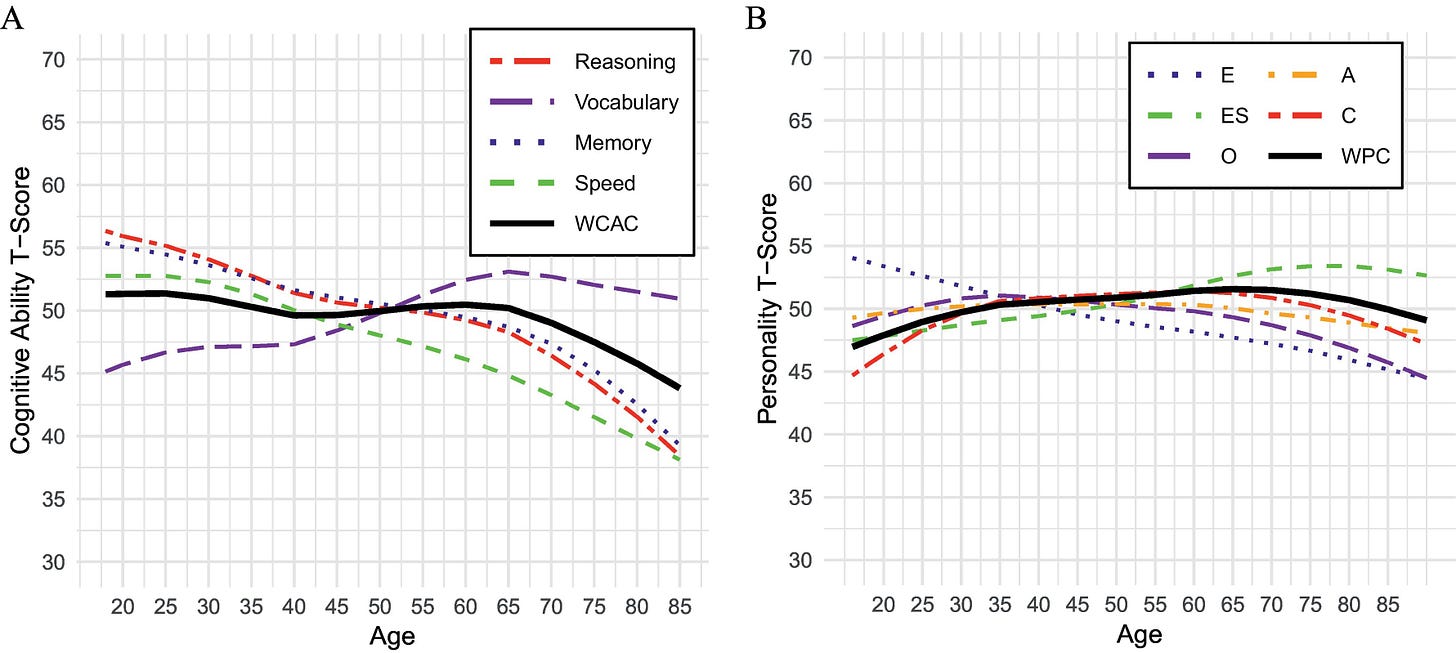
It was interesting. Because I was able to understand why investors seem to prefer young entrepreneurs. Founder-turned-investors have a wealth of knowledge and experience, so numbers 2 and 3 are their strengths. If we actively help entrepreneurs aged 20 to 35 who have number 1 as their strength and create synergy, it is a win-win.
Depending on the items of the founding team, the necessary strengths can be judged differently. For example, if you are trying to create something completely new that does not exist in the world, you should bet on number 1. Where competition is fierce or a playbook exists, you should bet on number 2. If the entrepreneur is hesitant to invest due to concerns, you can simulate whether these items will improve or worsen over time by substituting them into the age curve.
Conversely, when entrepreneurs are judging investors, they will be able to gauge which areas they will receive the help they need in the future. For example, if the auditor in charge is young, you should get help from his/her Fluid intelligence. An older partner should receive help in terms of decision-making and long-term execution based on his/her experience/judgment/contextual awareness.
It can also be applied to team building of startup teams. Rather than having all team members have the same strengths, you can create synergies with each other depending on the team's mission. From the CEO/manager's perspective, it can also reduce the mistakes of giving work instructions while ignoring the strengths of team members' ages.
Of course, as discussed at the end of this paper, this study also has several limitations, and this article is also close to a thought experiment. However, I have summarized the expression, "We look at people and invest", which we habitually say and hear, from the perspective of taking an analytical approach, even if it is only peripheral.
Thank you.
- Original text of the paper: https://www.sciencedirect.com/science/article/pii/S0160289625000649
- Paper summary: https://harvest.pub/shared/f219629e-33a9-4a69-95a6-34dc8596d85f