2025 was the first year AI coding agents truly broke the development bottleneck. For decades, software development had always been one of the main constraints for startups, so I used to imagine what the world would look like once development was no longer the bottleneck.
That turned out to be the wrong thought experiment. I should have imagined a world where development did not merely stop being the bottleneck, but became the easiest and cheapest commodity of all. Only now do I realize how long I stayed trapped in the old inertia.
In a world where development is the cheapest commodity, ideas are everything, questions become answers, and inspiration turns directly into outcomes. With AI, I keep seeing problems I once thought were too difficult to tackle alone get solved. Naturally, it feels like the era of the solo unicorn has arrived.
When you build with AI, you keep merging projects into a single codebase. It starts by putting multiple iOS apps together, then multiple web apps, then multiple API services, and eventually everything converges into one monorepo. If you want AI to work well, tightly coupled context matters, so this felt less like a grand strategy and more like a natural adaptation.
Last month, I formed a corporation with people who share my direction and gathered all the experiments I had been running into one place. The timing aligned with the moment high-quality skills for Claude, OpenCode, Codex, and Gemini started spreading by word of mouth.
That led us to a simple experiment: use those AI skills and agents not only for product development and marketing, but for every operational function inside a startup. After actually doing it, I came away convinced that this will soon become the standard.
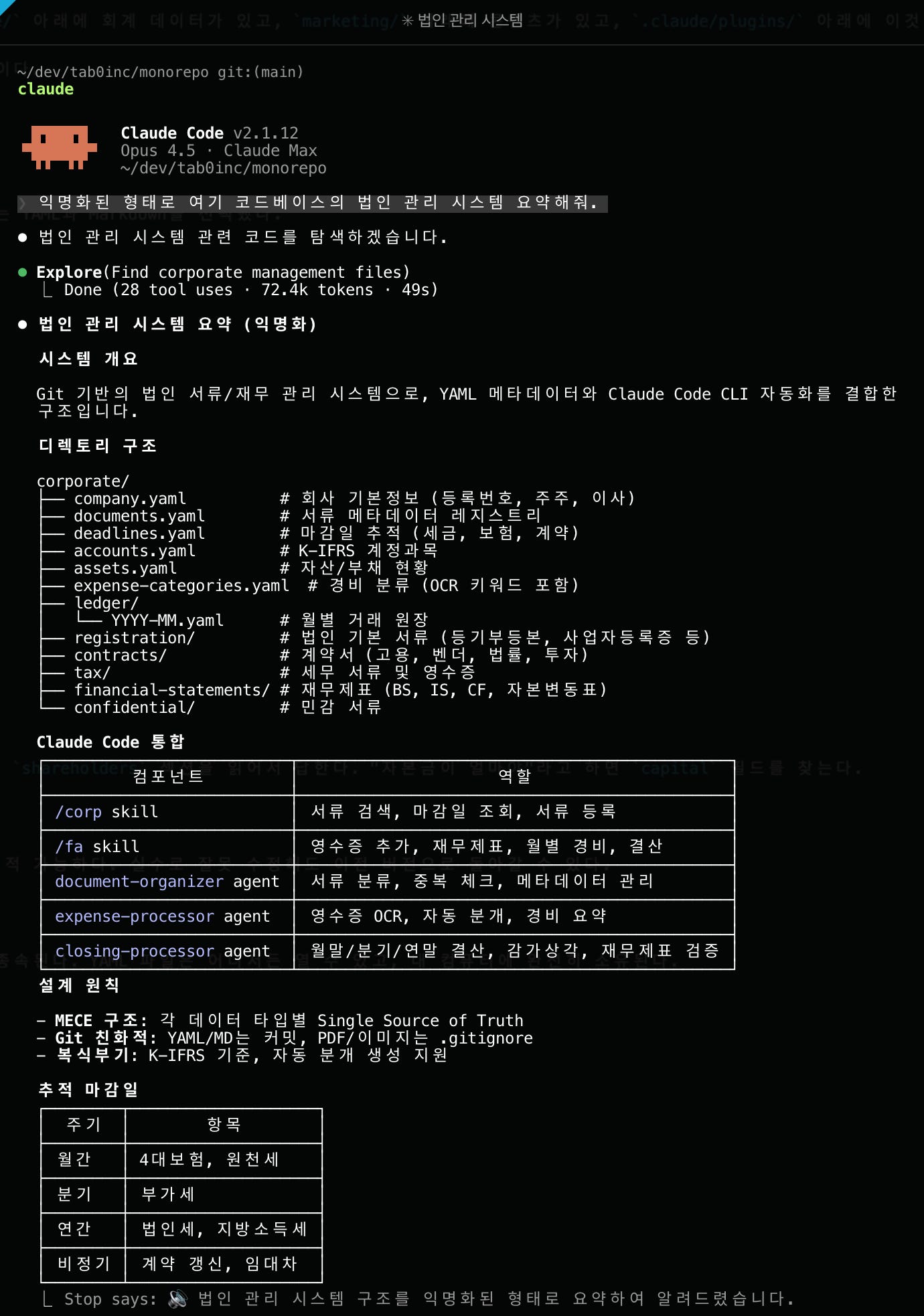
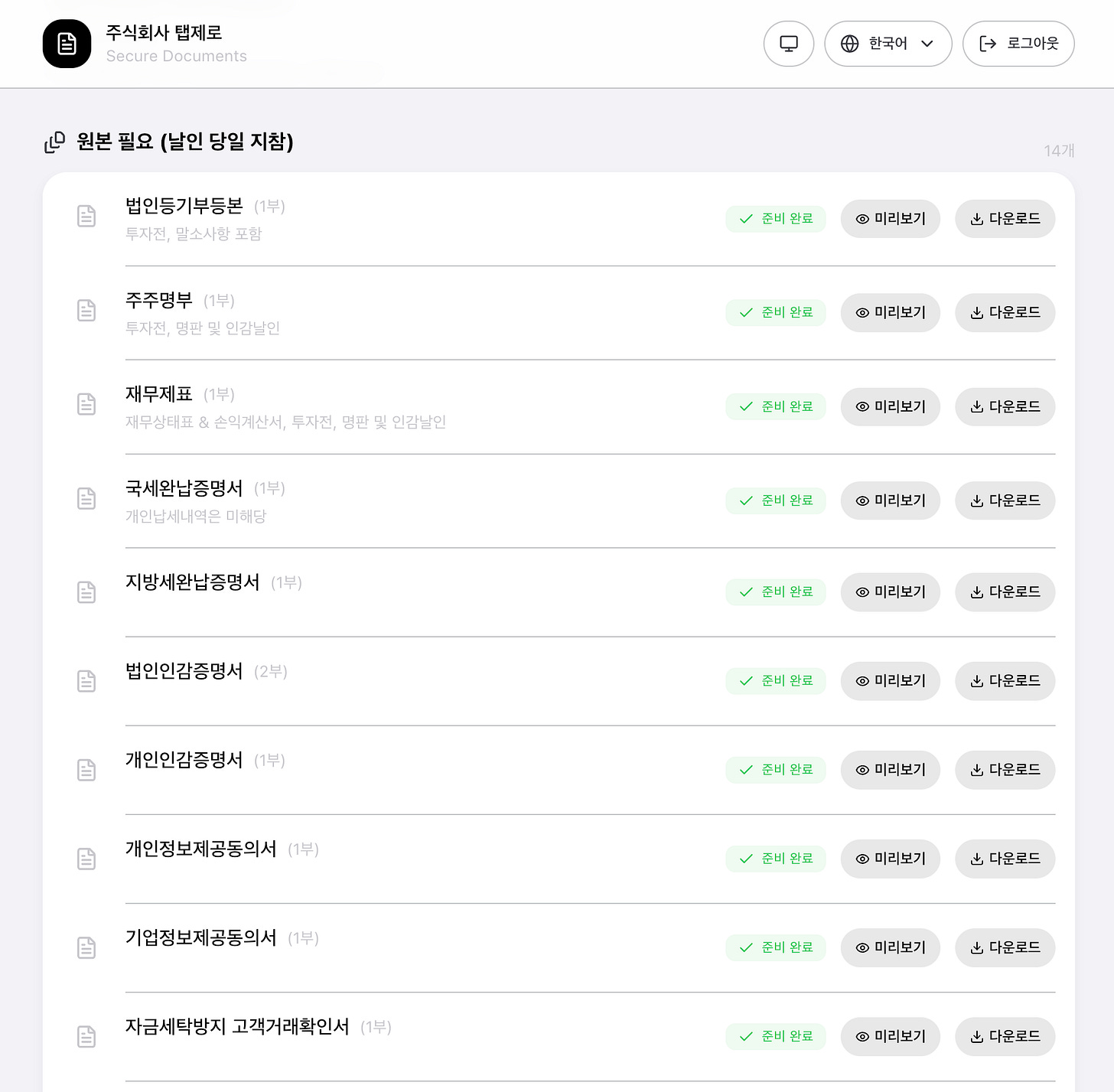
In Korea, setting up a corporation usually involves a process like this:
- Decide the company name, headquarters address, capital amount, and founding members.
- Draft the articles of incorporation, hold the founders' meeting, and complete company registration.
- Sign the office lease, register the business, and open the corporate bank account.
The only step I could not delegate to AI was physically visiting the bank to open the corporate account. Everything else was delegated, evaluated, and automated. If I decided tomorrow that I wanted to create 20 corporations, the limiting factor would mostly be my own willingness to do it. Once you imagine an AI agent that can log into financial systems through a browser MCP, handle certificate-based authentication, and issue tax invoices reliably, you can see how much of the rest becomes feasible.
Of course, there are caveats. I am a serial founder with prior experience and document templates. AI still cannot handle all of this perfectly from a standing start. But with a bit of help from an experienced mentor or investor, it becomes much more approachable. And if someone like a VC packages and shares the right skills and agents, the jump from confusion to execution becomes even shorter. That is the kind of world we are entering.
Inside a corporation, everything is a cost. Expense processing and accounting matter, but for early-stage founders they are often unfamiliar, tedious, or both, so people either collect receipts and hand them off to an accountant or subscribe to SaaS for it. Working with AI agents made me realize those workflows can also become dramatically easier.
I once had a tax filing done through an accountant and later got a large refund from the IRS because I had overpaid. Experiences like that make it hard to treat back-office work as something you can blindly trust and outsource forever. AI helps fill that gap.
We also had to prepare documents such as financial statements for investor due diligence. Because all company-related documents, contracts, and receipts were already committed into the monorepo through AI agents, we could generate them immediately. We built an agent that creates period-specific financial statements, and every time even a small expense is added, CI reviews the change and updates the current month's profit-and-loss statement.
When I asked for the PDF output to look as credible as possible, the agent referenced Samsung Electronics disclosure materials from DART. That is not even an approach I would have thought of myself.
I will still use an accounting firm and bookkeeping services. But it matters to me that under my own control, I can inspect, question, challenge, and improve every part of the process with just a small number of tokens. I have seen too many cases where blindly trusting a black box eventually creates problems downstream.

Here are a few suggestions for founders who want to move toward becoming a solo unicorn:
- Build your repository as more than a pile of source code. Make it a monorepo where the entire company is represented as one codebase. The real goal is to create a structure that is excellent for collaborating with AI through shared context.
- Your directory structure is your org chart. In the past, companies needed management layers and formal organization charts to achieve goals. Now, if AI is going to help achieve those goals, the directory structure needs to carry that operational shape.
- If AI cannot reliably repeat work that has already been thought through once, something is wrong. A company should create systems that compound value over time. Use structure, documents, skills, and agents so AI can accumulate impact through compound engineering.
Of course, this view is limited to January 2026. Next month some of this will feel obvious, and next year AI, not humans, may be the entity starting companies. This feels like a good, perhaps not very long-lasting, window to start something small and build the basis for compounding returns. At least, that is how I see it.
Today I looked at these changes from the perspective of company operations. Next, I want to talk about compound engineering from the product side: how to run AI agents 24/7 to test papers, turn experiments into engines, wrap engines with UI and UX to make features, and combine features into apps and services.
Thank you.