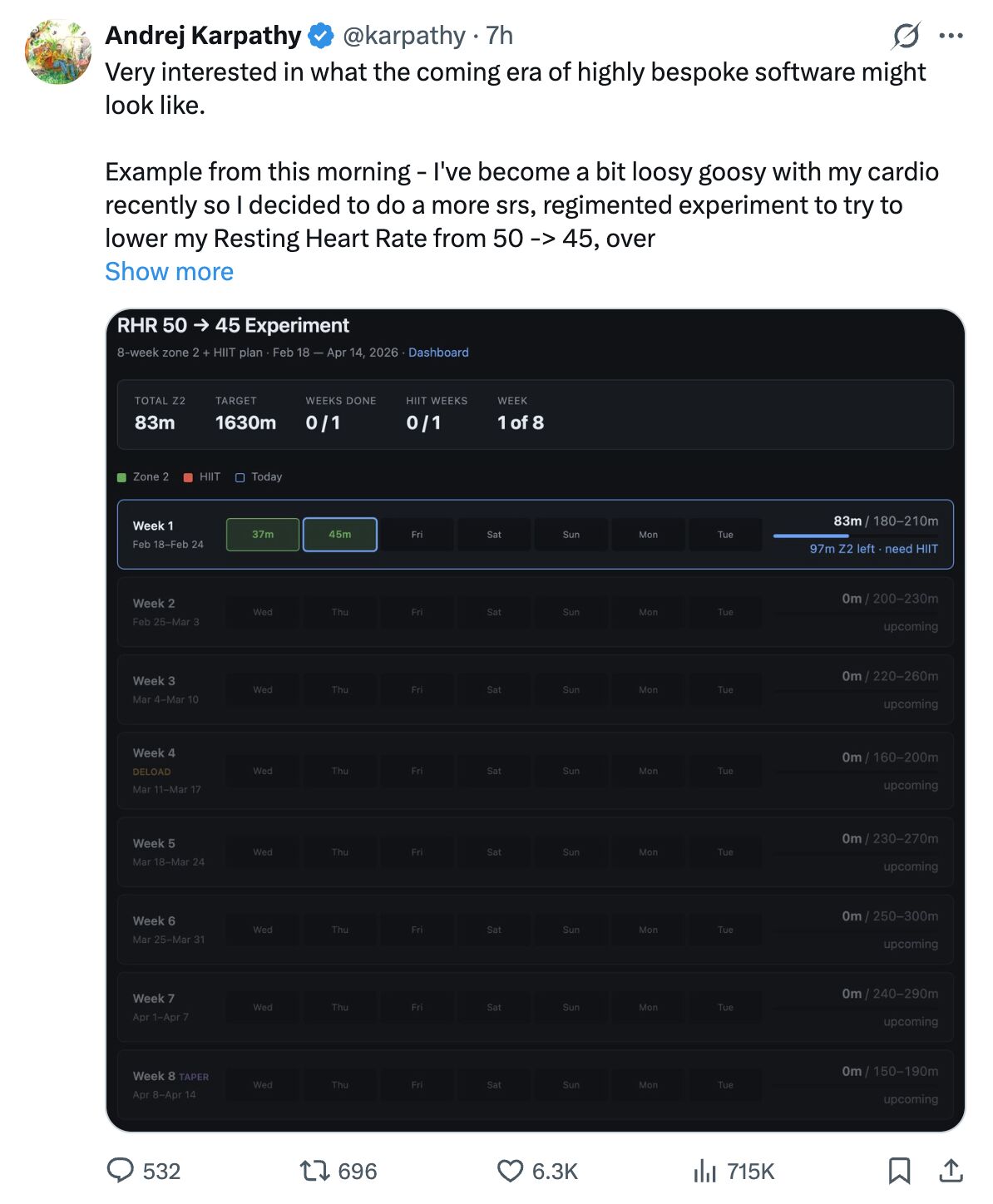
Andrej Karpathy posted his resting-heart-rate experiment on X. The same is true for me: these days, I hardly know a founder around me who is not using Oura, Whoop, an Apple Watch, or something similar. I would bet that it will become normal for individuals, like corporate data scientists, to live with a scientific mindset and run experiments on their own bodies, minds, and everyday lives.
People's personal blogs will gradually turn into collections of N=1 experiment papers. People will build and use their own experiment tools more easily, and "personalization" will be redefined, not as a company's monetization strategy, but as a model overfit to me that I have personally verified actually works for me.
Far more people around me no longer drink alcohol. Once they see, in numbers, how badly alcohol affects their health metrics, many move from cutting back to quitting entirely. Just as with companies, if people do not measure and look, they do not change.
A similar example: if the goal is dieting, then GLP-1 competes with CGM, and CGM competes with personalized metabolic-estimation models. A person whose body, mind, and daily life are all logged and modeled can run countless simulations on top of their digital twin. If you apply the successful ones back to real life, I believe that is AI for humans.