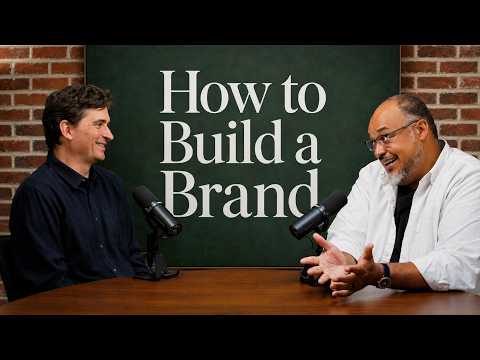
This video challenges the belief that startups can build a brand through logos, advertising, press coverage, and branding agencies alone. Dalton Caldwell and Michael Seibel describe a real brand as the reputation accumulated by repeatedly keeping promises through products and service. Founders must first clarify whom they serve and what they intend to do exceptionally well, then continuously improve their product to make customers' lives and work better.
1. Brands Matter, but People Misunderstand How to Build Them
The video begins with a joke about how awkward Anthropic's AI name, Claude, initially sounded. A name that first prompted "Was that the best they could do?" becomes natural and familiar once the product is useful enough.
"If Claude does enough for you, you start saying, 'It's my best friend. I love Claude.'"
They joke about starting a branding agency: step one, hire the agency; step two, profit. This is satire. They agree that building a great company requires a great brand. Their objection is to founders treating brand building as something solved through spending or external activities.
Michael lists common activities mistaken for brand building:
- Indiscriminately sending promotional messages
- Chasing press coverage
- Securing as many conference speaking slots as possible
- Constantly staging clever events and publicity stunts
These activities are not necessarily worthless, but they are not the core. What matters most is the service and product experience customers actually receive.
"Much of your brand comes from the service you provide to customers."
Dalton revives the once-common phrase word of mouth. Although discussed less today, customers' experience using the product remains the strongest force shaping the company's brand.
"If you want to build a brand, make your next customer love your product."
He argues that making one customer truly love the product creates ten times more brand value than most conventional branding activities. 😌
2. The Illusion That You Can Buy a Brand
Founders get confused because people naturally want to outsource difficult problems. They think, "Our product is great; we just don't have a brand," and assume a consultant or agency can fix it.
This resembles trying to buy Product-Market Fit. It reflects a wish to skip building a good product, understanding customers, and learning through trial and error.
"We want to buy the best thing and take a shortcut to a good outcome, without doing the hard work."
Apple illustrates the point. People admire its brand and wonder whom to hire to become like Apple. They may imagine recruiting a famous designer such as Jony Ive would do it. Michael summarizes what Apple actually did:
"Apple made products we really wanted to buy."
The envy of seeing a friend's iPod and thinking "That's really cool" is closer to the essence of its brand. People remember Apple's ads, but it is harder to say that any particular ad created the brand's strength.
Their conclusion is simple: there is no shortcut to a brand. A company must repeatedly exceed the promises it makes to customers over a long period.
"You build a brand by exceeding your promises again and again and again."
"Your brand is defined by what you repeatedly do."
Brand is accumulated at every customer touchpoint, not added as decoration. Features, support, deadlines, honest pricing, and responses to problems all contribute.
3. Real Customer Satisfaction Matters More Than the Growth Chart
Michael says founders often see an upward growth chart and conclude too quickly that the product works. They then ask how to increase distribution or strengthen the brand.
Many companies' charts initially rise, then bend downward and fluctuate. People try a product and use it during a contract, but do not enthusiastically recommend it if it disappoints. They may resent being told to use another new tool at work.
"When your company asks, 'Want to try this?' you say, 'Stop. I don't want another new tool.'"
Eventually customers leave. Before spending time on brand building, founders should use that time to solve problems well enough that customers genuinely enjoy working with the company.
"If you had spent your branding time solving customer problems, customers would say, 'I love this company.'"
The starting point is an experience customers want to talk about themselves, rather than a flashy message.
4. How Reddit and Twitch Built Real Brands
Dalton notes that Michael sits on Reddit's board and is a longtime friend of cofounder Steve Huffman. He asks jokingly whether Steve hired a branding expert to make Reddit the world's most important website.
Michael recalls a well-known exchange between Steve and Paul Graham, or PG. The advice was simple: assume many people on the internet are like Steve, and build something Steve himself would genuinely enjoy using.
"Assume there are many people like you on the internet, and make something you would really enjoy."
This gave the founder permission to believe that others might enjoy what he enjoyed. Early Reddit did not have today's many subreddits; it was essentially one community. Michael jokes that its only subreddit was Steve.
"Early Reddit was like Steve running his own personal subreddit."
Steve was not unique: many people shared his tastes and needs. Reddit grew by building a product loved by particular users, with the brand emerging afterward.
Twitch's Turning Point: Serving Streamers Well
Michael also shares his Justin.tv and Twitch experience. Brand did not matter much during roughly the first five years, because they had not identified the core users they could genuinely help.
The turning point came when they recognized streamers as their core customers. Streamers wanted income, stability, and good support. Better support led to more content, which expanded the platform: a virtuous cycle.
"Serving streamers well built our brand."
A competitor later offered large sums to recruit Twitch's popular streamers. COO Kevin Lin knew Twitch could not match those amounts and told them honestly:
"We cannot match that money. If you want to go, we understand. But if it doesn't work out, know that we love you and you can always come back."
Many left. But in month three, when their first promised checks were due, they were not paid. The competitor had promised large sums without the ability to monetize the streamers. Everyone who left ultimately returned to Twitch.
"Not lying to users can be a way to build a brand."
The story shows how honesty, trust, and treatment of customers build brand more than eloquence or design.
Michael sees inadequate customer service as a fundamental reason many companies fail. He puts it bluntly:
"There is probably a 99% chance your company didn't work because you didn't serve users well enough."
If a company does not meaningfully improve customers' businesses, lives, or work, different branding techniques are unlikely to fix the underlying problem.
5. Strange Names Become Familiar When the Product Is Good
Names that now seem like powerful brands often felt awkward or unattractive initially. Airbnb once used airbedandbreakfast.com. Dalton remembers finding its name and logo extremely unappealing.
"It seemed like the least appealing brand I could imagine."
Today Airbnb is recognized worldwide. People became familiar with the name and logo, and the useful service gave the name meaning.
Claude is similar. It initially sounded like a slightly odd human name. Once it helps users do their work, the name stops being an issue.
"If Claude does enough work for you, you say, 'It's my best friend.'"
Kalshi has also largely kept its original name and logo. Many users may not know the word's origin or meaning. Yet as the service grows and people encounter it in conversation and television ads, it becomes a strong brand.
"Ask people what Kalshi means, and they'll say, 'I don't know.'"
Whatnot likewise kept the name it used when applying to YC, with relatively modest website improvements. Its yellow W identity remained essentially intact. It is now a widely recognized brand with a high app-store ranking.
Famous startup brands may have required far less spending or sophisticated branding work than people assume. Most effort went into products, customers, operations, and solving market problems.
6. Do Not Import Another Industry's Branding Formula Unchanged
Dalton warns against directly applying other industries' branding methods to technology products. In commodity markets such as supermarket ice cream, where products may differ relatively little, packaging, color, logos, and shelf placement can strongly influence purchases.
He cites Talenti's transparent containers, which let shoppers see the ice cream. In such markets, the visible surface of product innovation may be packaging and design.
"If the surface of innovation is logos and packaging, branding conversations may matter more in that industry."
Software and technology products delivering complex functionality to consumers or businesses are different. Their value is more complex than packaging: doing work well, saving time, and being reliable matter more.
"If your product does all sorts of things for consumers or businesses, it's probably much more complicated than a logo and transparent packaging."
Instead of copying consumer-goods branding, startups should examine the core value customers experience in their own product.
7. First Define What You Will Do Well
Before discussing brand, founders should answer what their startup is trying to do, whom it serves, and what it wants to excel at.
"What is our startup trying to do? Whom do we serve? What do we want to be exceptional at?"
Brand is the ability to articulate those answers clearly and deliver them through products and service.
"Your brand is your ability to express those things and actually do them."
No branding campaign can rescue a founder who describes the company only as doing "various things for people."
"If you can't articulate that, no amount of branding helps. What are you actually trying to do?"
Founders must also know their values and what the company stands for. Brand is defined by repeated choices and actions, not the company's slogan.
8. Question the Product Before Blaming the Brand
Michael's practical advice is to assume the product is misleading you when results disappoint, before blaming the brand. The phrasing is harsh, but the point is that product problems are much more common.
"Assume the product is screwing you, rather than the brand. You'll be right more often than wrong."
Even if teammates or users call the product great, founders should remain somewhat skeptical. Good companies keep improving rather than settling for that praise.
"The best companies keep making a good product better and better and better."
The wrong attitude is to think a good product is finished and it is now time for brand, sales, and marketing. Brand is not an independent task separate from the product.
"Brand isn't something off to the side. It's part of the whole."
"Brand is the result of consistently making great products over time."
9. When Rebranding Makes Sense, and When It Does Not
A name change can be reasonable when the business outgrows the name's actual scope.
ZenPayroll became Gusto when it wanted to expand beyond payroll into services such as health insurance. "Payroll" could constrain how people understood its broader role, giving the change a legitimate reason.
"They wanted to do more than payroll."
But changing the name did not immediately make it a unicorn.
"They didn't become a unicorn just by renaming themselves Gusto."
Twitch also had a reason to move away from Justin.tv: it shifted from a platform for watching anything to one centered on gaming streams. A name reflecting the direction and reducing confusion made sense. But the change from Justin.tv Gaming to Twitch did not itself generate growth.
"Twitch didn't grow because we changed its name to Twitch."
Rebranding can explain a product and business direction more accurately or reduce customer confusion. It is not a magic cure for stalled growth.
10. Excessive Rebranding Can Signal Internal Politics
Dalton says much rebranding may try to solve internal politics and organizational problems, rather than serve outside customers. Google's many products with similar, confusing names may reflect separate teams independently creating and naming products.
"I think that's an org-chart problem."
Google's chat and AI offerings can leave users unsure what AI products it currently provides. The proliferation of names, including Gemini, may reflect internal boundaries and interests more than customer clarity.
Repeated changes among HBO Go, HBO Max, and Max illustrate similar confusion. They identify two likely explanations for repeated major branding or rebranding:
- A clear, urgent reason, such as business changes or customer confusion
- Internal politics and organizational conflict becoming visible externally
"If a company keeps doing branding exercises or rebranding, there is either a rational reason or it's a symptom of internal politics showing through."
Sometimes, as with Comcast becoming Xfinity, a company may also seek distance from an exceptionally poor reputation.
"Maybe they're running away from a terrible, terrible reputation."
11. Closing: A Brand Is a Cumulative Record of Kept Promises
The video's message is clear. Hiring a branding agency or changing a logo does not automatically create a startup brand. What customers tell friends after using the product, how honestly the company handles problems, and how much it improves customers' lives or work determine the brand.
When founders feel their brand is lacking, they should first ask:
- Exactly whom do we serve?
- Which problem do we solve for them?
- What do we promise to do exceptionally well?
- Do we exceed that promise every time?
- Is the product truly good enough, or are we blaming the brand?
A powerful brand may begin with a good name, but customer experience gives that name meaning. Their conclusion is that companies building good products, treating customers honestly, and consistently keeping promises develop the strongest brands over time.