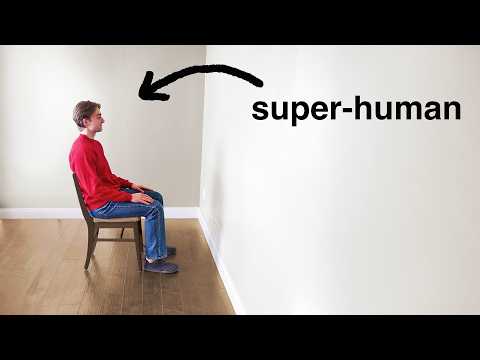
This video explores the true meaning of flow and focus, sharing the experience of a week of maximizing productivity using a unique method called 'staring at the wall'. Based on Ryan Doris' three principles, we show that minimizing unnecessary use of digital devices and preserving 'mental bandwidth' can increase not only work efficiency but also satisfaction with daily life. For those who want to increase engagement and improve their quality of life, this video will provide new perspectives and practical advice.
1. The beginning of numbness: Changes from an ordinary Monday 🫠
The video begins with the speaker staring at a wall, which he says, believe it or not, helped him have the most productive week of his life. They explain that the key to this technology is not the wall itself, but not doing anything else, such as looking at your phone or checking email. Instead, focus on the task at hand or remain in a state of doing nothing.
The narrator struggles with applying these new rules on his first day at work after the year-end vacation. Normally, I would have worked on a video, listened to music, or used a calculator app before work, but this week I couldn't do anything because it was a 'doing less is more' challenge. The second rule was 'Do not look at unnecessary screens while working or outside of work', and he honestly expresses his feelings, saying, "I don't like this." 😭
The reason he is taking on this challenge is because he is currently in charge of a very important and difficult project that requires solving the company's biggest problems. A lot of important people were counting on the success of this project, and he felt he had to get 'in' to make it a success.
When the speaker talks about immersion, he thinks of Ryan Doris. Ryan Doris explained how the brain focuses and how to increase productivity by leveraging the 'dopamine system' that causes cell phone addiction. He introduces Ryan Doris' three principles:
- Take a Boring Break: Emphasize that doing nothing, like not looking at your phone or staring at a wall for 20 minutes, is important for your brain to rest and recover.
"One of my favorite things to do is stare at the wall. Stare at the wall for 20 minutes and your mouth will water."
- Take advantage of gaps: I advise you to take time to 'just be', such as not taking out your phone even for a moment, waiting to use the bathroom, standing in line, or driving without music.
- Focus on one thing at a time: Avoid multitasking and focus entirely on the moment when making appointments or talking to others.
The speaker attempts his first 'wall stare', applying Ryan Dorris' principles in his own way. I set a timer for 10 minutes and looked at the wall, but at first I didn't feel the effect as strong as I expected. I didn't know how to look at the wall or how hard to focus. But he tells himself "Just hang in there. Don't look away, and next time it will open the door to something much deeper".
After work, the speaker experiences the first real effects of this routine. Not being able to do anything other than work all day made me feel a strong urge to play the drums, and I was able to fully enjoy the present moment when I went for walks with Kate. He expresses satisfaction with the change, saying "It's really nice to just do one thing and enjoy the rest of the time. It gives me space."
2. The beginning of immersion: Tuesday, signs of change 🧘♀️
On Tuesday morning, the speaker feels anxious that he has not been able to get as much done as yesterday, and decides that he needs to focus on work again. Although he still struggled with the temptation of distraction, he says he soon realized that he had to trust the process.
"You sit down and feel like you can't concentrate at all, but then suddenly a few hours pass and you're completely immersed. You just focus on your work and suddenly it becomes the most interesting thing you've ever done."
After lunch, feeling low on energy, I attempt a second 'wall stare'. This time I stared at the wall for 12 minutes and had an amazing experience. His head throbs, but then he completely relaxes and focuses on the light on the wall. As he watched the light slowly crossing the wall, he felt as if the light was bending and moving, and he had a strong feeling as if the wall was pulling him towards him.
"I don't know what to think, but I don't know if I'm doing it right. It somehow worked."
He says he achieves great results by being in a complete 'flow state' for several hours. We emphasize that we have laid the foundation for solving one of the project's biggest problems, and that this is significant progress.
After work, I have an experience that gives me a new perspective on this challenge. I wanted to relive the sense of peace I felt when I worked out without music on Sunday and drove home quietly, but this time I felt nothing. "We got rid of the screens and made everything simple, which was becoming a new reference point, a quieter reference point," he says, explaining that while life's moments can be exciting or boring, he is now more sensitive to those emotions and more able to notice the little things. It is said that this became 'an interesting piece of the puzzle' for him.
3. Total immersion: Wednesday, peak productivity 🚀
On Wednesday, the speaker truly enters the 'orbit of immersion'**. You start coming to work early, and as you get used to this routine, work no longer feels like 'work'. Thanks to the work he did in the morning, he achieved great results in important meetings. Everyone liked the form he created, and it represented an important step forward for the project.
At the same time, interesting changes occur. Talking to Kate allowed me to be more assertive than usual, and I felt like it gave me mental clarity and allowed me to process things better in real time.
"I feel like I have more mental bandwidth now that I'm not filling my head with emails, YouTube stats, podcasts and all that information. I don't really want to use any digital devices right now. Even if I could open my laptop, I really don't want to."
The third 'wall staring' of the day resulted in a much faster 'neural reset'. As he immersed himself in the wall, he became more relaxed, but his consciousness also resisted. However, as time passed, the resistance decreased, and he reached a semi-conscious state where he felt almost completely fused with the wall.
"The thoughts became blurry, like a dream. I felt like if I continued... (they would get deeper)."
After this experience, he says he was in a 'state of total flow' for hours, and describes staring at the wall as 'magical'. He is proud of how quickly he found solutions to the project's remaining problems, accomplishing many of the major accomplishments that would normally take a week in just two days.
Although he begins to feel confident about this routine, he also shows a cautious attitude, saying "He who is unprepared for war is doomed to defeat". And based on his own experience, he shares important insights about 'mental bandwidth'.
- You have more mental bandwidth.
- By not filling your brain with random information, you can become more immersed in your current experience.
- You notice all the little things, and you become more present in the moment.
- This makes the experience richer.
4. Unexpected difficulties: Thursday, cracks and realizations 📉
On Thursday morning, the narrator again begins with a small mistake, such as spilling coffee, and is wary of his arrogance. He confesses "I was too comfortable and I almost messed up badly on this challenge for the first time". Work is going smoothly when you go online to order something for your thumbnail, and then before you know it you're checking your email, watching YouTube stats, and responding to an interesting brand offer message. Twenty minutes go by in a flash, and he admits his mistake.
"I'm really screwed. I had no idea how seriously this would affect my brain. Now I have to put it all aside and get back to work. I keep thinking about that business deal. I put too much thought into it. It was probably a mistake."
He tried to delay lunch and focus on work, fighting the urge to check his email again, but it was difficult to focus with all the information he had already received. But this experience gave me the most important insight into 'concentration'.
The speaker explains the brain/mind using pictures. The brain has space, and when you focus on something, it occupies part of that space. The more space you have, the more useful and present you can be. But I've found that if I let other information in for a while, like work emails or YouTube studios, they don't go away and they stay in my mind all day.
"Once you open a door, you can't close it. So be careful what you focus on, because whatever you focus on will be welcomed."
With this realization, he begins to put the pieces together. But when it came to 'staring at the wall', I was overdoing it. I tried staring at the wall for 25 minutes, but the pain got even worse that day. He said his headaches got worse, and when he looked at walls, details disappeared and he felt as if he was looking through walls. In the end, I ended up sitting there completely exhausted with 9 minutes left.
"I don't know why I feel like my head is full of sand after doing this, but it puts me back into a flow state for hours."
Nevertheless, he went into 'immersion mode' for several hours again, and when he completed a complete prototype of what he was working on and showed it to his boss, he was very satisfied and praised it.
5. Fruitful Friday: Synthesis of Enlightenment 💡
As the week progressed, the evenings became simpler and less interesting, but the narrator says that was good for what it was. However, at this point, he expressed fatigue, saying that his brain was 'fried' due to extreme concentration. I tried to read the ad, but it didn't work very well.
On Friday morning, all the pieces begin to fit together in the narrator's mind. He illustrated his understanding of 'mental bandwidth'. Before starting this routine, he thought his mental bandwidth was split evenly between YouTube work and work, with plenty of room for other activities like housework and exercise.
But in reality, what I thought was YouTube work consisted of numerous fragmented activities such as checking email, checking YouTube studio statistics, editing, research, and thumbnail work. Even before he started working at the company, his brain was already full of too many thoughts. Additionally, I was constantly receiving additional information such as YouTube videos and podcasts.
"When I thought my bandwidth was like this, it was like this: I barely had any time to spend meaningful time with Kate or actively think about anything."
He realized that basically, he was filling his mind with too much information and that was why he was not doing well and was exhausted from doing so many things. There was almost no mental space.
With this realization, he shared his work with his team, and everyone gave him positive feedback on his work. Even the chief product officer reportedly responded enthusiastically. This was the result of his efforts, and it completely changed people's perception of the project.
Additionally, this routine has had a positive impact on his personal life. He found it more enjoyable to spend time with his wife, Kate, who also said that the atmosphere at home became more comfortable while he was taking on this challenge.
Kate: "I feel like the atmosphere in my house has become more relaxed. I would recommend it to others. It has inspired me to use my phone less. Some days I've thought, 'Now I don't have to look at my phone right away.' It makes my head quieter, and I think I'm better able to deal with other stressors and problems."
Friday's final 'wall-gazing' lasted 30 minutes, and he says he is now able to instantly engage at the deepest level as soon as he sees the wall. I had no thoughts and my body felt completely paralyzed.
"But it really dulls the brain. 30 minutes is probably too much."
He says 30 minutes was too long and he had to sit for the next 10 minutes and wait for it to end. This experience left him very exhausted.
"Honestly, you don't need to take that long."
6. Conclusion: 4 core principles for engagement ✨
After completing the week's experience, the speaker once again emphasizes the concept of 'mental bandwidth', which he explains is the overall ability to focus on something. Every time you focus on something, you use some of this bandwidth, and as the remaining bandwidth decreases, your concentration decreases. It is said that the more mental bandwidth you preserve, the more you can focus on the present, which enriches your life by allowing you to experience life's small moments more deeply.
Based on all of this experience, he presents Four Core Principles that he recommends to everyone.
- Don't do anything else before the most important thing.
- The first thing you focus on during the day occupies a prime position in your brain.
- Since there are no other competing factors, dedicate this time to the things you most want to focus on that day.
- The speaker himself says he will wake up at 5 in the morning to work on the video, but will only focus on a single goal (e.g. if it's editing, focus only on editing software).
- Stare at the wall for 10 minutes when you don't feel like working.
- 10 to 15 minutes is appropriate; any longer than that will reduce the effectiveness.
- This is a kind of 'hack' to reset your mental bandwidth.
- It is most similar to starting the day over again and has a brain-resetting effect similar to a power nap.
- He says you'll be amazed at how much easier things become after this.
- Use pen and paper whenever possible to preserve mental bandwidth.
- Screens provide us with so many 'inputs'** - notifications, flashy colors, icons - that they rob us of our mental bandwidth.
- All input - emails, videos, podcasts, social media, news - all drains your mental bandwidth.
- On the other hand, pen and paper involve no 'input' at all.
- In situations where you could use a screen or pen and paper, it's a good idea to use pen and paper to maintain mental clarity. (I recommend the mini notebook sold at Walgreens!)
- Delay unnecessary input as long as possible.
- The more you can block out all that extra information for as long as possible before it takes up your bandwidth, the more present you can be.
- Of course, he freely admits that he will look at this information during his lunch break, but he says it's important to be intentional about moderating it.
Lastly, he emphasizes that all of Ryan Doris' suggestions are great, and says that he especially likes 'inhabiting the in between'.
"I enjoy thinking and coming up with interesting ideas. It makes an incredibly big difference. And filling that space with checking social media feels like such a huge loss. It's a special time, I believe."
He asks those who have tried these methods or are already doing them to share their experiences in the comments, and jokes that he's ready to go back to watching trashy videos. 😉
Conclusion
This video delves into the nature of flow and the importance of managing your mental bandwidth through the seemingly simple act of 'staring at the wall'. It makes us realize how easily we lose focus and waste mental energy amidst the flood of information in the digital age. The speaker's one-week experience vividly illustrates the paradoxical truth that doing less can actually lead to achieving more, and suggests that we, too, can improve our quality of life through reducing unnecessary stimulation, intentional rest, and focusing on a single goal. The realizations gained through this journey go beyond simple productivity gains, and provide practical wisdom for living a richer and more present life in everyday life. ✨