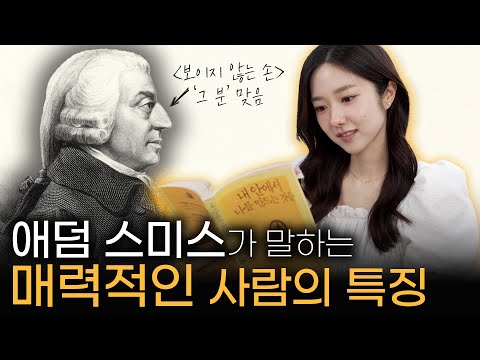
This video compares Adam Smith's two major works — The Wealth of Nations and The Theory of Moral Sentiments — to explore the depth of his philosophy. Through How Adam Smith Can Change Your Life, Russ Roberts's modern retelling of The Theory of Moral Sentiments, the video highlights the concept of the "impartial spectator," the two paths to earning "love" (wealth and fame vs. wisdom and virtue), and the importance of empathy and prudence in becoming a genuinely attractive person. It conveys Smith's message that true charm comes not from becoming rich or famous, but from caring about others' happiness and cultivating virtue — and it invites viewers to reflect on the kind of life they want to live.
1. Adam Smith and His Two Faces 🧐
When people think of Adam Smith, they typically picture the father of economics and the "invisible hand" — someone who argued for economic liberalism with minimal government intervention. One of his famous lines goes:
"It is not from the benevolence of the butcher, the brewer, or the baker that we expect our dinner, but from their regard to their own interest."
This is usually interpreted to mean that when individuals pursue their own interests, they ultimately benefit society as a whole. But remarkably, Adam Smith also wrote a book with a seemingly opposite message: The Theory of Moral Sentiments. In it, he writes:
"How selfish soever man may be supposed, there are evidently some principles in his nature, which interest him in the fortune of others, and render their happiness necessary to him, though he derives nothing from it except the pleasure of seeing it."
It is fascinating that these two seemingly contradictory claims came from the same person. 🤔 In fact, Smith was a moral philosopher before he was an economist. He wrote The Theory of Moral Sentiments before The Wealth of Nations, and he revised it six times over his lifetime — a testament to how much he valued it. He even reportedly wished for his epitaph to read: "Here lies the author of The Theory of Moral Sentiments." This story alone shows how central the book was to his identity.
The Theory of Moral Sentiments grew out of the moral philosophy lectures he taught at university, and the final revised edition appeared in the very year of his death — meaning he was still refining it until the very end. The book is deeply imbued with the insights of a lifetime.
2. Russ Roberts's How Adam Smith Can Change Your Life ✨
The book introduced today, "내 안에서 나를 만드는 것들" (published in English as How Adam Smith Can Change Your Life), is a modern, accessible retelling of Smith's Theory of Moral Sentiments by Professor Russ Roberts of Stanford University. Roberts had originally read only The Wealth of Nations, but when he stumbled upon The Theory of Moral Sentiments, he was convinced it was a true treasure that deserved to be widely known — because while The Wealth of Nations is universally famous, The Theory of Moral Sentiments has long languished in its shadow.
After reading The Theory of Moral Sentiments, Roberts says it completely transformed how he viewed other people's lives and his own, and taught him how to connect with others. That is why the original English title is How Smith Can Change Your Life — he wrote it hoping the book would have the same positive impact on readers' lives that Smith's work had on his. 😊
Two hundred and fifty years ago, Adam Smith was already asking fundamental questions about life: "What is happiness?" and "Does owning wealth make you happy?" The answers are embedded in The Theory of Moral Sentiments. As mentioned earlier, the book opens by explaining that however selfish human beings may be, they are by nature interested in the fortunes of others and wish to make others happy even when they stand to gain nothing from it.
"Why do we feel an impulse to help a stranger in difficulty on the street?"
3. The Impartial Spectator: The Conscience Within Us ⚖️
As one answer to why self-interested humans still want to help others, Adam Smith proposed the concept of the "impartial spectator." This impartial spectator is like a judge who watches us with a broad, clear-eyed view — something close to our inner conscience.
But while personal conscience can be subjective, the impartial spectator emphasizes objectivity. Even when no one is watching, this inner observer judges whether our actions are moral or not. Smith says this impartial spectator is formed over time through the accumulation of positive and negative feedback from others, beginning in childhood.
"A person who is conscious of the impartial spectator's gaze humbles their arrogant self and corrects their behavior to a level that others can sympathize with."
This leads to the realization that one is not the center of the universe — as if there were an avatar standing beside you, constantly watching. And this avatar is shaped through relationships with others. The video's host reflects that the impartial spectator might be Adam Smith's other "invisible hand" — one that, within society, creates not only economic order but moral order as well.
That is why understanding Smith solely through The Wealth of Nations is to know only half his philosophy. He cared just as deeply about the moral dimension of human life as the economic one.
"I did not intend to say only what is in The Wealth of Nations. I tried to provide balance in The Theory of Moral Sentiments."
Imagining Smith saying this to us from the grave, one can feel the sincerity behind his words. 😊
4. Two Paths to Love 💖
In The Theory of Moral Sentiments, Adam Smith says that the one thing we desperately want in life is "love" — not erotic love between partners, but love in the sense of respect, attention, and recognition. This is similar to the concept of love discussed in Alain de Botton's Status Anxiety, and indeed, de Botton himself cites The Theory of Moral Sentiments in that book.
The desire to be loved is almost instinctive. In primitive societies before civilization, failing to receive others' love was a threat to survival itself. Escaping the cold, protecting oneself from predators, gaining access to scarce resources — all of it was tied directly to love, meaning the recognition and care of the community.
Adam Smith presents two paths to earning this love.
4.1. The First Path: Becoming Rich and Famous 💰
He argues that people gravitate toward those with great wealth and power, which means the wealthy and powerful receive more attention and recognition. But Smith was critical of the pursuit of wealth.
"How many people ruin themselves by laying out money on trinkets of frivolous utility? The lovers of toys are fond of the machinery of the toy more than of the utility which it affords. Their pockets are stuffed full of little conveniences. They contrive new pockets, unknown in the clothes of other people, in order to carry a greater number."
And elsewhere:
"The misery and disorder of human life arise from overrating the difference between one permanent situation and another."
People, he argues, already have everything they need, yet they stake their lives on trivial things and spend money in ways that ruin them — because they believe those possessions represent who they are. The luxury boutique employee who looks down on a poorly dressed customer is acting from the same psychology: "I work at a luxury store, so I am luxury. My standards are this high, so I'm allowed to look down on people who don't dress well."
Fame is also a path to love, but Smith offers this perspective on it:
"People desire to attract the notice of their fellow creatures, even at the expense of constraining their own freedom. This is because they think such attention amply compensates the hardships, anxieties, and mortifications they endure in order to become objects of it."
But Smith emphasizes that the moment one achieves fame, one permanently loses freedom, ease, and carefree security. We frequently see in the media how paparazzi destroy the private lives of superstars. Elvis Presley, Marilyn Monroe, Queen — they received immense adoration, but suffered quietly in their later years. The host reflects that fame carries great advantages but also demands equally great sacrifices.
"In the most glittering and exalted situation that our idle fancy can hold out to us, the pleasures from which we propose to derive our real happiness, are almost always the same with those which, in our actual, though humble station, we have at all times at hand and in our power."
Once addicted to the dopamine of public adulation, the quiet pleasures of everyday life grow dull, and people can end up taking darker paths. In the end, Smith wanted to emphasize that while wealth and fame can be one way to earn love, the sacrifices and costs that come with them are steep. 😥
Those who achieve wealth and fame also become vulnerable to false praise and flattery. Because people constantly tell them only what they want to hear, it becomes difficult to find genuine friends or a sincere partner. The book gives the example of a newly appointed CEO who worries, "People seem to find me funnier all of a sudden" — and begins to question whether the applause and laughter he now receives are truly heartfelt.
5. The Second Path: A Life of Wisdom and Virtue 💖
Adam Smith offers a second way to be loved — one that carries none of these side effects or sacrifices. That path is to pursue a life of wisdom and virtue. We tend to assume that earning love requires accumulating enormous wealth and power, but Smith says that simply becoming a wise and moral person is enough to earn the love of others. His advice is not merely to be loved, but to become worthy of being loved.
Smith presents two human types and explains that the model we choose to follow shapes our character and behavior:
- One is the vulgar and showy person 💥
- The other is someone who is not flashy, but distinctive, elegant, and beautiful ✨
The former attracts the gaze of idle passersby; the latter draws the attention of those who learn diligently and observe carefully. In other words, all humans strive to be loved, and two roads lie before us — which one we choose is up to us.
The host suggests that this accumulation of choices is perhaps why the book carries its Korean title: "the things inside me that make me who I am." The inner qualities we cultivate and the paths we choose ultimately define us. This is why Adam Smith, speaking as a moral philosopher, advises us to walk the road of wisdom and virtue to become genuinely lovable and attractive people. 😊
6. The Virtues of an Attractive Person: Empathy and Prudence 😇
But "virtue" can feel like an abstract and difficult concept. One of the core elements of virtue in The Theory of Moral Sentiments is empathy.
Adam Smith explains that empathy ultimately means bringing your own emotional level down to match that of another person. For example, it is difficult for someone else to fully understand the pain you have experienced. So we consciously try to temper our emotions when in the presence of others. Appearing composed in front of others is not pretense or hypocrisy — it is a form of consideration, an attempt to meet the other person at their emotional level.
Imagine you've had a huge fight with a friend, partner, or family member and you're furious. Then your phone rings — it's your boss or a business contact — and you instantly switch to a calm, pleasant tone: "Yes, of course, sir." Strangely, once the call ends, your emotions have settled somewhat and it feels awkward to go back to being angry.
This is why Smith says emotions like anger are actually easier to calm in the presence of strangers than with friends — because we try to empathize by matching the other person's emotional register. The ultimate message is that a life lived in empathy with others is the life most worthy of trust.
Another crucial element of the "lovable person" — the person of virtue — as Smith describes them, is prudence. In today's world, many chase the dream of instant success and quick riches, but a prudent person is wary of such get-rich-quick temptations and instead strives to improve a little every day.
"Aren't such people incredibly attractive to those around them? They stand out precisely because they are different from everyone else."
Think of those who quietly and steadily do their work without fanfare — and you will see how magnetic this virtue of prudence truly is. Even without fame or wealth, the host notes, many of the people they have maintained close relationships with for over ten years share this quality. Many of their favorite friends have it too.
"Through profound insight, Adam Smith shows us how to become mysteriously compelling — and how to earn 'charm capital.'"
People who are deeply prudent, who know how to modulate their emotions when sharing difficulties, who pay careful attention to others and empathize — these are precisely those people.
7. A Life of Dignity and Refinement 👑
Adam Smith described the prudent person this way:
"The prudent man is not willing to subject himself to any responsibility which his duty does not impose upon him."
And elsewhere, in a passage the host connects to the idea of "vulgar promotion" — Smith writes that the prudent person disdains the cheap tactics that others use to seek public attention and fame.
"Vulgar promotion" — does that not immediately call to mind social media? As more and more people use exaggerated claims, fabricated stories, and aggressively provocative hooks to grab public attention, The Theory of Moral Sentiments seems to pose a deeper question: how do we maintain our dignity? 🧐
The video raises the question of how Smith, an economist who contributed so much to the journey of capitalism, could have written The Theory of Moral Sentiments. The two books can seem contradictory: The Wealth of Nations focuses on human self-interest, while The Theory of Moral Sentiments argues that humans are not unconditionally selfish and genuinely wish for others' happiness.
The host says, "These two perspectives finally feel like they are properly in balance." The plea, then, is to remember Adam Smith not only as the man who gave us the "invisible hand," but also as the man who gave us the concept of the "impartial spectator."
The Theory of Moral Sentiments is an old and dense book that can feel daunting. But with the help of books like this one — which translate the original into something easy and engaging — we can apply Adam Smith's profound philosophy to our own lives. ✨
Closing Thoughts 🌟
This video made clear that Adam Smith was not simply an economist, but a great thinker who explored the depths of human nature and morality. His concept of the "impartial spectator" and his teaching on "earning love through wisdom and virtue" remain as relevant today as ever, prompting us to reconsider what true attractiveness and happiness really mean. His message — that rather than chasing wealth and fame, the way to live a truly loved and valuable life is to empathize with others and cultivate our lives with prudence — resonates deeply. May you, too, build your own "charm capital" through Adam Smith's philosophy and live a life worth admiring. 💖