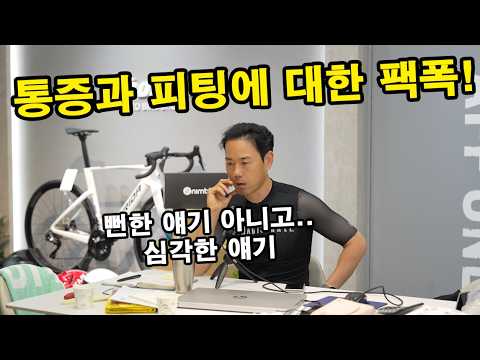
This video takes a deep look at the root causes of knee pain and other pain that can appear while cycling. It emphasizes that these problems cannot be solved by bike fitting alone. Most cycling pain comes from excessive training and accumulated damage in the body, and the speaker advises overcoming it by paying close attention to your body, training gradually, resting properly, and eating well. Fitting should focus on functional problems. Pain relief requires strengthening and caring for the body itself first.
1. Pain Is Uncomfortable, but It Is the Truth
The video begins with the speaker filming early in the morning. He says he wants to share a necessary message, even though riders may find it uncomfortable to hear. Cycling is enjoyable, but the process of gradually applying load, enduring pain, and becoming stronger means that pain is always present. At the same time, he says he personally did not suffer much pain, which raises the question of why.
"Stories that bring the truth are always uncomfortable."
As someone who has ridden for a long time and even won national amateur competitions, he says he is highly sensitive to how his body moves. Because of that sensitivity, he was able to manage pain well. He came to understand which approaches lead to the wisest and fastest recovery, and what the underlying causes of pain are.
2. The Main Culprit Behind Pain Is Damage
The speaker says that over more than a decade of cycling, he has met many people and realized that cycling is much deeper than it first appears. He recently changed his own fitting again, and that process made him think more deeply about other people's pain.
In analyzing the causes of pain, he says a large part of it comes from what he has long emphasized: damage.
"It is damage. Damage. I have said that a lot of pain happens because of damage."
There is now an enormous amount of fitting information on YouTube, but he points out that this information often does not solve people's pain. Sizing and fitting are processes of matching the body to the bike, but in many cases, simply moving the saddle a little does not make pain disappear.
3. Fitting Is Not a Cure-All for Pain
The speaker explains that in most cases, the root cause of pain is damage that has already accumulated in the legs themselves. Of course, the fitting can be wrong. But unless the problem is something basic, such as cleat position or a fundamental fitting mistake, fitting alone is unlikely to solve it.
When he consults with riders, he says he looks at their training style, leg condition, joint flexibility, core development, posture, and other factors together. Through that diagnosis, he tries to identify the cause of pain and prescribe a direction, while emphasizing that he is neither a doctor nor a human body specialist.
"As someone who had a disc problem and a misaligned pelvis, I trained my own body, learned the causes, understood muscle movement and functional issues, and became sensitive to my body. Because I had injuries, I became even more sensitive."
Because he experienced injury and learned how to become sensitive to his body and train it, he advises people who come to him to make their own bodies more sensitive as well.
4. The Key to Pain-Free Enjoyment: Tolerance and Gradual Training
When asked what riders should do before pain appears, the speaker says they need to build tolerance.
"I tell people to build tolerance in their body. Build tolerance."
By tolerance, he means how broadly the body can accept and endure stress or load. Instead of recommending a difficult route to a complete beginner, he emphasizes that riders should increase distance gradually and build muscle over time.
He uses his own experience as an example. Because he rode at his own pace without overdoing it, his legs did not break down. He advises riders to avoid riding with people much stronger than themselves, avoid overly difficult courses, practice restraint, and increase the load little by little. He adds that a proper fitting may be needed once during that process.
Recently, he led beginner rides not at a 20 km/h pace, but at a pace where everyone could enjoy the ride. Even complete beginners were able to finish a 60 km ride happily, and he uses this example to emphasize again the importance of gradual training.
5. Too Much Motivation Leads to Injury
The speaker shares a recent and unfortunate experience: some highly motivated members, with both talent and willpower, improved very quickly but eventually could not avoid injury. Because of that, he now explains the importance of rest, though he adds that members who have begun to enjoy cycling often do not rest well.
"It is fine to rest fully for a week or even two. While resting, build the muscles around the knee."
He gives the example of a student who complained of foot pain. Since there was no fitting problem, he diagnosed that the painful area itself was weak. He then guided the student to strengthen that area intensively, and the pain disappeared.
6. Fitting Is a Functional Issue; Pain Is a Body Issue
The speaker again emphasizes the essence of bike fitting.
"Fitting comes from functional issues. It does not relieve pain, everyone. This is the essence." "Fitting does not make pain disappear."
If a rider is within the normal fitting range but still feels pain, he says there is a high chance that the knee cannot withstand high intensity, meaning the rider is riding at an intensity the body cannot handle.
He says that if you are sensitive to your body and can take good care of yourself, self-fitting may be possible. But if not, he warns against constantly changing your fitting too casually. Changing the fitting too often can create even more confusion.
7. Why Do City Bikes Not Hurt Your Knees?
The speaker raises an interesting question.
"When you ride a city bike around the neighborhood, most of you almost never feel knee pain, right?"
He explains that city bikes do not hurt your knees because you ride them at a low level of intensity. This matches his own experience. A friend who spent a long time riding alone slowly and training his body may not have been very skilled, but he had no knee pain.
By contrast, riders who are passionate, energetic, and improving quickly may actually be more vulnerable to injury. The speaker reflects that he should have guided them more carefully and helped them slow down.
In the end, fitting can sometimes be a cause of pain. But the fundamental solution is to consult an expert, diagnose the body accurately, and train in the right direction.
8. Strict Self-Management for Better Performance
The speaker says everyone wants to ride better, but at some point everyone reaches a place where they become weak. To break through that threshold and become truly skilled, strict self-management, especially nutrition, becomes essential.
"Once you reach a certain level, nutrition is one of the things you have to manage with real discipline."
He explains that simply eating something like a bowl of gukbap will not lead to progress. To pull out your maximum performance, you need nutritional support, such as concentrated energy sources.
He says cycling becomes much more fun when you take care of your body and pay close attention to it. Riders who want to pursue higher goals need this effort. On the other hand, people who are satisfied thinking, "I ride well enough in my neighborhood," can stop there if they wish.
9. Pain Management: Rest and Expert Help
When pain appears, the speaker says you need to rest a little and pay attention to body care, including physical therapy or direct massage. Joint pain and iliotibial band pain require rest no matter what. Muscle pain, however, should be approached from a training perspective. In some cases, stronger training may need to be applied first, followed by rest.
He emphasizes the importance of gradual accumulation of damage and efficient training. If that is difficult, he tells riders they can come to him at any time. He is based at Neo Bike in Gumi Chilgok and says he is ready to care for riders according to their level.
"Come to me. If you come to me, I will raise your level systematically."
He says he is not a doctor, but he can help diagnose the cause of pain and understand the situation. He promises to keep working so that riders can get closer to the essence and the truth. Finally, even in a busy schedule, he expresses his desire to communicate with and help riders out of his love for cycling.
Closing
The video makes clear that cycling pain is not merely a fitting issue. It is the combined result of body damage, training style, and self-management. To reduce pain and enjoy riding more, you need to listen carefully to your body, train gradually without overdoing it, rest enough, and eat properly. Fitting matters for functional problems, but pain-free riding becomes possible only when strengthening and caring for the body itself comes first.