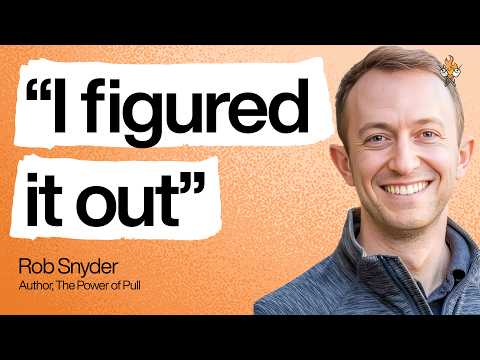
In this conversation, Rob Snyder walks through the mindset and process for discovering product-market fit (PMF), from initial ideas to first contracts, retention, and repeatable growth. The goal is not to persuade customers to buy through sheer effort, but to find the moment when someone with an urgent, unresolved task pulls the product toward them because they need it now. Rob offers a concise diagnostic framework: PULL—Project, Unavoidable, List of options, Limitations.
1. PMF Is About Pull, Not Push
Host Lenny introduces Rob Snyder as the author of The Power of Pull and the newsletter The Physics of Startups. Rob has helped more than 50 startups reach roughly $1 million in annual recurring revenue (ARR). He says his advice comes not from theory, but from a major failure he experienced as a founder.
For two years, he pushed a product customers did not want. People said it looked good and valuable, but did not buy it. After an accidental pivot, it began selling rapidly, changing his understanding of why customers buy.
"People may say, 'This product is great and solves a problem.' But that doesn't mean they will set aside their own priorities to buy it."
By pull, Rob means demand so strong that customers want to take the product out of the founder's hands, asking themselves why they are not already using it. Many early startups instead try to manufacture interest and push products on customers. They may sell a little, but that is not strong PMF.
"For someone with real pull, not buying is the strange choice."
This is more specific than simply finding a good problem. A customer has something they must accomplish now, and existing approaches cannot do it. If the startup clears that blockage, there is no reason to postpone buying. Rob compares this to a compressed spring: when the right solution reaches a customer already under pressure, the stored energy turns immediately into a purchase.
The video briefly includes an advertisement for WorkOS, which provides APIs for enterprise SaaS capabilities such as SSO, SCIM, permissions, and audit logs. DX, which measures the impact of AI in engineering organizations, is also introduced as a sponsor.
2. The Four Conditions in the PULL Framework
Rob breaks strong customer demand into four components. All four must exist together to create strong buying motivation.
-
P — Project
- The specific task the customer is trying to accomplish now.
- It should be a real objective, such as hiring more employees, not merely wanting to buy recruiting software.
-
U — Unavoidable
- Why the task must be done now rather than later.
- Examples include deadlines, legal requirements, a manager's demand, lost revenue, or operational risk.
-
L — List of options
- Alternatives the customer is already considering or using.
- These include doing it themselves, hiring someone, outsourcing, using existing tools, or doing nothing.
-
L — Limitations
- Why those alternatives are insufficient.
- They may be too expensive, slow, inconvenient, unable to meet regulations, or beyond the internal team's capabilities.
"The customer has a project, must do it now, and has already considered alternatives that all fall short."
The first two resemble the familiar idea of an important, urgent problem. Rob particularly emphasizes the last two: even if a task matters, customers will not buy something new if their current approach already handles it well enough.
"If they can do it themselves or solve it with existing tools, they have no reason to buy from you."
Hearing about discomfort is therefore insufficient. You must find out whether customers are actually trying to change and how badly existing solutions block them.
3. Jump: The Demand Created When All Four Conditions Exist
Rob uses Jump, an AI meeting-notes tool for financial advisers, to illustrate PULL. Advisers must document client meetings and enter them into a CRM. Failing to do so can expose them to regulatory or legal problems, making it unavoidable work rather than just a nuisance.
Their situation is:
- Project: Document client meetings in the CRM.
- Unavoidable: Failure to keep records may create regulatory and legal risk.
- Existing options: AI note-taking apps, manual notes, and existing CRM workflows.
- Limitations: Insufficient CRM integration and uncertainty about financial-regulatory compliance.
Advisers who saw Jump therefore did not merely find it interesting. They reacted strongly and wanted to adopt it immediately.
"This must have been what it felt like when Alexander Graham Bell invented the telephone."
By contrast, the same product did not sell well to insurance agents. They also meet clients and keep notes, but CRM documentation was not a mandatory obligation for them. Unavoidable was missing. Their most realistic alternative was simply not taking notes—and that was what they did.
The example shows that customer groups that look similar do not necessarily represent the same market. Even with the same problem, a purchase may not happen without pressure to solve it right now.
4. Pull Is Discovered, Not Created
Rob's most liberating realization was that pull is not something to force into existence through product or marketing. It is something already present that must be discovered.
"The projects on their to-do lists existed before me and independently of me. I don't need to persuade them into existence; I need to find them."
Founders often ask, "Our product is valuable, so why don't customers understand? How do we persuade them?" Rob recommends changing the question. Before persuading people, find those who already have strong motivation to buy.
Customers with real pull say things like:
"Wait, what exactly can you do?"
"How do we get started?"
"Do you already have a product?"
"Can we adopt it right now?"
By contrast, these may be compliments but are not evidence of pull:
"That's really interesting."
"It looks like the future of the industry."
"That could help cut costs."
"Send me some materials and I'll review them with the team."
Especially in B2B, founders must remember they are selling to a specific individual, not an abstract company. They are not selling to SpaceX, for example, but to a person such as its head of legal who has a task they cannot resolve.
"You aren't selling to SpaceX. You're selling to SpaceX's head of legal."
5. Find Ideas in the Field, Not in a Meeting Room
Rather than inventing an idea and then finding a market, Rob recommends first finding people and settings where pull exists. It is hard to judge a list of product ideas, but much easier to test the hypothesis that a particular person is currently blocked on a particular task.
He says ten Zoom customer interviews are not enough. Treat it as a matter of survival and enter the customer's actual working environment.
"If your life really depended on it, would you stop after ten 30-minute Zoom interviews? You need to go and see."
He describes a founder friend with no product idea, only a desire to help small businesses. The friend observed several industries firsthand, found solar installers a poor fit, and moved on. Eventually, after spending days working alongside independent physical therapists, he felt a connection.
He went so deep that he considered buying a physical-therapy clinic franchise to inspect its profit-and-loss statement. Along the way, he found therapists urgently trying to reduce a particular expense, while existing consulting approaches were expensive and slow.
Rob emphasizes field experience for two reasons:
- Real opportunities rarely emerge from whiteboard brainstorming.
- Building a company means making thousands of decisions to serve particular customers well; without firsthand experience, good judgment is difficult.
"The purpose of building a company is to help someone. Without firsthand experience, how will you make the thousands of decisions needed to help them properly?"
Looking across roughly 50 startups he has helped, he estimates that 10% of ideas came from founders' own problems, while 90% came from direct experience in customers' environments.
6. Test Your Pull Hypothesis with Two Slides
Once you discover an opportunity, formulate a pull hypothesis before building the product. Rob recommends two slides instead of a complicated pitch deck when testing it with prospects.
The first summarizes the customer's reality:
"You are trying to do X. You need to do it now because of Y. You've tried A and B, but they haven't been sufficient because of Z. Have I understood correctly?"
The desired reaction is:
"Oh my God, yes. That's exactly it."
The second shows a conceptual picture of the solution:
"It sounds like you want a faster way to reduce this cost than traditional consulting provides. If we helped you do it through XYZ, would that be the direction you want?"
The goal is not approval in principle but concrete buying behavior:
"Great. How do we start?"
"I can pay now. Can you do that for me?"
Rob calls these pull-shaped verbs. The customer should ask how to proceed now, not say they might use it someday.
"'We could consider it next quarter' is not pull. Pull is 'I need it now.'"
The advice to solve your own problem should also be tested this way. A problem you would actually pay to solve is a good starting point. Merely wishing a product existed is risky.
"Look in the mirror and ask yourself, 'Would I really buy this right now?'"
This works especially well in B2B, but can apply to consumer products too. Spanx is cited as a business that began with the founder's own problem and refined the specific product through real customer responses.
7. The Hail Mary Question for Lukewarm Reactions
Not every customer interview produces an "Exactly!" response. Many are lukewarm. Before abandoning the conversation, Rob recommends one final, direct question:
"Is there anything on your to-do list that you would pay me to solve for you right now?"
He calls this the Hail Mary question, like a last-minute football pass seeking a miracle. When the original hypothesis fails, it can open a new opportunity.
One startup tried selling an applicant-tracking system to government agencies without much enthusiasm. When it asked this question, a customer identified writing job descriptions as something worth paying for now. That became the first contract, and the company then grew rapidly.
This approach also reduces fear of selling. As an introverted founder, Rob once found sales burdensome because he thought he had to persuade someone to buy. A different perspective made it easier:
"I'm just finding out whether I can help someone with something they're stuck on. If they don't need help, that's fine. If they do, we can explore it together."
8. Traps to Avoid at the Idea Stage
Rob identifies several patterns early founders should avoid.
Building the Product Too Soon
The biggest trap is believing you must build a product before showing anything to customers. AI makes prototyping faster, but spending weeks or months building without customer conversations remains dangerous.
"Don't put off for the longest time the reality you need to face the soonest."
Test whether customers actually want to buy before building. You do not need a finished product initially; a hypothesis, sketch, or service proposal can be enough.
Trusting Design Partners Too Much
Contrary to common advice, Rob does not strongly recommend design partners. They may share a founder's vision and provide abundant feedback without ever paying.
"They may be playing the role of 'helping this startup,' rather than having something they need to solve right now."
Customers with genuinely urgent tasks do not want to collaborate on development; they simply want the problem solved quickly.
"Someone who needs an important task done doesn't want to become a design partner. They just want it done."
He therefore advises attempting a real sale as soon as possible instead of first proposing free pilots, proofs of concept, or design partnerships. If a trial is required by the customer's purchasing process, that can be followed. The key is not weakening the buying signal by volunteering a free experiment.
9. Outreach That Creates Your First Customer Conversations
With a pull hypothesis, the next step is talking to prospects. Rob's early target is a consistent two or three prospect conversations a day.
He advises against lengthy explanations of the product's value or problem-solving capabilities in LinkedIn messages or emails. The goal at this stage is not a sale, but simply opening a conversation.
"The message is not a tool for creating pull. It is just a way to start a conversation to find out whether pull is already there."
He calls this founder magic. A message can amount to: "You're interesting, I'm interesting, let's talk."
One startup wrote:
"Hi. Snoop Dogg invested in us. We thought you might find that interesting. Would you like to talk?"
Another approach is a personal connection that resonates with the customer group. When contacting HVAC businesses, for example, "I helped with my parents' plumbing business in high school" may work better than "I'm Sam Altman's former chief of staff."
Usually, one or two sentences suffice. Rob believes mass-producing AI-personalized messages is not particularly effective early on. Customers readily recognize an AI-generated summary of facts they already know about themselves.
"The customer will think, 'Claude wrote this.'"
His approximate LinkedIn outreach benchmarks are:
- Send 100–150 connection requests a week.
- Add roughly 20 people a day, consistently.
- Expect an acceptance rate of about 30–40%.
- A reply rate of 30–50% among those who accept is reasonably good.
Below those rates, check two things. If requests are not accepted, the founder's profile may look like that of someone about to make a sales pitch. If people connect but do not reply, the message may not be interesting enough.
10. The First Sales Call: Discovery, Not Persuasion
Rob divides a sales call into two stages:
- Discovery: Determine whether the customer actually has pull.
- Proposal: If pull is confirmed, briefly and clearly show how you can help.
The premise is forceful:
"If you have pull, you'll take the product out of my hands."
It is not a session in which the founder forces persuasion on the customer. With a sufficiently strong problem, the customer will instead persuade the founder to let them buy.
Calls are usually scheduled for 30 minutes. Rob recommends opening with:
"Thank you for making time. You probably hear from a lot of people—what made you decide to talk with me today?"
The answer may reveal the customer's project, urgency, current approaches, and limitations. The founder can then ask permission to go deeper:
"That's interesting. Could I ask a few questions to understand the context better?"
This avoids making the customer feel interrogated. If they cannot clearly explain their reason, ask a broad PULL-oriented question:
"Is there something important you haven't been able to accomplish with your current tools, team, or way of working?"
When they identify a task, follow up:
- Why must it happen now?
- Could it be left undone, or is postponement impossible?
- What alternatives have they already tried?
- Why were those alternatives insufficient?
The scariest but most important question is:
"You've probably considered other approaches. Aren't those already working well enough?"
The customer might say, "Yes, actually we can do it ourselves." Rob says hearing that quickly can save years of a founder's life.
"That question can prevent years spent forcing an unwanted product into the market."
If roughly five calls reveal neither strong pull nor new insights, revisit the hypothesis. Failure in one industry is not necessarily the end, however. One team got nowhere after five banking-customer calls, but an introduction to someone in defense produced a powerful reaction on the very first call.
"We don't sell for the sake of selling. We sell to learn."
11. What Matters More Than Being Ten Times Better
Rob does not fixate on the claim that a new product must be ten times better to succeed. The more important question is how severely the customer is blocked by existing alternatives.
Other AI note-taking tools existed when Jump arrived, but they did not satisfy financial advisers' CRM and regulatory needs. Strong pull arose not because Jump looked vastly prettier, but because it let customers properly accomplish something they needed for the first time.
"The real question isn't 'Is it ten times better?' It is whether the customer is a compressed spring, and how they react when I appear."
Linear versus Jira can be viewed similarly. Linear is known for a faster, more attractive experience, but good UX alone does not win every market. Jira's friction may obstruct one customer's work, while an old interface is irrelevant to another's purchase decision.
Rob himself once believed a superior UX would ensure success, only to fail because buyers did not care about that UX.
"Even if you build me a home printer that's a hundred times better, I won't buy it if I don't need one."
The key is not whether the product looks objectively better, but whether it actually removes a particular customer's current blockage.
12. Closing the First Deal and Setting a Price
When a customer says they want to buy, the founder must offer a concrete next step even without a finished product. Rob describes a founder speaking to a pharmaceutical executive. The founder had neither product nor slides, but when the executive complained about slow, inefficient market research, the founder summarized the problem on the spot:
"You want faster market research, with a solution similar to your current approach but better in a few respects—is that right?"
When the customer agreed, the founder proposed:
"I'll bring a prototype of what I have in mind in two days. We can see whether it meets your needs and decide whether to proceed."
No elaborate presentation is necessary at first. Bring a sketch or service design and ask what else you need to know about purchasing requirements.
Pricing can emerge naturally from PULL. The value customers receive or what they currently spend on alternatives provides a starting point. If a customer pays market-research consultants $50,000 annually, for example, that can anchor the conversation:
"If you currently spend $50,000 a year on market-research consultants, how would you feel if we also charged $50,000 a year?"
For early customers, confirming real willingness to transact matters more than optimizing price. For an important contract or ahead of demo day, however, Rob suggests offering a pricing case study based on market examples instead of naming a price directly:
"Similar projects cost $80,000 in some places and $1 million in others, with many somewhere between. What do you think of that range?"
This makes pricing a joint exploration rather than a one-sided proposal.
13. Start as a Service and Work Backward from the Customer's Deadline
You can sell before a complete platform exists. A service-led approach, delivering some parts manually while automating others, can be useful. For example, you might sell an "AI product manager" while initially having people do much of the work and gradually automating it behind the scenes.
This risks becoming trapped in consulting, but Rob says every strategy has drawbacks, and learning real customer needs can be much more valuable at the start.
"Customers don't expect a complete enterprise platform next week. Initially, they may expect something closer to a service."
Large enterprise deals also require managing internal purchasing processes. Instead of simply asking the buyer or champion what comes next, first establish when the project must demonstrate success:
"By when do you need results from this project?"
If the answer is the first quarter of next year, work backward from then. Scheduling implementation, security review, demos, decision committees, and contracting in reverse creates momentum through a complex buying process.
14. When It Fails, Enter Goblin Mode
Most founders do not get the first hypothesis right. Rob says finding strong pull immediately is rare. After several weak calls, analyze them again: who showed even slight pull, and what unexpected information emerged? Then form a new hypothesis.
When nothing becomes visible, what Rob calls goblin mode may be needed. This means getting much closer to customers with unusual persistence, even to the point of seeming a little abnormal.
"It's doing whatever you can to find out who would buy from you right now."
If a European conference full of potential customers starts tomorrow, for example, get on a plane. Another example involves an acquaintance's parent visiting dental practices one by one and asking them to speak with the founder. Dental-hygienist staffing startup Teero found its opportunity through this kind of bold fieldwork.
"Time is incredibly precious. You don't want to stay stuck for a long time in the hardest part, going from zero to one."
Goblin mode is an emergency measure when a hypothesis collapses and direction is lost, rather than a permanent operating style. The normal loop is:
- Form a pull hypothesis.
- Open conversations with short, interesting messages.
- Conduct roughly five customer calls.
- Check whether customers actually want to buy.
- Revise the hypothesis based on what you learned.
- Use the Hail Mary question and goblin mode to find new clues if needed.
- Repeat until strong pull recurs.
15. Retention Means Making It Strange to Leave
Selling is not the end. Rob recalls once giving customers login credentials after a sale and doing nothing else—like a dog that catches a car and does not know what to do next.
Retention is not mainly about surface metrics such as usage or high satisfaction scores. It is about finding the point at which quitting would feel strange.
"Every customer can churn until they reach a particular point. The core of service is identifying that point and getting every customer there as quickly as possible."
For Slack, sending thousands or tens of thousands of messages within a certain period was known as a leading indicator of retention. Once that much organizational communication accumulated, leaving Slack became impractical.
Rob's earlier startup built customer-retention software for restaurants. If a restaurant identified an at-risk customer and successfully prevented churn within its first two weeks, it strongly understood the product's value. Onboarding was therefore designed to produce that first success as quickly as possible.
Rather than simply sending the product to early customers, founders should use it alongside them and keep asking:
"What are you going to do now?"
"At what point do you feel you can't live without this?"
16. Churn Is a Signal About Your Ideal Customer, Not Just Failure
High churn is common in horizontal products serving broad audiences. Rob describes a startup with a general-purpose AI-workflow product whose customers mostly left.
But closer analysis revealed that freight brokers kept using it for a particular workflow. After identifying this pattern, the team focused the product and company on that group. It moved from a low-priced horizontal product with high churn to a more specialized, valuable offering for freight brokers.
"Losing more than 90% of your customers is painful. But looking at who stayed and why can teach you who your real customers are."
Rob says founders rarely reach complete certainty. Even large companies may remain unsure of long-term product success after revenue becomes substantial. The goal is not to eliminate every uncertainty, but to build a little more evidence for confidence at each stage.
17. A Startup Is a Repeatable Case-Study Factory
Rob's overarching operating model is the case-study factory. A startup should not create an entirely new kind of success every time; it should make the same type of customer success repeatable.
An ideal case study follows this structure:
- A particular customer was trying to do X.
- Existing options fell short because of Y.
- Our product or service provided Z.
- Before buying, the customer said, "Of course I need this," and afterward keeps saying, "Of course I'll keep using it."
"We're not making software. We're making case studies."
This factory has three stages:
-
Lead generation
- How do we get similar prospects to talk with us?
-
Sales
- How do we convert them into paying customers?
-
Delivery and retention
- How do we ensure they receive value and stay?
The model makes bottlenecks clear. Depending on whether leads are scarce, conversion is low, or churn is high, the company can identify the single most important thing to work on now.
"If lead generation is the bottleneck, solve that. If converting contracts is the bottleneck, that is the only thing that matters right now."
Case studies can become actual marketing materials, but the more important role is as a mental model. It lets founders quickly recognize customers who fit the ideal case and decisively exclude those who do not.
18. Established Companies Must Validate New Products the Same Way
The framework is not just for early founders. It also applies when established companies build new features, product lines, or second products.
Rob says some companies he advises try selling unbuilt products to existing customers first. Trust from an existing relationship does not remove the need to validate pull for the new offering separately.
A product leader at another established company said all successful ideas came from sales calls. Features customers actually asked for—"Can you also do this?"—succeeded, while those invented in internal whiteboard sessions often failed.
"Products customers requested during sales calls succeeded. Products we thought up at the whiteboard almost never did."
Established companies should act like founders when launching something new: form a hypothesis, speak to five customers, test actual willingness to buy, learn, and repeat.
19. Final Advice and the Lightning Round
Rob says the method looks simple but is not easy. Finding good ideas is hard, and searching for PMF is lonely and painful. The framework can, however, reduce years wasted on a market that does not want the product.
"It's like a metal detector on a beach. It won't find gold everywhere, but at least it won't leave you digging sand with a spoon."
In the lightning round, he shares:
- His favorite books are architect Christopher Alexander's four-volume The Nature of Order.
- He enjoys Pride and Prejudice and The Penguins of Madagascar.
- A recently useful AI product is Muse.
- His life motto is:
"Life is what you make it."
Finally, he identifies a recurring bad idea: entering a market with an established winner without a differentiation hypothesis. Seeing a fast-growing product does not mean an identical or slightly better version will succeed.
"They may already have won or already done it. Without a clear theory of a particular customer the existing product doesn't serve, these ideas usually don't work."
Rob says his own framework is not a finished theory, but work he will refine over the next 10–20 years. He asks viewers to apply it and send feedback.
Closing Thoughts
The central message is clear: do not merely build a product that looks good. Find customers with urgent, unresolved tasks. If existing alternatives cannot solve their problem and they ask, "How do we start right now?" as soon as they see the product, that is pull.
"Make a hypothesis, show it to people, and see whether they actually want to buy."
PMF is ultimately demonstrated not by founder confidence or customer compliments, but by customers pulling the product toward them before buying and refusing to let go afterward.