.png)
Momentum's 'Apple Health MCP Server' is an open-source solution that seamlessly connects Apple Health data to AI. This tool enables AI to easily analyze complex health data, making it broadly useful for athletes, medical professionals, general users, and researchers alike. Let's take a detailed look at the significance, how it works, real-world use cases, and challenges of this project that aims to achieve safe data use, openness, and extensibility all at once.
1. Project Overview and Core Values
In 2025, Momentum opened the path for AI to freely use personal health data that had been locked away in individual devices or proprietary formats through the Apple Health MCP Server. The big goal of this project is to provide a standardized open-source bridge connecting AI and medical data.
"Medical data is already among the richest personal data, but most of it has been locked inside devices or fragmented." "We don't stop at just showing code — we propose the approach itself. We believe easier, reusable, and open healthcare technology benefits everyone."
The Apple Health MCP Server isn't just a tech demo — it's an important technology for realizing developer productivity, user data ownership, and AI adoption innovation across diverse fields.
2. What Is MCP (Model Context Protocol)?
MCP (Model Context Protocol) is a new AI communication standard introduced by Anthropic in 2024, designed to help AI efficiently understand diverse environments and data. The core idea is to deliver structured and unstructured data to AI models in a standardized way.
"MCP is designed to clearly convey diverse information — documents, system metadata, user contexts, and more — to AI."
MCP adoption is spreading rapidly across the industry. Major companies including Google, Meta, and Microsoft are actively adopting the standard, and the development environment is evolving fast. Momentum has been implementing and validating features in real-world environments to keep pace with MCP's rapid changes.
"A few months ago, I looked at the docs and implemented an auth module — and before long, the framework itself had completely changed. In the MCP ecosystem, this level of change is now routine."
3. Why Build an Apple Health MCP Server?
Three main motivations drove this project:
-
Real-world MCP experience To respond in real-time to MCP's rapidly changing structure and present practical integration methods, security approaches, and standardized server architecture.
-
Practical use of personal data Millions of people accumulate Apple Health data, but getting meaningful analysis easily has been difficult. This project aims for AI to analyze that data in natural language and turn it into actionable insights.
-
Wearable data experimentation ground To directly work with years of massive time-series data on an MCP foundation, experimenting with time-window management, customized result delivery, and other real-world challenges.
4. How It Works: Apple Health Data → MCP Server → AI
Understanding the Data Structure
Apple Health exports all health data as a single export.xml file.
It contains various items — exercise, body metrics, heart rate, and more — all recorded with timestamps.
.gif)
The most common data types are:
- Active energy burned (~30%)
- Heart rate (15%)
- Basal metabolic rate (11%)
- Walking/running distance (10%)
- Step count (9%)
Data Transformation and Loading: XML → Elasticsearch
- Momentum parses the XML, improves data consistency and accuracy, then bulk-loads it into Elasticsearch.
- All dates are converted to ISO 8601 format, and values are converted to numbers to support fast search and statistical analysis.
MCP Server Architecture and Features
es_reader_router = FastMCP(name="ES Reader MCP")

@es_reader_router.tool
def get_health_summary_es() -> dict[str, Any]:
	...
Each tool is separated into xml_reader.py and es_reader.py for easy maintenance and extension.
Key Features
- Summary/statistics: Overall records, type-specific aggregation, time-series trend analysis
- Search/queries: Complex filtering by date, value, and source
- XML structure/content analysis: Full structure, specific type extraction, pattern-based search, etc.
5. Real Use Cases: AI Health Assistant for Everyone
The Apple Health MCP Server enables customized data analysis and insight generation across diverse fields.
(1) Athletes and Active Users
- AI automatically analyzes your exercise history to build and improve training plans
- Example prompt:
"I'm preparing for a marathon — can you give me advice based on my data?"
- Example response:
"You successfully completed a 26.46-mile marathon in March 2022. Your recent average pace is 6.2 mph (9:40/mile), suggesting you could target Sub-4:00. I recommend starting long runs at 8-10 miles and increasing by 1-2 miles per week."
(2) Medical Professionals
- AI provides supplementary clinical data insights for post-surgical recovery, chronic disease symptom changes, and early detection of abnormal patterns
(3) Fitness Coaches and Trainers
-
Automated reports and feedback tailored to athletic ability
-
Example prompt:
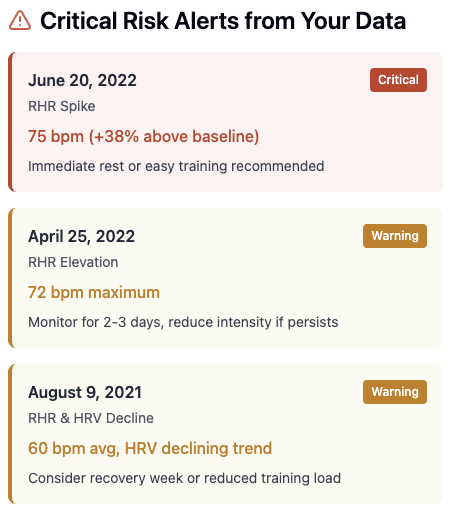
"I'm preparing for a race — can you check if I'm at risk of overtraining?"
-
Example response:
"Over the past 2 weeks, resting heart rate (RHR) has risen 11% above normal and HRV has dropped significantly. Warning: Focus on rest 2-3 weeks before the race, and take immediate rest if condition deteriorates."
(4) Wellness and Lifestyle Management
-
Real-life pattern analysis, low-activity day detection and healthy habit improvement
-
Example prompt:
"Can you analyze my low-activity days and help me adjust my lifestyle?"
-
Example response and insights:
.png)
"Activity is lowest during evening hours and extended work periods. Starting with 5-10 minutes of stretching in the morning can make a big difference."
.png)
(5) Research and Large-Scale Data Analysis
- Anonymized multi-user data processing, health trend comparisons across groups, seasonal/environmental effect analysis, and various research applications
- Example prompt:
"How do changes in daylight hours affect physical activity?"
- Example response:
.png)
"Activity peaks in spring (March-May) as daylight hours increase, showing a clear seasonal effect. Indoor exercise strategies are recommended for winter."
6. Real-World Challenges and Solutions
(1) Privacy and Security
Solution: By default, the MCP server runs only on the user's local computer, ensuring data doesn't leave the machine. External transmission only occurs when using a cloud LLM. Limitations: Large-scale local AI operation requires PC performance; cloud integration requires separate HIPAA and legal compliance.
(2) Barrier to Entry for Non-Technical Users
Solution: Desktop Extension installation automation is planned; tooling to enable one-click setup is in progress. Limitations: The technology is immature (introduced June 2025), Node.js-centric, and integration challenges exist in some environments.
(3) No Official API or Real-Time Integration
Solution: Manual/semi-automatic XML extraction support tools and direct Elasticsearch loading are provided. Limitations: No native iOS integration possible; real-time monitoring is limited.
(4) High-Frequency/Large-Scale Data Optimization
Solution: High-frequency data aggregation/summarization, alternative DB options, and enhanced MCP tool query efficiency. Limitations: Speed/memory issues exist in some edge cases.
(5) Irregular Measurements and Duplicate Data Cleanup
Solution: Time-unit resampling and deduplication algorithms applied during import.
7. Roadmap and the Role of Community
This project is continuously evolving:
- HTTP-based communication support
- High-frequency data summarization
- Installation automation tools (Desktop Extension) ...and various other improvements are underway.
"The power of open source lies in collaboration. Anyone can contribute code and leave feedback."
Detailed roadmap and first-time contributor guides are available on GitHub Issues.
8. Momentum's Open-Source Strategy: Innovation for Everyone
From the start, Momentum has aimed to make healthtech "simpler, more open, and more practical."
"We open-sourced this project for three reasons: (1) Transform complex medical data into 'clean insights' AI can use immediately, (2) Provide a reusable and extensible codebase, (3) Strengthen the ecosystem preparing for the future with MCP."
This project isn't just for Apple users. Its significance lies in creating a precedent for ethical, responsible connection of AI and sensitive medical data, and serving as a practical reference anyone can learn from.
9. FAQ
Q. What is the Apple Health MCP Server?
- An open-source server that converts Apple Health XML data via MCP protocol for easy use by AI, databases, and more.
Q. Why is XML data challenging?
- The structure is complex, and standardization/automation is essential for analyzing large volumes of data.
Q. Can it be used for research?
- Yes, it can be applied to population data analysis, clinical research, wellness projects, and more.
Q. Is there an official API or real-time integration?
- No. Apple doesn't provide an official API, so data must be manually exported first.
In Closing
The Apple Health MCP Server provides everyone with true ownership of personal data and the future of AI-powered health management. Built on openness and extensibility, an ecosystem is emerging where both technical and non-technical people can use health data more intelligently. In the spirit of open source, we look forward to your participation and collaboration in setting new standards.