
Brief Summary: This review analyzes, based on research from the past four years, how digital twins (DT) and artificial intelligence (AI) are revolutionizing personalized medicine in healthcare through chronological practical cases across various health domains. In addition to specific AI-digital twin cases applied in real clinical settings -- including cardiovascular disease, diabetes, and mental health -- it also covers technical and ethical considerations, limitations, and future directions. This provides a comprehensive understanding of how digital twins are opening new paradigms for patient-specific care, predictive medicine, and data-driven decision-making.
1. The Future of Healthcare Through Digital Twins and AI
The central topic of modern medicine is patient-specific personalized treatment. As diseases become more complex and medical data explodes, traditional approaches struggle to reflect the subtle differences between individual patients. Enter digital twin (Digital Twin, DT) technology. A digital twin creates a "virtual twin" containing all of a patient's medical and biometric data, and simulates various treatments on this virtual patient to predict outcomes in advance.
"Each patient's disease journey can become a dynamic simulation reflecting the individual's experience, rather than a simple repetition of treatment and outcomes."
Early digital twins originated in engineering fields like aerospace and machinery as digital models that functioned identically to real machines. This concept has gradually expanded into healthcare. Recent rapid growth has been driven by emerging technologies like artificial intelligence (AI), big data, and IoT.
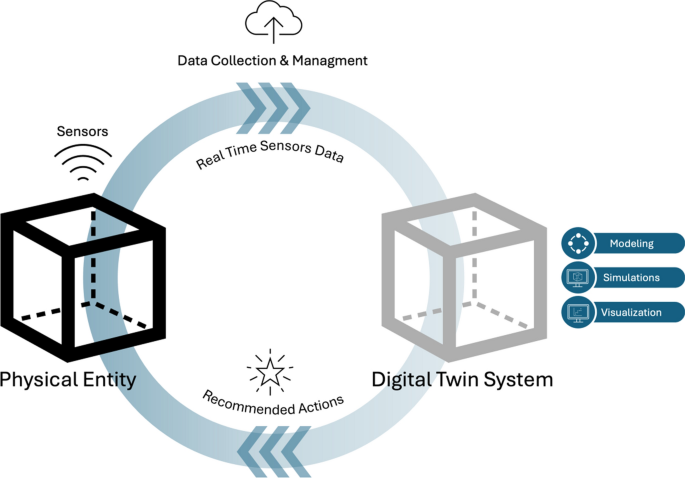
Standard digital twin architecture: connecting real-time data, computational models, visualization, and treatment recommendations
The essence of DT lies in bidirectional data flow continuously synchronized with the real world (patient/organ/physiological processes). Patient medical records, sensors, imaging, and genomic information evolve the digital twin in real time, while conversely, simulating various treatment scenarios directly supports clinical decision-making.
2. Study Selection and Methodology
This review collected 206 papers from Web of Science, Scopus, Google Scholar, and other databases spanning 2019-2024, ultimately selecting 17 papers for final analysis through rigorous criteria.
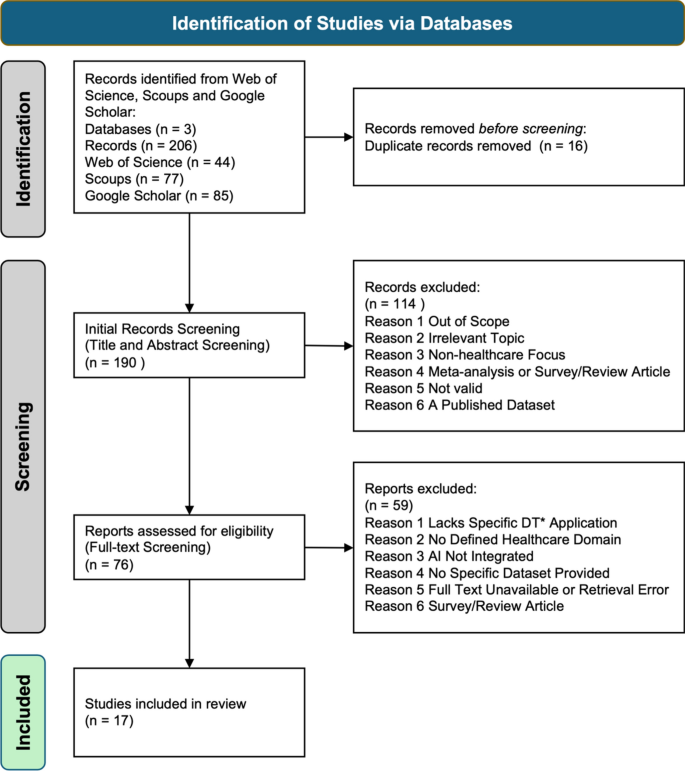
Search, deduplication, first/second screening, and final selection at a glance
The following criteria were clearly applied:
- Practical digital twin applications (excluding purely theoretical studies)
- Inclusion of AI/machine learning based applications
- Explicit use of real datasets
- Studies limited to the medical and health fields
"Through this approach, we were able to identify clear empirical results and trends showing how digital twins are advancing patient-specific care beyond theoretical concepts."
The following sections systematically categorize and introduce use cases by health domain.
3. Key Digital Twin Applications by Health Domain
3.1 Cardiovascular Disease -- Digital Twins for Precision Heart Care
-
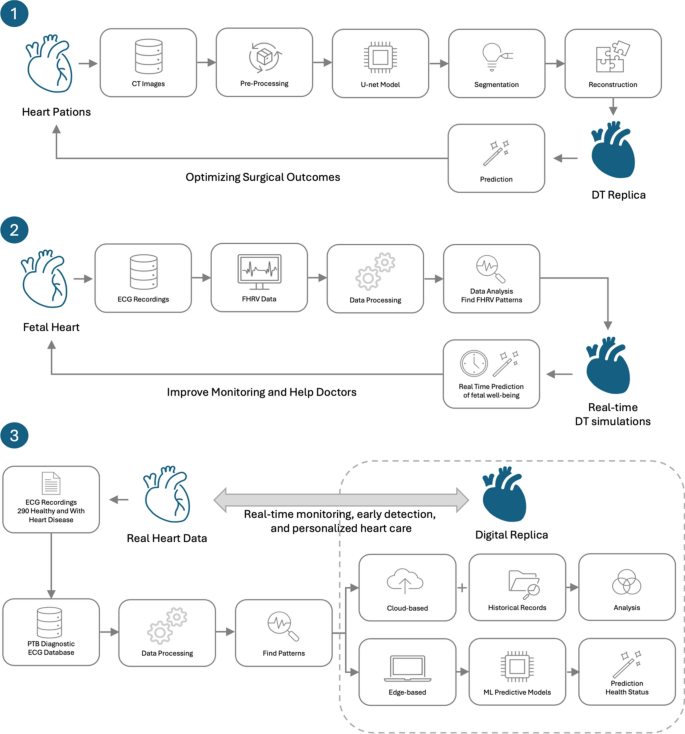
CardioVision (Rouhollahi et al., 2023): AI (deep learning, U-Net) automatically segments CT cardiac images to generate patient-specific 3D heart models, simulating pre- and post-procedure scenarios for complication prediction and treatment strategy optimization
"This model visualized calcification distribution -- a factor directly affecting AS progression and treatment success rates."
-
Fetal cardiac monitoring (Lwin et al., 2024): A digital twin combining fetal ECG data with various entropy metrics for real-time prediction of abnormal signs during delivery
"The digital twin system helps ensure safe delivery for mother and fetus by providing early warnings."
-
Cloud/edge-based cardiac disease prediction (Dervisoglu et al., 2023): Using real-time ECG data for dynamic monitoring of cardiac status, with edge-based approaches offering lower latency and faster response
3.2 Innovation in Diabetes Management
-
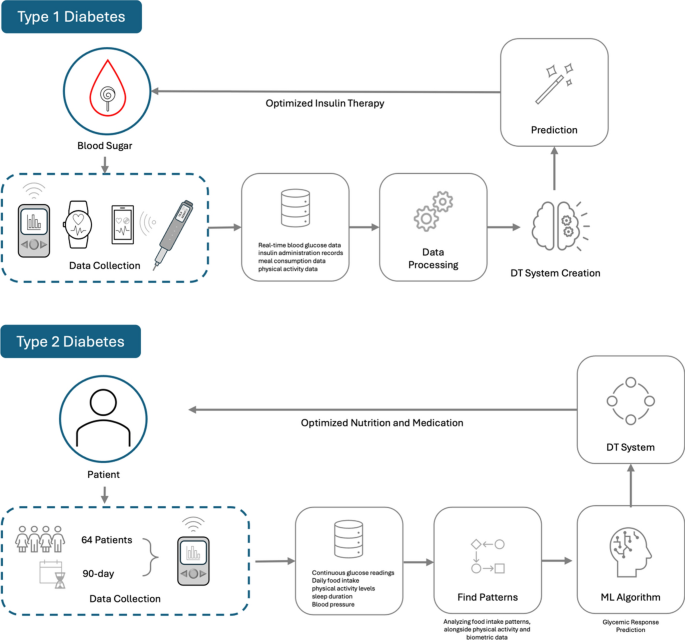
TWIN System (Cappon et al., 2023): A digital twin-based clinical decision support system (DSS) for pediatric and adolescent Type 1 diabetes patients. Integrating continuous glucose sensors, smart insulin pens, and exercise data to simulate the patient's in-body response in real time -- providing individualized insulin dosage recommendations.
"The TWIN system significantly reduces the burden of manual input by patients and caregivers while helping with personalized blood sugar control."
-
Precision nutrition-based Type 2 diabetes management (Shamanna et al., 2020): A digital twin learns the patient's dietary, activity, and blood sugar patterns, reducing medication dependence and providing personalized nutrition and management strategies.
3.3 Applications in Mental and Neurological Health
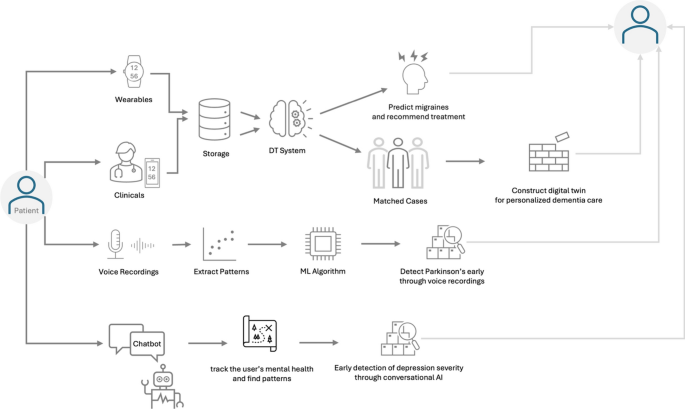
"Digital twins can integrate all data -- behavioral, cognitive, biosignals -- to predict diagnoses and treatment actions."
- Migraine management: Combining wearable biosignals (stress, heart rate, etc.) with clinical information and genetic markers -- enabling per-patient attack prediction and drug response simulation
- Dementia management: Developing patient-specific twins by referencing similar cases, then presenting diagnosis and treatment plans
- Early Parkinson's disease diagnosis: Using smartphone voice data, AI (k-NN + fuzzy logic) sensitively detects early and subtle voice disorders
- Depression diagnostic chatbot: NLP-based conversational AI using BERT for real-time psychological state assessment from patients' verbal expressions
"In chatbot experiments with real conversation data, early depression could be classified with 69% accuracy."
3.4 Other Practical Medical Applications: Wound Care, Respiratory, Stress, Public Health
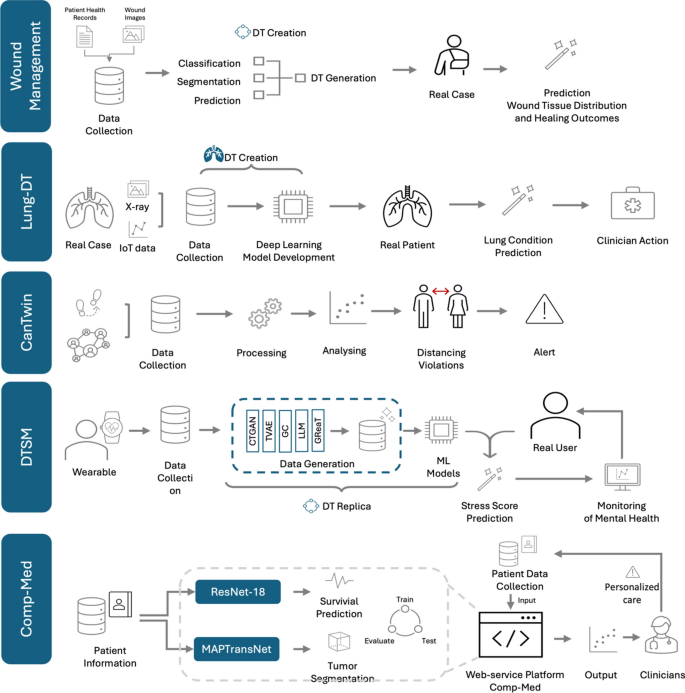
- Chronic wound management (Sarp et al., 2023): GAN models predict wound evolution to visualize treatment effectiveness and complication likelihood
- Pulmonary disease/COVID management (Lung-DT): Combining X-ray + IoT sensors (SpO2, etc.) with YOLOv8 deep learning for real-time classification/prediction of numerous pulmonary conditions
- Precision lung cancer prognosis/emergency response (Kolekar et al., 2023): Using large patient cohorts with AI (ResNet, MAPTransNet) for survival prediction and early deterioration detection in emergency patients
- Social distancing management (CanTwin): Real-time indoor crowd monitoring via sensors and IoT to minimize public health risks
- Stress management digital twin: Combining wearable data + synthetic data + AI models (XGBoost, LightGBM, etc.) for personal stress prediction/management
4. Latest LLM and Graph-Based DT Applications
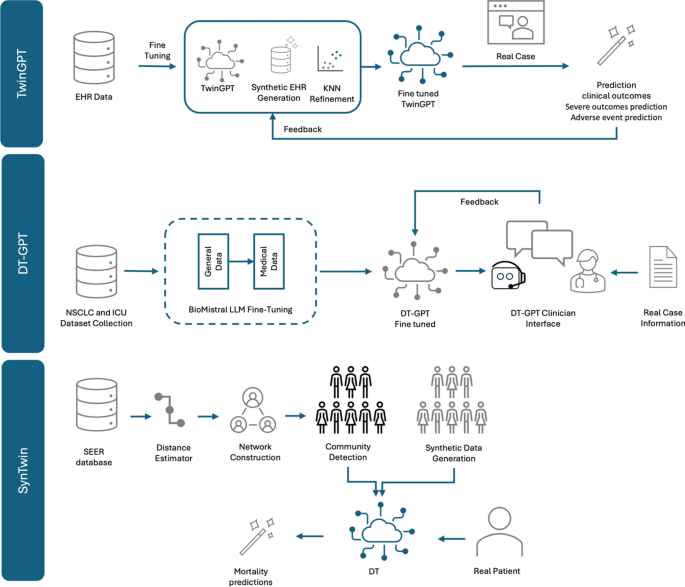
- Twin-GPT: Large language models (ChatGPT, etc.) used for generating customized twins of clinical trial participants and predicting various scenarios
"Even when individual medical data is scarce, LLM-based twins can create virtual patients to safely innovate clinical trials."
- DT-GPT: Latest LLMs (BioMistral, etc.) analyze even unstructured and incomplete patient data in sophisticated multi-layered structures, predicting future health trajectories for NSCLC (non-small cell lung cancer) and ICU patients
"DT-GPT can predict variables it has never seen before, with adaptability superior to humans."
- SynTwin: Combining graph theory and synthetic patient generation from data of over 10 million patients (SEER) for precision prediction of mortality risk and other outcomes by cancer patient
5. Ethical, Regulatory, and Clinical Implementation Challenges
The potential of digital twins is matched by deep concerns about ethics, security, and regulation.
Key Challenges:
- Data privacy/security:
"The risk of sensitive information from wearables, mobile devices, EHRs, and other sources being leaked grows alongside innovation."
- Technical measures such as anonymization, synthetic data, encryption, and edge-based processing are essential
- Regulatory gaps:
"Existing regulations are centered on static (fixed model) approaches and fail to properly address the learning and evolving nature of DTs."
- Standards for validation and stability of adaptive models need to be established
- Clinician acceptance and trust
- Explainable AI, integration with existing infrastructure like EHRs, pilot testing in real clinical environments
- Transparent explanation of the "why and how" behind AI recommendations
Conclusion
Digital twins + AI in healthcare are already demonstrating the future of patient-specific care across diverse domains including diabetes, cardiovascular disease, and mental health. However, the mountain of challenges around data quality, scalability, privacy, and transparency must also be addressed. Ultimately, this technology leaves us with the message that interdisciplinary collaboration among clinicians, engineers, data scientists, and policy experts -- alongside building patient-centered safety, ethics, and trust frameworks -- is paramount.
"Technology advances rapidly, but the evolution of corresponding ethics and operational systems must keep pace -- a reminder this review offers once again."