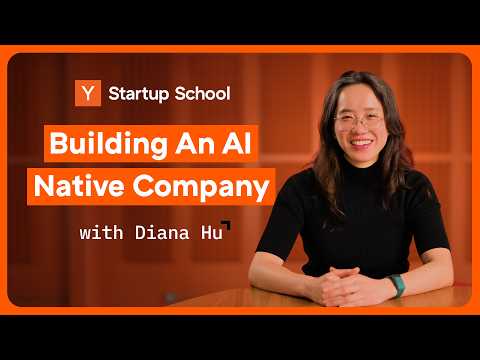
This piece covers Diana Hu's argument that companies need to go beyond merely "bolting" AI onto existing workflows and instead redesign so that every decision and execution passes through an AI intelligence layer. The key is turning the company into a closed-loop (feedback-driven) system, which requires making the entire organization queryable by AI. When that happens, the role of middle management shrinks dramatically, and small teams can build products at overwhelming speed by maximizing token usage.
1. AI Is Not a Productivity Tool — It's the Company's Operating System
YC partner Diana Hu opens by describing a shift she has grown increasingly certain about over the past few months. AI isn't just "making development faster" — it's going to change the very way startups operate: which roles are needed, and what products become possible.
"AI isn't just changing how fast software gets built. It's going to fundamentally change how startups should operate."
She also calls out the common productivity framing people use for AI: "engineer productivity," "let's add a copilot to existing workflows," "let's ship more features." But Diana says this perspective misses the real transformation underway — the emergence of entirely new capabilities.
"This is less about productivity improvement and more about entirely new capabilities coming into existence."
She then distills the conclusion into one sentence: AI shouldn't be a tool the company uses — it should be the operating system the company runs on.
"AI shouldn't just be a tool the company uses. It should be the operating system the company runs on."
In other words, the proposal is for every workflow, every decision, every process to pass through an intelligence layer — and for that intelligence layer to continuously learn and improve.
2. From "Open-Loop Company" to "Closed-Loop Company"
Diana then explains company operations using an analogy to control systems. (It sounds technical, but the core is simple: do you have a structure that measures outcomes and corrects course, or not?)
- Open loop: Actions are taken but feedback doesn't systematically return
- Closed loop: Outcomes are continuously monitored and the process is constantly adjusted toward the goal
Many companies in the past operated essentially as open loops, she says. Decisions were made and executed, but systematically re-measuring results and updating processes didn't "always" happen.
"In the old world, companies mostly ran as open loops. You decide and execute, but you don't systematically measure outcomes and adjust."
A closed loop, by contrast, is self-regulating: it continuously watches outputs and corrects inputs to meet the goal. Diana emphasizes that in an era when self-improving agents are possible, companies should be running as closed loops.
"In an era of self-improving agents, companies should be operating as closed loops."
3. To Build a Closed Loop, Make the Entire Company Queryable
As the practical step toward building a closed loop, Diana makes one strong point: make the entire company queryable. Rephrased, the entire organization needs to be legible to AI.
"To build a closed loop, you need to make the entire company queryable. The whole organization needs to be 'readable' by AI."
The key principles for doing this are:
- Every significant action in the company must leave an artifact (a record or output)
- Those artifacts become the material from which the central intelligence layer learns and improves
Diana then proposes very specific operational habits:
"Record meetings with AI note-takers, minimize DMs and emails, and embed agents in every communication channel."
She also says to build custom dashboards that capture all key metrics and activities in the company at a glance — revenue, sales, engineering, hiring, operations — all of it.
"Dashboard everything in your company. Revenue, sales, engineering, hiring, operations — all of it."
4. Engineering Example: Sprint Planning Becomes "Agent Analysis" Instead of "Status Reporting"
Diana uses engineering sprints as an example of what this actually looks like in practice. Imagine a single agent with access to:
- Linear tickets
- Slack engineering channels
- Customer feedback (emails, tools like Pylon)
- GitHub
- High-level plans in Notion/Google Docs
- Sales call recordings
- Daily standup notes
With that much context, the agent can analyze what was actually shipped in the last sprint and how well it addressed customer needs — and take it one step further by suggesting a more accurate plan for the next sprint.
"The agent can analyze what was actually shipped last sprint and how well it addressed customer needs — and then propose a more accurate, predictable sprint plan."
Here Diana pinpoints the problem with the old approach: "status rollups" are inherently lossy — a lot of information leaks out, and summaries introduced by the person doing the rolling up tend to introduce distortion.
"The era of lossy, manager-style status rollups is over."
She says she's managed engineering teams herself and has seen this shift firsthand across YC companies.
"I've managed teams myself, and I've seen this across many YC companies — this is a game changer."
Teams operating this way have cut sprint time in half while delivering nearly 10x as much in the same period. 🚀
"Teams doing this have cut their sprint time in half and delivered close to 10x as much in that time."
She repeats the core principle: to get real capability out of a model, you need to give it the same level of context you'd give an employee — not a rough summary.
"You need to give the model as much context as you'd give an employee to get real capability out of it."
5. The "AI Software Factory" and the Rise of the 1,000x (or 10,000x) Engineer
Diana then describes a shift in how products are built: the AI software factory paradigm. For anyone who knows test-driven development (TDD), she says, think of this as "the next level."
The structure works like this:
- Humans write specs and tests that define success
- AI agents generate the implementation code
- Agents iterate until the tests pass
- Humans define "what to build" and evaluate results
"Humans define 'success' via specs and tests, and agents produce the implementation and iterate until the tests pass."
She even says some companies have gotten to a point where there's almost no human-written code in the repo — just specs and a test harness. 😮
"Some companies have repos with no hand-written code at all — just specs and a test harness."
As an example she mentions the "StrongDM AI team," whose goal was essentially to eliminate the need for humans to write or review code. Specs and scenario-based validation drive agents that write tests and iterate until code reaches a probabilistic satisfaction threshold — meaning, in problems without a single fixed answer, you set a "good enough" bar and keep improving until you hit it.
Diana connects what these systems produce to the concept of the "1,000x engineer": surround one engineer with an agent system and they can build things that were absolutely impossible alone.
"Surround one engineer with an agent system and they'll build things they never could have before."
She goes even further:
"The era of the 1,000x — even 10,000x — engineer is here."
6. Why Middle Management Disappears: "Information Routing" Gets Replaced by AI
Once AI loops are embedded throughout the company, the organization is queryable, and the software factory is in place — Diana argues that traditional management hierarchy simply stops making sense.
In the past, middle managers existed because as organizations grew, information scattered everywhere, and you needed people to relay and coordinate it up and down. Diana calls this "human middleware."
"In the old days, middle managers and coordinators had to inefficiently route information up and down the hierarchy."
Now that role falls to the intelligence layer. If a company is artifact-rich, AI-legible, and always queryable, there's far less reason to station people as "relayers."
"If your company is queryable, artifact-rich, and AI-legible, you barely need human middleware."
She also makes the speed equation explicit:
"A company moves only as fast as information flows. Every human routing layer you remove is a direct speed gain."
She cites the conclusion Jack Dorsey reached at Block: if you leave the org chart intact, you've fundamentally missed the point of the transformation.
"If you keep your org chart and management structure intact, you've completely missed the shift."
7. The Future Organization: ICs, DRIs, and the "AI Founder" Become the Core Roles
Drawing on Jack Dorsey's perspective, Diana outlines three employee archetypes that will be central to companies going forward.
1) IC (Individual Contributor): The Maker and Operator
ICs are "builder/operators" — in an AI-native company, they directly build and run things. Crucially, this isn't just engineers.
"This isn't just for engineers. Everyone builds and operates — support, sales, everyone."
Meeting culture changes too: instead of slide decks, people bring working prototypes.
"Everyone comes to meetings with working prototypes, not pitch decks."
2) DRI (Directly Responsible Individual): Single Owner of Outcomes
A DRI isn't a traditional "manager" — they're someone who is explicitly accountable for strategy and customer outcomes.
"This is not a classic manager. It's a clear owner of outcomes. One person, one outcome — nowhere to hide."
3) The AI Founder Type: Founders Must Lead from the Front
The third archetype is a message aimed specifically at founders: they need to remain builders, coaches, and leaders who demonstrate by doing — they cannot delegate AI strategy to someone else.
"If you're a founder, this has to be you. Don't delegate AI strategy to someone else."
8. The Winning Company Maximizes Tokens, Not Headcount
Once this structure is in place, Diana says companies can achieve far larger outcomes with far smaller teams. Here she uses a particularly striking phrase:
"Maximizing token usage — not headcount — will become the defining shift."
In other words, the best companies will be token-maxers. What used to require a large engineering team can now largely be done by one person with AI tools. So not just engineering, but design, HR, and admin too — teams will become dramatically leaner.
She also says to flip your cost intuition: if API costs run high, but they're replacing what would otherwise be far more expensive salaries (and bloated organizations), they're worth it.
"You need to be willing to stomach uncomfortably high API costs. That's the cost replacing even more expensive headcount."
9. Conviction Comes from Using the Tools Yourself, Not from Listening to Others
In the final section, Diana issues something close to a warning to her audience — especially founders. Conviction about this shift won't come from hearing someone tell you about it; you need to use the tools yourself until your assumptions about what's possible break down.
"You can't outsource conviction about the power of these tools."
Her advice is concrete: sit down with a coding agent and keep using it, and eventually your prior beliefs about what's possible will shatter.
"Sit down with a coding agent and use it. Your priors about what's possible will break."
She then summarizes why early-stage founders are particularly well-positioned: no legacy systems, no outdated org charts, no thousands of people to retrain — they can design AI-native from day one.
"Early-stage founders have an incredible advantage. No legacy systems, no outdated org charts, no thousands of people to retrain."
By contrast, large incumbents have to maintain already-running products while dismantling years of SOPs and deeply held assumptions about how software gets built. Some can spin up separate small skunkworks teams to rebuild fresh — Mutiny is cited as an example.
Diana's conclusion: because startups lack these constraints, designing systems, workflows, and culture around AI from the start means they can outpace incumbents by an overwhelming margin.
"If you design around AI from day one, you can run 1,000x faster than existing companies."
Closing
The AI-native company this video describes is not "a company that uses AI" — it's a company AI flows through. The core practices are: make the entire company queryable, run everything as closed loops, and shift development to a spec- and test-driven software factory. Do that, and the organization flattens, and competitive edge is determined not by headcount but by the ability to leverage tokens.