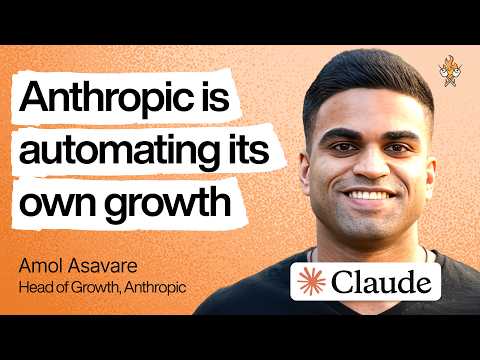
This video features Anthropic's head of growth, Amol Avasare, discussing the secrets behind the company's remarkable growth and its strategy for the AI era. Anthropic's journey from $1B to $19B in annual recurring revenue in just 14 months was driven by rapid AI model advancement, a sharp focus on B2B and coding, and a distinctive safety-first company culture. Amol shares insights on automating growth experiments with AI, the evolving roles of PMs and engineers in the AI age, and personal lessons drawn from a traumatic brain injury.
1. Anthropic's Remarkable Growth Story and How Amol Joined 🚀
The video opens by highlighting Anthropic's stunning trajectory. ARR was $1B at the start of 2025 and surged to $19B in just 14 months — an unprecedented pace of growth. As Anthropic's head of growth, Amol explains what made this possible.
"Anthropic is literally the fastest-growing company in history. We were at $1B ARR at the start of 2025, and the last number I saw was $19B ARR. That's $1B to $19B in 14 months."
Amol also shares the unusual story of how he joined. He was an avid Claude user who felt the company's growth function was underdeveloped, so he sent a cold email to Chief Product Officer Mike Krieger. Anthropic wasn't actively hiring for growth at the time, but the email landed at the right moment, and he became the only PM ever hired through a cold email. 📧
"I was a user of Claude, and I thought, 'This company has a really great product but a really weak growth team.' So I emailed Mike Krieger. 'Hey, I love what you're doing. The product is great. But I think you really need a growth team. Want to chat?'"
Amol describes himself as something of a cold-email expert. He says he has spent years honing the subject line, content, and tone of his emails, and he jokes that he guards his highest-performing subject line like a secret. He also emphasizes the importance of tracking down people's personal email addresses and persistently following up until you get a reply.
2. The Growth Team's Role and the Challenge of AI Product Activation 💪
Amol candidly admits that his day-to-day as head of growth is extremely demanding. About 70% of his time goes toward solving "success disasters" — unexpected problems that arise precisely because the company is growing so fast.
"It's the hardest job of my life. You have to know that when you come to Anthropic, you're going to throw out 50, 60, 70% of the playbooks you ran before."
The remaining 30% is spent on traditional growth work: choosing which products deserve "product juice," setting long-term pricing and packaging strategy, and optimizing post-launch. He singles out activation as the toughest challenge for AI products. Because model capabilities evolve so quickly, it's hard to ensure users actually discover and leverage new features.
"Activation is a massive challenge in AI. Model capabilities are advancing so fast that we constantly have to learn and update. It's hard to help users fully utilize everything a new model can do."
He draws on his experience at Mercury to illustrate how a quality-focused approach can drive growth. Mercury zeroed in on "quality" during a complex onboarding flow and saw conversion rates climb significantly as a result. At Anthropic, he describes adding "the right friction" to onboarding — learning what users care about and recommending tailored products and features accordingly.
"In every company I've worked at in growth, I keep seeing that adding friction and adding the right steps increases conversion and funnel completion. You want to remove annoying friction that adds no value."
3. Growth Strategy for the AI Era: Big Bets and Experiment Automation 🤖
Anthropic's growth team is roughly 40 people, organized similarly to a traditional growth team — platform and monetization functions alongside teams focused on specific audiences: B2B, Claude Code, knowledge workers, and API growth. What's unusual is the investment ratio. While most growth teams focus on small optimizations, Anthropic invests 70% in large bets and 30% in small ones — the inverse of the norm.
"We're investing much more in bigger swings. Maybe 70/30 or 50/50 toward larger changes rather than smaller ones. It's probably one of the biggest shifts."
This reflects the exponential growth potential of AI products. Amol predicts the product's value could be 1,000× higher two years from now than it is today, and argues that such opportunities demand bold investment.
Going further, Anthropic is running a project called CASH (Claude Accelerates Sustainable Hypergrowth), which uses Claude to automate growth experiments. The system walks Claude through a four-stage experiment lifecycle: opportunity identification, feature building, testing and validation, and data analysis.
"We're finding ways to use Claude to automate growth experiments. It's still very small and early — we only started a few months ago. But it's already producing results."
So far, results are coming from smaller experiments like copy changes and minor UI tweaks, with expectations to scale to larger, more complex experiments as the models improve. He notes, however, that human cross-functional stakeholder management remains an area AI can't easily replace. 🗣️
4. How AI Is Changing the Roles of PMs, Engineers, and Designers 💡
Amol turns to the impact AI is having on PMs, engineers, and designers. Right now, engineers are experiencing the greatest productivity gains from AI, and this is putting serious pressure on PMs and designers.
"Even as PMs and designers get more leverage from AI, engineers are getting the most leverage of all. Tools like Claude Code give engineers leverage that I think exceeds what PMs and designers are getting today."
He explains that with engineers becoming 2–3× more productive, PMs and designers find themselves effectively managing the equivalent of 15–20 engineers. Anthropic is exploring two responses: hiring more PMs, or cultivating product-minded engineers who can serve as "mini PMs." 🧑💻
"We're feeling pressure on PMs and designers right now. We're asking ourselves, 'Should we be hiring a lot more PMs?'"
At Anthropic, for engineering projects under two weeks, engineers own the PM role themselves — handling security, legal, and cross-functional stakeholder coordination directly. This lets PMs focus on bigger projects while giving engineers a deeper understanding of the product. Amol also reveals that he often moves forward without a PRD (Product Requirements Document). Simple projects can be handled through a Slack conversation, and even complex ones are often better served by rapid prototyping to share ideas, with early stakeholder alignment meetings to get everyone on the same page.
Personally, Amol uses Claude to analyze 20–25 charts every morning, surface key insights and anomalies, and automate tedious administrative tasks like email triage and expense reports. He even mentions building an AI version of his manager, Ammy Vora, to receive feedback from each week — demonstrating that AI can play a coaching role in evaluating and advising employees. 🤯
"My manager Ammy Vora was a guest on your podcast. Based on everything publicly known about Ammy, what she's written about product, and our internal conversations, what feedback would Ammy give me about what I did and didn't do this week? I ask that question every week."
5. AI Safety and Anthropic's Culture 🧘♀️
AI safety is Anthropic's foremost mission — the company's official description even includes the phrase "AI safety company." Amol discusses what it means to pursue growth within that constraint. He explains that the company's legal structure is itself built around public benefit rather than shareholder value maximization; Anthropic is organized as a Public Benefit Corporation (PBC).
"Our ultimate purpose is to ensure that the transition to powerful AI goes well and is purely beneficial to humanity."
Anthropic even had an early version of Claude before ChatGPT launched but delayed the release over safety concerns — a concrete example of the company choosing safety over revenue. Amol believes this is a long-term competitive advantage.
He also highlights Anthropic's distinctive company culture as its "secret sauce" and hardest-to-copy asset. Employees freely share their thinking and work-in-progress via "notebook channels" on Slack — essentially personal Twitter-like feeds inside the company — where even open dialogue with leadership is encouraged.
"Slack is a labyrinth — so much happens there. We're very open. Everyone has their own notebook channel, like their own Twitter feed, where they share their thoughts."
This open culture plays a critical role in rapidly spreading beliefs and values across the organization during rapid change, and helps new employees get up to speed quickly.
6. Advice for Thriving in the AI Era and Personal Experience 🌟
Amol offers three pieces of advice for individuals looking to succeed in the AI age:
- Master the tools: Actively use AI tools like Claude Code and Co-work, learn new capabilities with each model release, and sharpen your product instincts.
- Strengthen your competitive edge: Double down on your core strengths and strive to be the best in your domain. PMs should deepen their technical understanding; designers should gain coding skills — cross-disciplinary capabilities are increasingly important.
- Stay adaptable: Don't cling to past success formulas. Approach new environments and technological shifts with flexibility.
"You have to know that when you come to Anthropic, you'll probably need to throw out 50, 60, 70% of your old playbooks. They won't be relevant anymore. And if you try to hold on to them, you'll create a lot of friction and it won't help you."
Finally, Amol shares a deeply personal story about a traumatic brain injury. In early 2022, he hit his head during Muay Thai training and spent nearly nine months unable to function normally. Compared to this experience, he says, shutting down a company felt like nothing. But the ordeal taught him about resilience, meditation, and finding freedom within life's constraints. 🧠💫
"It was the hardest period of my life. Shutting down a company was nothing compared to it. I couldn't work for almost nine months."
He says the experience led him to practice brief daily rest and meditation, which now helps him stay grounded in the fast-moving environment of a company like Anthropic.
Closing Thoughts
Amol Avasare's story offers more than a window into Anthropic's success — it provides deep insight into how individuals can grow, overcome adversity, and find meaning in the AI age. His experience and advice serve as a reminder that even as technology accelerates, fundamental values and human capability remain essential.