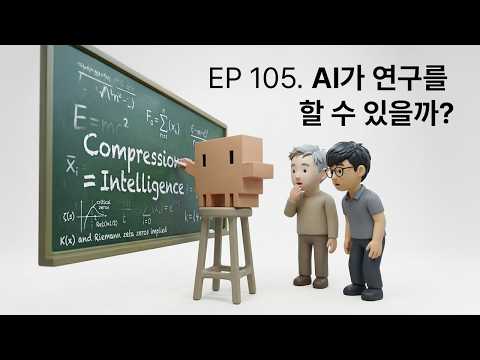
This video examines the academic peer review system, arXiv, the explosion in the size of academic societies, and reproducibility issues, focusing on the question Can AI actually conduct research and produce good research? Next, we discuss the differences between the IMO gold medal and actual mathematical research, areas that RLVR finds difficult to address, and the possibilities and limitations of AI research through the perspective of "compression is intelligence". The second half introduces a wide range of AI research and evaluation hackathons, self-improvement models, vintage LM, Inkling and Kimi K3, GPT-5.6, and experiences using Minecraft agents.
1. Question posed by the PPO paper: Who recognizes good research?
The video begins with a conversation recorded on July 18, 2026. The first topic is a simple but very fundamental question.
"Can AI do research?"
Jonghyun Park brings up the example of the PPO (Proximal Policy Optimization) paper to explain this question. PPO is an algorithm closely related to RLHF, that is, reinforcement learning through human feedback, used in the learning process of ChatGPT. It played an important role in the process of humans evaluating the user's conversation with the AI and learning the model to give better answers based on that evaluation.
However, it is said that the paper introducing this algorithm was rejected by academic journals and academic societies in 2017. The technology that later had a decisive influence on the development of ChatGPT and large-scale language models was not fully recognized by the judges at the time.
"Good research does not necessarily translate into publication in good academic conferences. Sometimes it is rejected."
There are more than one or two similar cases. Research that is now very famous and influential was often not recognized as having much potential by reviewers in the past. All researchers share this experience to some extent.
PPO can be understood as a method in which humans evaluate the quality of conversation, create a compensation model that mimics that evaluation, and then adjust the model to provide better answers. However, at the time, it was difficult for even the author himself to be certain that this algorithm would later be applied to LLM and have such a great impact.
"It is very difficult to evaluate whether a study is good. It is not easy to give a score."
Ultimately, the important problem here is that the value of the research may not be clearly revealed at the time of publication. It is difficult not only for judges but also for researchers themselves to accurately predict future influence.
2. Cracks between arXiv and academic societies in the era of AI slop
Although the PPO paper was not published in an official academic journal or conference, it was uploaded to arXiv and was widely shared and cited. arXiv is originally a preprint platform that quickly releases papers before they pass peer review.
Reviewing for academic journals and conferences takes several months, sometimes longer. In rapidly developing fields, the research flow may already have changed by the time the paper is formally published. Therefore, arXiv has played an important role as a channel to quickly share knowledge and discover research that was missed during review.
However, recently, a problem has arisen as the number of papers written using LLM has increased. The cost of writing a paper has dropped significantly, but the cost of verifying whether the paper is actually valuable is still high.
"The cost of creating a thesis with an LLM is very low, but examining and evaluating whether the thesis is really good is expensive and difficult."
As a result, concerns have grown that a large number of low-quality papers that have little to do with research**, so-called **AI slop**, may be uploaded to arXiv. An overabundance of this content can cause people to lose trust in the platform itself.
On the other side, there are arguments that the original purpose of arXiv should not be undermined.
"Isn't arXiv a place where papers are uploaded and shared before peer review? Shouldn't we block the way for research like PPO to be discovered?"
In other words, arXiv has both the advantage of quickly disseminating unverified research and the risk of being flooded with unverified garbage research.
This problem also appears in academic societies. About 23,000 papers were submitted to ICML and more than 6,000 were accepted. Compared to the hundreds of papers presented at academic conferences in the past when researchers were in graduate school, the scale has grown explosively.
There has been an increase in the number of cases where not only papers but also reviews are written by AI. As writing papers became easier, the number of papers to be reviewed increased, and a situation arose where reviewers were unable to handle the task, so AI was used to write reviews.
"After writing papers became easier, the average quality of papers decreased, and as we could no longer handle reviews, we started using AI even for reviews."
Some judges chose to review directly without using AI, but were excluded when it was revealed that they had actually used AI. The peer evaluation system itself, which academia has maintained for a long time, is experiencing cracks due to the emergence of LLM.
So what is good research? Jonghyun Park defines research as follows.
"I think that if it adds even a little bit of new knowledge to the total knowledge of mankind, that is research."
And they say that if the newly added knowledge has a great impact on the world and changes the world in a good direction, it can be considered good research. Seungjun Park adds that research ethics must be included here. Even if it is new knowledge, it is difficult to call it good research if it is created while ignoring war or human damage.
3. Reproducibility issues and new evaluation methods using AI
Currently, the most representative method for mankind to identify good research is peer review. This is a method in which researchers read each other's research and judge its value and validity. Although it is a system that has been around for hundreds of years, a clearly better alternative has not yet emerged.
However, as the number of studies and papers has exploded, it has become difficult for humans to evaluate all studies alone. Hugging Face's ICML Replay Challenge is introduced as an interesting attempt to solve this problem.
This challenge does not just read the paper and evaluate its logic, but also asks the AI agent to directly re-implement the method presented in the paper. Even if the paper claims that "performance was greatly improved using this method," it is to check whether the same results are obtained when the code is actually run.
"It is about actually executing the logic written in the paper and verifying whether the data really comes out the same way."
In the academic world, the issue of reproducibility has been controversial for a long time. Even if the experimental method was written in a plausible paper, the results often did not come out when other researchers implemented it themselves. For research that requires hardware or closed simulators, it is difficult to disclose both code and environment.
As the number of papers written with AI increases, this problem may become more serious. This is because there is a possibility that data was created without actually conducting an experiment, or that the experiment results were misinterpreted.
"If you look at the paper, it says that the experiment results came out like this, but in reality, the experiment may not have been conducted."
It is mentioned that out of about 6,000 papers at the time, about 800 had completed reproduction work. Since the challenge is still in progress, the final results must be confirmed later, but this process can be viewed as an intermediate reward or verification system that links simple peer review and actual implementation.
Although this method cannot completely determine the authenticity of a study at once, it at least helps answer the following questions.
- Are the experiments described in the paper actually carried out?
- Can the claimed performance be reproduced?
- Are the results incorrect or exaggerated?
- Was the experiment performed in the first place?
4. Research Ralphthon and AI screening agent
The next one introduced is Ralphthon, which is popular in Korea. It is an event where projects are carried out like a hackathon all night long using Ralph, and this time it was held in the form of Research Ralphthon.
Two tracks have been prepared.
- Track where you actually research and experiment using the LLM and then write a thesis
- Track to evaluate and review the papers created in this way
Participants were diverse, including professors, doctors, and researchers, as well as high school students. Jonghyun Park introduces the story of a 15-year-old participant he met at the site as a particularly impressive example. This student was interested in the phenomenon of performance dropping at some point when data was continuously placed in the context of LLM.
"Should important data be put first or last? When and how will performance decline?"
Although this student had not had much formal research experience in school, he was creating his own questions and designing experiments to solve problems. The host exclaims that this is an attitude that is close to the essence of research.
At Ralphthon, an AI wrote a paper, and another AI reviewed the paper. Afterwards, papers were ranked based on the scores and a poster presentation was conducted. Actual researchers participated as reviewers and directly selected good papers, while also evaluating how similar the scores of the human reviewers were to those of the AI review agent.
Interestingly, the highest-rated review agents were not models that used any particularly popular evaluation methodology. It was simply the agent that showed the highest correlation with the evaluations of human judges.
"If it is difficult to define what constitutes a good review, one method may be to use as a criterion how similar the evaluation is to that of a human judge."
These results raise questions about the nature of review quality. Does good review mean having a special philosophy to objectively evaluate papers, or does it actually mean making judgments similar to those of trustworthy human experts?
This is also connected to RLVR. The view is that if a good reward is given, the model can be allowed to explore various methods on its own without necessarily forcing it to use a specific method.
However, because the value of research is often difficult to immediately verify, compensation in the field of research is not yet completely verifiable, that is, compensation that can clearly determine whether it is true or false. Nevertheless, attempts are continuing to use AI to specify evaluation criteria and automatically compare as many studies as possible.
5. IMO Gold Medal is not AGI
The conversation then moves on to an interview with Grant Sanderson and Adam Brown on the Dwarkesh podcast. Grant Sanderson is a math communicator famous for his math education channel 3Blue1Brown, and Adam Brown is a former physicist who covers superintelligence and scientific research at DeepMind.
First, we discuss whether AI's gold medal-level performance at the IMO (International Mathematics Olympiad) means AGI. Three years ago, people asked this question.
"If AI wins the IMO gold medal, doesn't it mean it can be called AGI? If it's that good at math, isn't it really smart?"
At the time, Grant Sanderson said no. IMO, it is an important test, but in the end it is just one of several benchmarks, and there is a difference between AI specializing in a specific test and achieving high scores and having general intelligence.
"It's just one of many benchmarks. LLM is very good at hitting that one specific test."
In fact, even after AI won the IMO gold medal, people did not immediately call it AGI. In this respect, Grant Sanderson's judgment at the time is assessed to have been quite prescient.
IMO is a competition where you solve a total of 6 problems over 2 days, taking about 9 hours. Among humans, only very talented students can solve it, but actual mathematical research is a long-term task that requires thousands or tens of thousands of hours.
"The IMO gold medal may be the entrance to becoming a mathematician, but actual mathematical research requires 10,000 or tens of thousands of hours."
Also, IMO the problem is fully trainable. This means that you can improve your performance by repeatedly solving similar types of questions to past exam questions. It is explained that the Korean CSAT math problems are somewhat similar to training through previous exam questions and similar problems.
What is more important is the fact that even within mathematics, there are large differences between fields. Algebra, geometry, number theory, and combinatorics require different abilities. A model may be very good at solving geometric problems but barely able to solve combinatorial problems.
"Even within mathematics, independent, pointed intelligence exists."
Therefore, unless you are good at all of math, and furthermore, you are not good at common sense and physical judgment in the real world, IMO, it is difficult to judge general intelligence based on grades alone.
6. Galois group theory and the long period of research
When I think about what good research is, the example of group theory created by mathematician Galois comes to mind. Group theory later influenced many fields, including physics, particle research, and prediction of quarks, but it is said that it took about 100 years for its value to be fully recognized and to have a significant impact on the real world.
"After a theory emerges, it can take a very long time for it to be proven to be really good research and have an impact on society."
As such, the true value of research may only be revealed decades or even 100 years later. Therefore, there is a large gap between the time of RLVR, which immediately checks whether the correct answer is correct and provides compensation, and the time of actual research.
RLVR should usually be able to immediately check whether the answer is correct. But finding out whether a new theory or definition is truly important requires lengthy verification and connections to other fields.
The sentence quoted by Grant Sanderson also illustrates this problem well.
"Good mathematicians prove theorems, great mathematicians give good conjectures, and the greatest mathematicians make good definitions."
Currently, AI is making great progress in its ability to prove already given theorems or problems. However, it is still unclear whether it will be possible to reach a higher level the ability to create new questions and propose new concepts and definitions.
7. Can AI connect different fields?
Jonghyun Park believes that AI can conduct excellent research. One of the reasons for this is the ability to connect knowledge from different fields.
Mathematician Montgomery and physicist Dyson worked in different fields, but during their conversations, they discovered that there was a similar structure between the Riemann zeta function in number theory and certain phenomena in physics. These connections can emerge when researchers meet by chance and have conversations.
"Things that we thought were completely different fields may actually have a lot in common."
Human researchers are deep in their own field, but cannot know deeply in all fields. On the other hand, LLM allows you to refer to knowledge in a vast field at once. In theory, it is possible to apply concepts from one field to another field to find knowledge that has not yet been discovered by humans.
However, Seungjun Park points out the curse of context. If you don't explicitly ask your model to make connections to other fields, the model is likely to generate only answers that are generally common in that field.
"If you don't ask your model explicitly, she'll end up saying the average thing in that field instead of actively bringing in knowledge from other fields."
To overcome this, the following methods are possible.
- Require prompts to reference concepts from other fields
- Including data from related fields directly in the input
- Building an exploration harness that connects multiple disciplines
- Design compensation so that the model explores in a different direction than usual
- Utilize methods like LLM Daydreaming, which allow models to connect concepts 'while they sleep'
In the end, the process of humans reading a paper and thinking, "What if I apply this idea to another problem?" is a research method that AI can also try.
8. The perspective that "compression is intelligence"
The topic Compression is Intelligence, which is being serialized on 3Blue1Brown, is introduced.
Einstein's theory of relativity was created through thought experiments, physical exploration, and numerous hypotheses and verification over a long period of time. But today, we can learn the results in a lecture that lasts just over an hour.
"Knowledge accumulated through decades of exploration and experimentation is continuously condensed and delivered in a form that people can understand. That in itself is intelligence."
3Blue1Brown's strength lies in visually condensing complex mathematical concepts into an easy-to-understand form. Jonghyun Park says he finally understood the Fourier transform, which he learned in school but did not actually understand, after watching 3Blue1Brown's video.
From this perspective, intelligence is not simply the ability to store a lot of information, but the ability to find key structures in vast amounts of information and express them in a short, understandable form.
This idea also applies to AI and human knowledge accumulation. Although the brain hardware of people 1,000 years ago and people today is not very different, the reason modern people can do much more complex things is because they quickly acquire the knowledge accumulated by mankind through education.
"It's not that the human brain itself has changed significantly, but rather that knowledge is well compressed and stored in the head, so isn't it possible to do more things?"
Education, language, mathematics, and science are a kind of thinking tool and stepping stone that condenses the knowledge accumulated by mankind. AI can also utilize this compressed knowledge to create new knowledge and connections.
This concept is also connected to algorithmic information theory, Kolmogorov complexity, and Solomonoff induction. Marcus Hutter, the mentor of DeepMind co-founder Shane Legg, also studied the relationship between compression and intelligence, and compression is mentioned as one of the important theoretical backgrounds of AGI research.
However, as Ted Chiang described LLM as "the result of a blurry JPEG compression of the Internet," there is still debate as to whether LLM's compression is truly understood.
9. Theoretical research without experiments and the potential of AI
The Adam Brown interview specifically addresses the relationship between theoretical physics and AI research. Theoretical physics is very difficult to conduct actual experiments. This is because particles may need to be accelerated close to the speed of light, or enormous equipment may be required. So researchers often rely on thought experiments and mathematical reasoning.
So how much can AI advance research without real experiments?
Adam Brown says that if LLM had Einstein-level intelligence, it could create not just one, but tens of thousands of such models. By having these models generate different hypotheses and run numerous experiments in their heads, they can repeat on a large scale an exploration that only a very small number of geniuses in human history have been able to perform.
"You just have to view the problem as a search and invest the enormous resources of computation into that search."
Additionally, humans tend not to easily doubt theories that they already believe to be correct. Newton's theory of gravity was once thought to be completely correct, but later, with the advent of relativity, it became necessary to revise it.
AI can repeatedly verify existing theories in a way that would seem wasteful to humans, and disprove hypotheses already considered correct.
"Verification that seems like a waste to a person may not be a waste to an LLM."
In this respect, the Hugging Face Reproduction Challenge is also meaningful. Even if a paper has passed peer review, the process of re-running it and checking for possible errors can be a starting point for new research.
However, the pace of development will vary by field.
- Fields that can be reasoned out in one's head, such as mathematics and theory, are likely to develop rapidly.
- Fields that require actual experiments and material synthesis, such as biology and chemistry, may be slower.
- Fields that can provide immediate compensation can benefit greatly from RLVR.
- Research or creative fields that do not have a single correct answer may progress more slowly.
10. The role that remains for humans even in the AI era
Seungjun Park believes that a significant portion of human roles will remain even in the era of intellectual automation. The forms of intellectual breakthrough mentioned by Grant Sanderson can be divided into three types:
- Connecting different fields like lightning
- Creating a completely new conceptual system like building a new mountain
- Finding the answer by performing tremendous reasoning without any new concepts
First, AI can do it relatively well. The second requires long-term verification, and the third is already largely automated through systems such as Lean and Mathematica.
However, there is a difference between a proof being true and it being a meaningful and important idea to humans.
"It's one thing to be true, but it's another thing to know if it's what we want and if it's something that will change our thinking."
Even if AI can produce millions of lines of Lean code and prove theorems, it is difficult to convey the meaning of the research if humans cannot understand the results. Therefore, the role of explaining things in a way that humans can understand, determining what is important, and deciding in what order to show things to people is still important.
Good writing is different from code where the result is simply correct. You need to consider where the reader will stop, what misunderstandings they might have, and what order in which you should explain it so they will accept the next sentence.
"In good writing, each sentence and word is not just packaging, but the content itself."
In this respect, the meaning of creative writing and research is difficult to easily optimize with RLVR. This is because the final result does not need to be executed like code, but all intermediate expressions and choices are part of the result.
Even in education, the teacher's role can become closer to social relationships and motivation than simply delivering explanations.
"The reason teachers are needed is not simply to explain things, but because education is a social and relational activity."
In the end, the important abilities that remain in humans are as follows.
- Ability to decide which questions are worth asking
- Ability to discover connections between distant ideas
- Ability to judge whether a new concept will be effective in the long term
- Ability to condense complex results so that humans can understand them
- The ability to choose what is important and what to pay attention to.
11. Why RLVR is difficult and a matter of taste
RLVR is a method in which an external verifier verifies the results and provides compensation. For example, when a model writes code, it runs tests to check whether it is successful and increases the probability of a successful path.
This method is powerful in areas where the results are relatively clear, such as math problems or programming. However, there is a problem that as long as the final result is correct, the entire process can be treated as good.
For example, the answer to a math problem may be correct, but the solution may be too long or complicated. RLVR can give high rewards up to millions of lines of lean code just because the answer is correct.
"If the answer is correct, the entire solution process is generally considered correct, and the overall probability of the path is increased."
As a result, an absurdly long proof may be chosen over a concise and beautiful proof. Writing and design are even more difficult. This is because there is not one correct answer, and multiple results can all be okay.
Jonghyun Park cites design work as an example and says that even if AI creates several designs, it is the person who ultimately chooses which is good. A person selects elements such as soul, mood board, and taste, selects the one he or she likes among the various results, and inputs it back into the model.
"People still do things that belong to taste."
This is a human-in-the-loop method in which humans continue to enter the AI creation process. Rather than AI creating everything at once, people provide direction and standards, and AI quickly explores multiple possibilities.
12. Latest News: Vintage LM, Inkling and Kimi K3
In the second half, various recent news from the AI industry continues.
First, the Vintage LM project conducted by Alec Radford is introduced. This is a project that trains a language model using only data from before the 1930s and then tests how much the model can infer technology and developments after the 1930s.
"If we can imagine future developments using only past data, we can get interesting clues about future predictions."
This is meaningful in that it tests to what extent the model can predict the direction of technological development without looking at already known future information.
Also mentioned are Thinking Machines Lab's Inkling model and Kimi K3. Inkling means 'faint clue' or 'premonition' in English, and is interpreted as a name like a trailer before the actual start. It was also noted that a model worth close to 1 trillion won was released as an open weight.
What is particularly interesting about Inkling is self-fine-tuning. This is a way for a model to fine-tune itself to suit a specific purpose. As an example, the lipogram experiment is introduced, in which a model learns to write without using the letter 'e', the most commonly used letter in English.
"The part about RSI that allows the model to re-tune itself for a specific purpose is interesting."
This process is a mixture of directly changing model weights and improving the harness surrounding the model. Organizations like AIDE² are introduced as attempting self-improvement by improving harness, that is, the environment in which the model works and the structure of tool use rather than the model itself.
Kimi K3 is an open-weight large model that is difficult for individuals to run, but can be utilized through multiple GPU clouds and OpenRouter. Technical attempts, including MoE structure and chip design, are mentioned, and the careful composition of not only the model but also the presentation video and teaser production is evaluated as impressive.
13. Review of GPT-5.6 and Minecraft Agent
Jonghyun Park shares his experience using GPT-5.6 for about a week. There were cases where the model continued to perform the task it started for more than 10 hours.
"The work I started last night wasn't finished even after 10 hours, so I ended up stopping it."
This is explained as an example showing that GPT-5.6 has developed into test-time compute, that is, performing more calculations and searches before providing an answer.
Seungjun Park introduces his experience using multiple models together while developing a Minecraft agent. When the user gives a command, the model-controlled robot moves and performs tasks within Minecraft. In order to directly check why the robot is stuck, we also created an interface that a person can directly operate based on the commands used by the robot.
During the development process, Fable 5 and Sol were used together, and Sol reviewed Fable 5's results very rigorously.
"Sol was very strict every time, constantly pointing out mistakes here and mistakes there."
In the end, Sol solved the problems with Fable 5's large-scale area loading and streaming methods. Each model had a different working method. While Fable 5 was relatively accepting, Sol was more picky about pointing out problems and fixing them.
This case shows that one model is not good at everything, but that better results can be achieved when different models are deployed as generators and reviewers.
14. Conclusion: The future of AI research depends on 'good questions' rather than 'right answers'
The conclusion of the video does not answer the question of whether AI can conduct research with a simple yes or no.
AI can already write papers, implement code, reproduce experiments, solve mathematical problems, connect knowledge from different fields, and explore new hypotheses. In particular, there is a high possibility of rapid development in fields where the correct answer can be verified and where performance improves as more exploration is conducted.
However, the true value of the research may not be immediately verified. Some theories only become important decades later, and a good definition or concept requires a much higher level of judgment than a simple correct answer. RLVR is still difficult to fully compensate for this long-term and ambiguous value.
In the end, the core role that remains for humans is to judge what is important.
"The ability to recognize which issues are worth raising, to discover connections between distant ideas, and to determine whether new concepts really work in the long term is critical."
Even if an era comes where AI can create more hypotheses and perform more proofs than humans, the problems of deciding what to study, what results are meaningful, and how to make them understandable to humans will not easily disappear.
The video ends with a conversation that considers how far the scope and speed of research can be expanded by humans and AI together in the future, rather than whether AI can replace research.