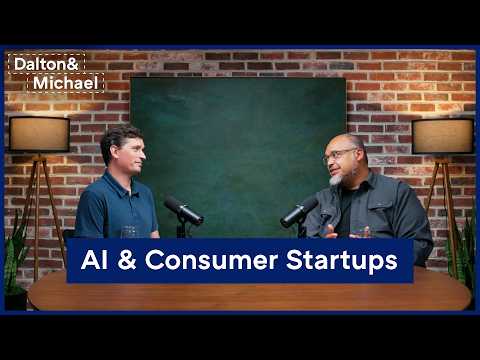
In this video, Dalton Caldwell and Michael Seibel discuss the opportunities consumer startups should seek in the AI era. The goal is not to make an existing service slightly more convenient, but to use technology to democratize ultra-premium experiences now enjoyed by very few people. Drawing on medicine, travel, finance, education, shopping, and food, they argue that AI should not be merely a cost-cutting chatbot. It should become a tool for scaling personalized, seemingly magical experiences.
1. On the Early Internet, Putting a Missing Experience Online Was Innovation
The hosts begin by recalling when they built consumer internet companies as young founders. Moving something onto the internet or a phone often created an overwhelmingly better experience because the competitor was not another polished app, but paper, telephone calls, physical stores, or effectively nothing at all.
"Truly great mass-market consumer experiences begin in the luxury market."
Dalton illustrates the power of older technology products with Napster, Netflix, and Google Maps. Using Napster for the first time was astonishing because any desired music seemed available for free. Previously, people bought expensive CDs and received 15 unwanted songs along with the two they actually wanted.
"This is all the music, it is free, and I do not have to buy CDs?"
Netflix was incomparably better than visiting a video-rental store. In an era when a laptop had a screen but could not show a movie, streaming was a radical change rather than the obvious feature it seems today.
"I have a laptop and it has a screen. Why can't I watch a movie on this screen?"
Google Maps was similar. Seeing your location as a live dot on a smartphone and no longer getting lost competed with paper maps and handwritten directions.
"Turn left, then right on this road… You followed instructions written on paper and hoped for the best."
Michael says these products competed not against numerous startups, but against absence. Justin.tv and Twitch could create live-streaming culture because the many platforms and creator tools that exist today had not yet been built.
2. Simply Moving Online No Longer Makes Something Ten Times Better
The two acknowledge that today's consumer environment is much harder. A country gains enormous productivity when it moves from an agricultural economy to an industrial one, but it cannot repeat the same transition forever. Likewise, many consumer experiences have already moved to the internet and mobile devices.
In navigation, flight booking, and video, building one more app does not greatly improve an experience that is already online. A founder today can reasonably feel burdened by advice from the generation that "only had to put it online."
"You only had to put it online."
Michael partly agrees.
"We did it in a much easier period. The internet was new, and almost nothing was on it."
That does not mean consumer opportunity is over. With AI, the question must change. Do not build a service that improves an existing product by 10%. Find an experience 100 times better that most people cannot easily access today.
The hosts imagine a founder who dislikes B2B SaaS and wants to build an exciting consumer AI company. Their most dependable method for finding an idea is:
"Study the world's best premium experiences enjoyed by people with unlimited resources, then use technology to make them available to everyone."
3. The Core Principle: Find the Most Expensive Experience and Democratize It
The central principle is clear: in areas people value most and spend the most on, observe the experience enjoyed by the wealthy and powerful, then offer it in a cheaper, scalable form.
Technology has always followed this pattern. Comfort and convenience once reserved for kings and aristocrats eventually spread to the public, as cars, air travel, communications, and medical technology demonstrate.
"In many ways, we live as kings of the past lived."
The trap is using your current experience as the baseline and asking how to improve it by 10%. Instead, founders should assume that an ultra-premium version they do not know about exists somewhere.
"Do not assume the experience you receive today is premium. Assume there is an ultra-premium version you do not know, and go find it."
Dalton recounts struggling to find a good doctor. A wealthy investor later told him about a level of medical service he had not known existed. It cost more but was not impossibly expensive, and offered care and access entirely different from an ordinary hospital visit.
"There is a separate world like this? I never would have known."
Many people do not even know such services exist. A founder interested in medicine should therefore first study the best experience: how a head of state, major-company CEO, or ultra-high-net-worth person uses the healthcare system.
"What medical experience does a head of state receive? If you can give that experience to everyone, it is a very good startup idea."
4. Airbnb's Eleven-Star Thinking and Uber
Brian Chesky's eleven-star experience framework helps expand this thinking. Inside Airbnb, Chesky asked the team to imagine not only a five-star experience, but six-, seven-, and even eleven-star versions.
For check-in, opening the property from an app might be a normally excellent experience. At six stars, a car waits at the airport. Seven stars might mean a welcoming parade. Eleven stars could mean riding an elephant in a parade all the way to the Airbnb—an absurdly exceptional scene.
"An eleven-star experience is a parade at the airport and a march to the Airbnb on an elephant."
The point is not to build that literal feature. It is to escape incremental improvements and enlarge the imagination of what would truly amaze users.
It is also important that you need not invent a new experience. Many already exist but serve very few people because they are expensive or difficult to scale. Uber did not invent chauffeured black cars; it let anyone summon one with a button in an app.
"Uber did not invent the black car."
Michael remembers that people riding black cars in childhood New York seemed to belong to a different class. He knew subways and taxis, but not even how to access a luxury car with a private driver. Uber Black changed that access.
"More expensive than a taxi? Yes. But it is better."
The key is an overwhelmingly better experience, even if the price is somewhat higher. Do not obsess only over cheapness. Reconfigure an existing luxury service so more people can access it at a feasible price.
5. Do Not Use AI Only as a Cost-Cutting Chatbot
Many consumer AI startups focus on replacing human work with chatbots or voice agents. An AI that answers immediately and resolves a problem without an hour on hold can certainly create value.
But if AI is only a 95%-adequate substitute for a person and the founder's pitch stops at "we save costs," the result is unlikely to become a great consumer company.
"The problem is that many experiences do not become that much better than working with a person."
"It should not merely save money. It should be 100 times better."
Dalton says an email that feels as though it came from an automated AI tool is unpleasant. The subtitle's "OpenClaw" reference appears to mean an automated AI response tool; the underlying issue is the distrust created when the user wonders whether anyone human is present.
"This is terrible. Am I talking to some automated bot?"
If that experience makes the user want to cancel, it is the opposite of premium. The sender also loses over time: replying quickly is no victory if everyone they communicate with comes to dislike them.
"You replied quickly, but is that good if everyone you talk to hates you?"
AI should strengthen not impersonal automation, but unlimited personalization that was previously too expensive. A good financial adviser does not merely know finance, but understands the client's life and circumstances. AI may expand this personalized expertise to many more people.
6. Travel: Provide a Local Fixer, Not an Itinerary Generator
Michael uses Kayak as an example. It was once an extraordinary product because it assembled every flight in one interface, replacing visits to individual airline sites or calls to travel agents.
"You could see every flight between two places, adjust departure time, and sort by price. It was astonishing."
Today, however, an AI chatbot that merely finds flights may not feel magical enough. Go beyond automating search and imagine a service responsible for ensuring the user has a genuinely excellent business trip or vacation.
Michael introduces the fixer, a concept he learned from Anthony Bourdain's shows. A fixer knows the destination deeply and does not merely book what the user asks for. They recommend a better place when the user is making the wrong choice and design the trip around time zones and travel routes.
"You say you want to go there, but this is where you should actually go. And that itinerary will not work because of jet lag."
The same budget can produce a much better experience with a local expert. Michael recalls disliking an ordinary meal in Bologna, then returning with local founders whose menu choices turned the same place into one of his best restaurant experiences.
"We disliked that restaurant. When we returned and ate what they ordered, it became one of the best."
The real opportunity for travel AI is therefore not a generated schedule, but affordable access to the personal trip design and local guidance wealthy travelers receive.
7. Finance: A Personal Banker Who Knows the Customer
Drawing on investments in fintech companies including Brex, Dalton describes premium financial service. An ordinary bank routes a declined card or question through a telephone tree, web form, and unfamiliar support agent.
In ultra-premium banking, one person knows the customer, understands their life and needs, has sufficient internal authority, and solves the problem. The customer sends one text and the banker makes it happen.
"Truly premium banking gives you a person who knows you and knows your life story."
"When there is a problem, you text them, and they make it work."
Imagine an ultra-wealthy person such as Elon Musk dealing with finance. He is not filling in a complex application or waiting on hold. He messages a trusted person and the matter is resolved.
"They do not say, 'Complete this form' or 'Wait on the phone for a long time.'"
Dalton mentions a personal banker naturally handling even family banking, contrasting it with a large bank's standard service. Michael contrasts it with having a card blocked abroad because the bank was not notified before travel.
AI could offer many people financial service that remembers the customer, understands context, and acts proactively. The crucial quality is not unattended automation, but the feeling that "an expert who knows my situation is beside me."
8. Education: Replace Uniform Schooling with Hyper-Personalized Learning
Education is another major opportunity. Public education necessarily contains uniform structures and compromises because it must educate many people at once. Michael says he received a Texas public-school education and ultimately did well, but there is clearly room for improvement.
"Public education has to serve everyone. Many things that feel strange in education are compromises society made to educate everyone."
People with resources already receive much more personalized education through private tutors, customized curricula, and rich experiential opportunities. The hosts say we already know what excellent education looks like and can bring it to more people.
"We already know what good education looks like."
"In the future, everyone will have an excellent, highly personalized educational experience."
AI can remember and reflect each student's level, interests, pace, weaknesses, and goals over time. The educational opportunity is not merely a tool that solves questions or supplies answers, but a personal-tutor-level experience that understands each student deeply and designs a path for growth.
9. Social Media: Seek Greater Joy, Not a More Addictive App
Entertainment and social media are harder. TikTok, Facebook, and X already possess enormous content libraries and sophisticated recommendation algorithms that absorb hours of attention. A new consumer product needs far more than adequacy to compete.
"Your competitors are black holes that consume human attention."
In the past, few services competed for leisure time. TikTok now knows what users enjoy and offers endless content, making a direct fight with a more addictive algorithm extremely difficult.
Michael jokes that wealthy people are equally captured by social media. Donald Trump and Elon Musk still spend substantial time on X despite unlimited wealth, meaning the service gives them real attraction too.
"Even with unlimited wealth, they spend a substantial portion of their waking hours on that website."
The two do not regard social media as purely harmful. People use it because it provides real enjoyment, connection, and stimulation. Founders should ask not "Can we build a more addictive algorithm?" but "Can we create greater joy?"
"We may not build a more addictive algorithm, but can we create more joy?"
Dalton believes wonderful offline experiences may be one answer. Rather than intensifying online addiction, services can help people meet, enjoy themselves, and do memorable things in the real world.
10. Shopping and Delivery: Take Responsibility for the Whole Household
Michael criticizes Amazon search results for being overrun by SEO-optimized, low-quality products. Delivery is excellent, but choosing a genuinely good product remains difficult.
"Amazon has been completely consumed by SEO. The odds of receiving a truly good product are too low."
His premium Amazon experience is simple: ask someone, "What is the best X?" receive a trustworthy answer, and get that product. Services such as Wirecutter offer part of this, but the experience could become much more personal.
Dalton goes further. People use Amazon not simply because they want to shop, but because maintaining a home, clothes, and household supplies creates countless small tasks. A better service would not stop at recommendation, but take responsibility for keeping the user's home and life supplied.
"If I am clicking around on Amazon, several things have already gone wrong."
Necessary supplies would be replenished before they ran out, the right objects would naturally be present, and the user would not even need to remember the management work. Dalton says wealth increasingly provides this experience: whenever you reach for something, it has already been prepared.
"You reach out and what you need is there. Someone else already thought about it."
Michael compares this with a luxury hotel such as the Four Seasons. Many conveniences guests take for granted there do not exist at home. Founders can examine what a luxury hotel provides as a matter of course and imagine bringing it into private homes.
11. Food: Beyond DoorDash to the Personal-Chef Experience
For DoorDash, the ultra-premium model is a personal chef. A chef prepares food around the user's tastes, health, dietary goals, and available time. The user largely escapes the complex food system of grocery shopping, choosing restaurants, and deciding what to order.
"Someone with a personal chef can live almost as though they do not participate in the food system."
This is not merely luxury or display. A personal-chef-level service can sustain healthy eating, reduce decision fatigue, and make life more stable. It solves a much higher-order problem than delivering food from a good restaurant.
"This is not merely luxury. It is connected to health too."
Restaurants are also seeking differentiation and want to avoid the food industry becoming fully commoditized. Combining AI with logistics and restaurant operations to make a personalized meal experience closer to a private chef available to a broad public can become a significant opportunity.
12. Conclusion: Great Consumer Products Turn Luxury into a Universal Right
The hosts close by restating their thesis. Excellent mass-market consumer experiences often begin in luxury markets. Air travel and cars were once luxuries for a tiny minority; today's premium medicine, education, travel, finance, housing, and food services can likewise spread much more broadly. ✨
"Truly great consumer experiences for the public begin in the luxury market."
"Everyone should receive medical service at the level given to a head of state."
They see this not as unrealistic optimism, but as a recurring historical pattern of technological development. In many respects, an ordinary person today has access to better medical technology than a president did 100 years ago. The point is neither envy nor dismissal of wealthy lives. Founders should understand the exceptional experiences they receive and find a way to give them to everyone.
"Do not tear someone down for living a life you cannot afford. Find a way to give that way of life to everyone."
Their practical advice to consumer AI founders is clear: observe wealthy friends and acquaintances, and ask how they find tutors, design travel, and solve medical and financial problems. The goal is not literal copying, but understanding how high the standard of excellence can go.
"Assume someone is doing what you do 100 times better, and go find it."