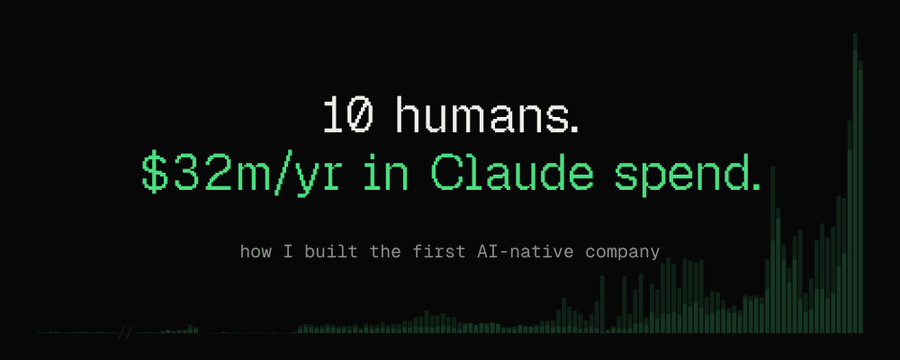
This article describes how Spawn, a small team of ten, uses AI agents to build and operate products with extraordinary speed and efficiency. Spawn spends 30 times its payroll on AI tokens each month and makes more than 77,000 substantive changes a month. This is a completely different approach from traditional human-centered development, made possible by giving AI agents responsibility for almost every part of the company. A permanent team of AI agents called the "fleet" handles everything from engine development to finance and bug triage. The approach is distinctive and efficient enough to attract attention from major AI companies such as Anthropic.
1. Spawn's AI-Centered Development Philosophy 🧠
Despite its small team of ten, Spawn spends $3.1 million a month on AI tokens, making it one of Anthropic's major customers. 😮 Whereas other companies use AI as a tool, Spawn makes AI agents the primary actors, fundamentally changing its development process. An Anthropic researcher even said Spawn operates more like Anthropic itself than other companies do. Since its founding in 2024, Spawn has invested in the potential of AI agents, believing AI will keep getting smarter, faster, and cheaper.
"Most companies run large human teams that use AI. We run a small human team alongside a large team of agents."
2. The Birth and Evolution of the Fleet Agent System 🤖
Spawn built a distinctive agent system called the fleet, unlike ordinary agents that are short-lived and focused on a single task. Each fleet agent:
- Is persistent, has a name, and retains memories of past work.
- Has real authority within the system and honors commitments.
- Owns and manages a particular area of the company, such as the engine, operations, finance, or bug triage.
These agents use many helper agents to process enormous amounts of work, sometimes spawning thousands of helpers in a day. The human team works with the fleet on larger, more ambitious projects.
This became viable with the release of Anthropic's Fable model on June 9, 2025. Earlier models were too "dumb" to make it work, but within two days of Fable's release, Spawn was making 214 changes a day. 🚀 Fable's strong consistency and judgment play a central role in making the system work. Other models reportedly caused serious problems.
"We had been imagining this system for two years. When we finally had a model that could power it, everything around it began to break, because the surrounding world had never been built for this kind of system."
3. Reinventing Traditional Development Practices 🔄
By adopting its AI agent system, Spawn removed several bottlenecks in traditional development.
3.1. Rethinking Communication Between Agents 🐜
The first problem was excessive communication between agents. Human teams coordinate through messages such as, "We're about to change how player data is stored, just so you know." But when agents tell one another about everything, communication volume grows exponentially.
Spawn took inspiration from ant colonies. Rather than communicating directly, ants communicate indirectly through pheromone trails and changes to their surroundings. Similarly, Spawn's agents change code directly and communicate through the live product and database. Each agent understands the whole system deeply, so when a change affects another agent, that agent fixes the resulting problem itself.
"An ant doesn't say, 'I'm going to look for food,' or 'I found food over there.' It leaves a trail, and other ants follow. Every ant observes and changes its surroundings."
3.2. Removing Pull Requests and Deploying Continuously 🚀
Human teams review code changes through pull requests because people have specialized roles. Spawn's agents understand the entire system, so the PR process was unnecessary. Spawn removed PRs and let agents change code directly.
Rather than waiting for every change to be perfect, Spawn accepts less-finished changes and brings all its systems into alignment every hour. When something goes wrong, a separate agent is immediately spawned to identify and fix the issue. This differs from having the human developer who wrote faulty code fix it.
"Even if the code breaks at 2 a.m. on December 25, nobody wakes up. Claude is happy to jump in and make everything work."
Testing follows a similar pattern. Before applying a change, an agent runs its code and tests the product, but does not run the entire test suite. The full suite runs against the latest code every 15 minutes, and an agent fixes any issues immediately. With this fast, automated process, only 0.9% of Spawn's last 123,548 changes were rolled back—a very low error rate.
4. Minimizing Human Intervention: Hyper Observability and Autonomous Resolution 🔭
Spawn built a Hyper Observability system so agents can detect and resolve problems without human intervention.
- Real-time error detection and resolution: Because agents change live code and deploy to production in real time, they directly read and analyze every error, bug report, and metric. About 60% of Spawn's work starts with production errors, bug reports, log anomalies, or feature requests.
- Savi's own bug reporting and resolution: Savi, the AI used to create games on Spawn, reports bugs when either it or a user finds one. An agent receives the report and decides whether to fix it. Usually, the user receives the fix and an explanation within an hour. 🧑🔧
- Agents monitoring every input: Agents also monitor all company expenses, including Anthropic and AWS bills. When an Anthropic API key leaked, agents detected abnormal spending within 15 minutes, disabled the key, and rotated all keys. 💳
Because these processes are automated and the feedback loop is closed, Spawn can keep improving. It values rapid deployment so highly that an hour without a deployment counts as a highest-severity, SEV-0 incident. 🔄 Since agents can handle only a limited amount of work at once, shipping quickly helps them remain coherent.
"A loop this tight works only if it never stops. So we consider an hour without a deployment a SEV-0, the most serious kind of incident."
5. Addressing the Taste Bottleneck: Introducing AI Judges 🎨
Around October 2025, Spawn's next bottleneck was decisions involving the founder's taste. Agents generated countless questions about feature implementations, configuration changes, and more—too many for the founder to answer. One morning, the founder found more than 700 unanswered questions. 😱
Spawn had stored two years of decisions and conversations in its code repository. Using that record, it built AI judges that identify and apply the principles behind each person's taste.
- When asked a question, an AI judge does one of three things:
- If an answer is already documented, it provides that answer and cites the source.
- If the question itself is misguided, it sends it back to the agent.
- If a new judgment is required, it waits for a human decision.
In their first eight days, the judges made more than 11,000 decisions, requiring the founder to intervene only 27 times. Agent throughput jumped from 1,000 to 7,250 tasks a day. 📈
6. New Human Roles: Supplying Taste and Entropy 🎨💡
What do Spawn's ten human teammates do now? Their roles have changed completely. Engineers are now more like paratroopers than owners of particular systems: they drop into a problem area, quickly understand the situation, and help agents with their work.
Two important new roles have emerged for the human team.
-
Taste: Making thousands of small decisions and setting directions that improve the product. As they use the product, humans provide many feedback prompts, sometimes giving Claude blunt feedback such as, "If this code exists, delete it," or "Does this seem fun?" Removing code and features that are no longer useful is also important. 🗑️
"Claude shipped capsules and spheres as stand-ins for distant players. 'No stand-ins. If you can render them, render them; otherwise, don't.'"
"This broke chat????? Revert it Claude please"
-
Entropy: Proposing ambitious ideas and creative directions the model is unlikely to suggest on its own. Models excel at improving existing things, but are weaker at bold attempts to invent entirely new architectures or achieve improvements of 100 times or more. Humans give models big goals by asking, "What if the world were truly infinite?" or "How could we load a world 1,000 times the size of GTA on a phone in one second?" 🤯
"The model won't ask for a 100× improvement on its own. So we do."
7. Why Large Companies Struggle to Adopt Spawn's Approach—and AI's Real Value 🏰
Spawn's founder expects large companies to struggle with this approach because they lack the willingness to accept the risks of closing the loop. The approach works only if you accept the possibility that an AI agent may break production.
Interestingly, human developers reportedly cause production problems more often, while agents do so much less frequently. When agents do cause trouble, they fix it quickly and can even roll back a change in 30 seconds. ⏱️
The founder also argues that forcing AI into a human mold is misguided. Spawn's customer-support AI occasionally makes small mistakes, but recovers quickly and provides immediate answers and solutions, earning high customer satisfaction. Customers much prefer this to a human representative saying, "I'll look into it," then returning with a solution two days later. 🗣️
Finally, the founder emphasizes the virtuous cycle in which new AI models improve the capabilities of the entire company. When Spawn upgraded from Fable to Fable 5.1, most of its problems disappeared, and it expects this progress to continue. With the right system architecture, each new model makes the whole company substantially better—a pace the founder says other companies will find extremely hard to match. ✨
Closing Thoughts
Spawn's story is a powerful example of AI moving beyond a tool to become a primary actor in running a company. 🚀 Persistent agent systems such as the fleet, autonomous problem-solving through Hyper Observability, and automated decision-making through AI judges are central to its exceptional efficiency and speed. Humans now concentrate on creative and strategic work, supplying the taste and entropy AI cannot provide and bringing out its full potential. This offers important insights into future company models and inspiration for how organizations should evolve in the AI era.