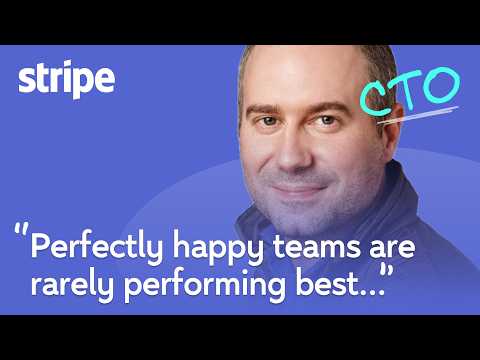
David Singleton is an engineering leader with an impressive trajectory — from junior developer at Google, to VP, to CTO of Stripe, to co-founder of an AI startup. In this interview, he shares candid, in-depth insights on his career growth, leadership philosophy, hiring engineers at scale without LeetCode, why engineering leaders should keep coding, and memorable management habits and book recommendations. Whether you're navigating a technical career or interested in engineering culture, there's plenty of practical takeaway here.
1. Where Programming and Career Began
David grew up in Northern Ireland with computers and coding from an early age. With a computer that arrived at home, he built custom invoice software for his parents' business — and that's where he first felt the joy of building and its real-world impact.
"My parents used to stay up all night sorting through accounting paperwork by hand. After I built the invoice software, they just pressed a button and it came out of the printer. That's when I realized software could have a huge impact on people's lives."
That experience planted a deep belief that software can change lives, and he went on to study computer science before entering the tech industry.
2. Symbian and Joining Google: Early Learning and Growth
His first job was at Symbian — a pioneering company building mobile phone operating systems in the pre-smartphone era. Working with teams from multiple global manufacturers, he gained early first-hand experience of how much organizational culture shapes outcomes.
"Working with teams from different companies gave me a real taste of different cultures. Samsung was all speed and competition; Nokia was meticulous planning and predictability. Those differences had a decisive impact on what actually got shipped."
That experience sparked a deep interest in engineering productivity and team design.
He joined Google shortly after its IPO, as part of a newly formed mobile development team in London. He initially thought he'd stay a year or two to learn and grow — but ended up spending over a decade taking on a wide variety of roles and continuously pushing himself.
"At Google, I'd end up in a completely new role every year or two. Whenever I felt like I was still learning, I naturally stayed. That feeling kept pulling me back."
3. Moving into Management, the TLM Role, and Leadership Style
His transition from IC (Individual Contributor) to EM (Engineering Manager) felt natural. He also experienced the TLM (Tech Lead Manager) role — handling both full-stack development and team management simultaneously.
"Being a TLM means genuinely switching between two modes all day long. You need the 'balcony view' — helping team members through blockers and keeping the big picture — and you also need the 'dance floor' mode, where you're heads-down in the code yourself."
As he moved into senior management and VP-level roles, he developed a systems-level perspective on work — treating an organization like an operating system.
"A frontline manager focuses on conversations and one-on-ones. But once you become a manager of managers, the main job is designing the systems, processes, and operational rhythms of the organization. You start seeing the whole org as an OS."
"Teams that are perfectly happy rarely perform at the highest level. Some degree of tension, feedback, and drive to improve is what makes an organization genuinely grow."
4. Communication and Influence: A Non-Negotiable Leadership Skill
David emphasizes that both verbal and written communication skills are essential for leaders — and that they require constant practice.
"I used to get nervous presenting too. The key is relentless practice. And developing the habit of pausing to give your audience context about what matters right now — that habit has an outsized impact."
He also shares what he learned from Stripe's culture around large-scale written communication: get peer feedback, and give public credit for it.
"For blog posts or important documents, I always designate co-reviewers, credit them, and go through a proper revision process. You'd be surprised how many perspectives you miss when it's just you in your own head."
5. Process, Culture, Organizational Design, and Distributed Teams
He took what he learned about 'process' from large Silicon Valley companies and experimented with fast, autonomous organizational cultures at Stripe and in startups.
"Process isn't bureaucracy that kills creativity — it's a tool for consciously designing how you work. It only functions when it's used where it's actually needed, and when everyone understands the why behind it."
He also shares deep insight on remote and distributed teams.
"The greater the distance and time-zone spread, the more you need to fully separate a team's mission and give them real autonomy. When a team has its own identity, people take care of each other and actively work to improve things. That said, it still has to stay broadly aligned with the company's overall culture."
6. Stripe's Hiring Culture: Evaluation Without LeetCode, and What Meta/Google/Amazon Do Well
At Stripe, hiring wasn't centered on LeetCode problem-solving. Instead, candidates were evaluated through pair programming in a real development environment, assessing genuine engineering ability, thoroughness, and intellectual curiosity.
"At the time, the industry was all whiteboard coding interviews. We used laptops and real tools — pair programming. It let us evaluate a candidate's abilities in the closest possible approximation to what they'd actually do on the job."
He also emphasizes that great documentation, well-designed APIs, and a polished developer experience are themselves a recruiting tool.
"Having a product that's beautiful and well-crafted attracts great engineers on its own. After that, it's about managing a rigorous, Silicon Valley–style hiring process."
Comparing companies like Meta, Google, and Amazon, he notes that Stripe's 'Users First' mindset and thoroughness, and Amazon's structured, systematic operational discipline, were both influential in shaping his thinking.
7. Maintaining Organizational Culture and Product Quality
He returns again and again to the idea that culture must be modeled by leaders themselves.
"Operating principles aren't abstract values — they're specific descriptions of behaviors that have actually proven effective. Leaders have to visibly practice those behaviors themselves."
"The surest way to maintain culture is to never forget: what you tolerate becomes the standard. If someone's behavior goes unchallenged, that behavior becomes the norm."
At Stripe, a variety of tools were used to spread culture and standards across the organization — including a bug-report mailing list, 'walk the store' (product use demo meetings), and 'friction logs' (documenting pain points).
8. Building a New AI Startup: Dev Agents and a New Challenge
After leaving Stripe, he co-founded Dev Agents, an early-stage AI platform. Its goal is fundamental innovation in AI agent infrastructure.
"Back in the early days of mobile OS, I was hands-on building patterns for how new technology would work in the real world. I became convinced that AI would need the same thing — new patterns, new experiences, new infrastructure."
Dev Agents' vision is to build a new agent ecosystem that connects developers and users.
9. Career Reflections and Advice: Growth, Opportunity, Regrets, Books, and Habits
He returns repeatedly to the idea that the core of a successful career is maintaining a posture of continuous learning.
"The reason I stayed at Google and Stripe for so long was that I could keep learning. The moment growth and learning slow down even a little, it's important to actively seek out a new environment."
His regrets include early in his management career being so focused on making everyone on the team 'happy' that he missed the chance to drive peak performance, and holding back his own opinions in meetings.
"If you're the one actually doing the work, you have more context than almost anyone else. Say what you think, with confidence. The more senior the leader, the more they welcome that kind of voice — I know that now."
Memorable Habits and Tools
- Each week, write a 'rocket document (🌱🚀)' capturing the core goal you want to achieve that week, and treat it as the top priority throughout the week
- Consistent exercise: "When my energy tanks, nothing beats exercise."
Books That Made the Biggest Impact on His Career
"High Output Management by Andy Grove — it's the original source for Silicon Valley management practice, and it explains in one book the origins of the techniques we all use: OKRs, one-on-ones, and more. Everything you need to know about how great companies run is in this one book."
He also recommends Accelerate by Nicole Forsgren for anyone interested in engineering productivity and operational stability.
10. Advice for Young Developers and Aspiring Leaders
"When I was starting out, I thought my voice didn't matter — but in reality, I was often the one with the most context. So speak up. The best companies and leaders will actively welcome it."
And above all, he stresses honestly understanding where you find joy and a sense of accomplishment. The closing message is an encouragement: focus on your own version of growth and meaningful work — not other people's benchmarks or a competition over titles.
Closing
David Singleton's career story isn't just a tale of success — it's packed with practical wisdom on continuous learning and growth, organizational culture and teamwork, the essence of leadership, and the execution needed to drive real change. It's a genuine source of inspiration for anyone who wants to take a step forward as a technologist or a leader.
Key Themes
- Engineering leadership, team design, process and culture, feedback, autonomy and growth, real-environment interviews, "walk the talk" leadership, facing friction logs directly, a systems view of operations, written communication, mentoring
- ⭐️ Recommended books: High Output Management, Accelerate
- 🚀 Useful habits: Weekly rocket document & consistent exercise
This summary is based on content from 2025.