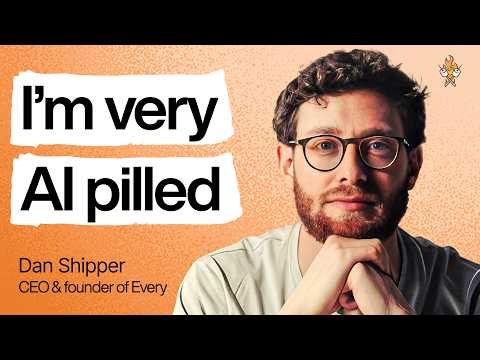
This video features Dan Shipper, cofounder and CEO of Every, speaking on Lenny's Podcast about how work is changing in the AI era and what the future may look like. Drawing on his experience accurately predicting the potential of Claude Code a year earlier, Dan offers bold and sometimes counterintuitive predictions about how AI will change the way we work. The main ideas fall into three areas: how work will be done, what work will consist of, and who will succeed in the AI era and how to prepare. Dan emphasizes the AI paradox: even if AI automates work, the human role will not simply shrink. Instead, new, more important work will appear. His advice is to use AI actively, because that will be central to future success.
1. Why These Predictions Matter: Every as a Front-Runner in the AI Era
Dan Shipper is the CEO of Every, and he describes the company as a living laboratory for glimpsing the future of the AI era. Every has about 30 employees, all of whom are active AI early adopters. Engineers, writers, editors, salespeople, and customer-support teammates all use AI to get work done. That means Every experiences the development and practical application of AI technology earlier than most organizations.
"Every employee is an AI early adopter. There are almost 30 of us now. At the time of last year's interview there were 15 of us, so we doubled over the past year. All of us try new technology, experiment, stay curious, and are deeply immersed in AI."
Dan says the team often tests AI models before release, and the insights they gain help them predict the future and shape the direction of AI technology. He points to his earlier prediction about the usefulness of Claude Code for non-engineering work as one example that turned out to be right. His current predictions come from that same pattern of hands-on exposure.
"Claude Code was the thing I talked about last time I was on Lenny's Podcast, when I said people were overlooking Claude Code. Especially for non-engineering tasks: organizing files, sorting hard drives, all the things people were not thinking about. Nobody was talking about it. That was a year ago."
2. How Work Will Change: Living With Agents
Dan predicts that the way people work will change in two major directions.
2.1. Super Agents and Personal Agents
The first change is collaboration with agents. Dan believes everyone will talk to at least one agent, or AI assistant, and delegate work to it. At first he expected each employee to have their own individual agent. Now he thinks the more likely near-term model is a company-wide "super agent." Like Shopify's River or Ramp's internal agent, one central agent may handle work for the entire company and be managed centrally.
"Every company will have at least one agent that people can give work to."
"For now, I think it will be a one-super-agent-per-company model. Shopify has an agent called River, and Ramp has one too."
This model minimizes the effort required to maintain agents. A forward deployed engineer or similar specialist would manage the agent so it works efficiently across the organization. If agents become independent enough, the age of personal agents may return. But for now, Dan sees the super-agent model as more realistic. Communication with these agents will likely happen mainly through workplace messengers such as Slack.
2.2. Work Environments Centered on Codex and Claude Co-work
The second change is that environments such as Codex and Claude Co-work will become the main operating systems for work. In the past, the common idea was to integrate AI into the browser. Dan now sees the reverse: the browser will be integrated into the AI agent, and work will happen inside the agent environment.
"Most work on your computer will happen in an environment like Codex or Claude Co-work. It will become a kind of operating system for all of your work."
Dan says he already uses the Codex desktop app for writing, email, research, and almost everything else. Through a browser inside Codex, he visits websites and collaborates with an agent in real time. If this pattern spreads, users will bring their own AI tokens into apps, allowing SaaS companies to reduce the cost of AI integration and improve margins.
"I use the browser inside the Codex app to write documents. Codex can see what I am doing, and I can see what Codex is doing. It feels like I have a coworker working with me."
"I ask Codex to gather my emails for our email agent Cora and render a small page. Then all I have to do is monologue about each email: 'Research this. This is a question from a lawyer. Can you gather all documents from the past four years and make a report to send back?' Then Codex handles it."
2.3. The End of the CLI Era
Dan bluntly says the era of the CLI, or command line interface, is over. Claude Code made people notice the potential of CLI-based work, but Dan believes people will ultimately prefer the convenience of GUIs. GUI-based tools are especially necessary for non-programmers, and even programmers are likely to use tools such as Codex and Cursor more often.
"The CLI era passed quickly. It was fun, but I think the CLI is over now."
"GUIs are better. And you can get all the benefits inside a GUI, especially for non-programming work."
2.4. The Revival of SaaS: Agents Increase the Number of Users
Contrary to many predictions, Dan is extremely optimistic about the future of SaaS. He argues that the idea of SaaS dying is baseless. Instead, agents will dramatically increase the number of SaaS users. As agents use many SaaS products at scale, demand for SaaS companies will grow.
"I think SaaS doomerism is stupid. I would buy SaaS stocks right now."
"What agents do is increase the number of SaaS users, not eliminate SaaS."
Dan therefore advises SaaS companies to focus on building products that both humans and agents can use. They will need to consider new capabilities such as concurrent agent requests, real-time feedback, and rollback.
3. How the Content of Work Will Change: A New Relationship Between People and AI
Dan also emphasizes that the nature of work and roles will change significantly in the AI era.
3.1. More Code and the Rising Importance of Review
Because AI lets people in non-technical roles perform technical work, the amount of generated code will explode. That will make review work much more important. Just as data scientists now spend time reviewing bad AI-generated analyses, software teams will need people who can review and integrate generated code.
"People who used to be non-technical can now do technical work, and the amount of code being generated is exploding. That creates more pressure on code review."
"A data scientist friend told me that people now share analyses, and most of the work has become reviewing bad data science."
3.2. The Rise of the Forward Deployed Engineer
For AI agents to operate and stay maintained, continuous human attention and management are still essential. Dan therefore expects roles such as forward deployed engineer to become very important. These people build agent systems and help the rest of the organization use AI without needing deep technical knowledge.
"Every agent needs a human. It needs someone responsible for it and making sure it works well."
"We thought automation would eliminate jobs, but it is creating new ones."
3.3. The Spread and Acceptance of AI-Generated Content
Dan predicts that we will read far more AI-generated writing, documents, and email, and that we may even come to like it. AI will play a larger role in structured work such as internal documents and email. He says AI already writes most of his emails, and sometimes it sends something more appropriate than he would have written himself.
"We will read much more AI-generated writing, documents, and email, and we will like it."
"There is a difference between AI-generated documents that are terrible and those that are not. A terrible document takes less time for me to read than it took to create."
Dan's advice is not to reject AI-generated content by default. Instead, people should focus on using AI to produce better outcomes. AI can handle repetitive or formal work efficiently, freeing humans to focus on more creative and deeper thinking.
4. Who Will Succeed in the AI Era, and How to Prepare
Dan points to product managers and full-stack designers as two groups that may thrive in the AI era. He also stresses that everyone should use AI actively.
4.1. The Age of the Product Manager
Dan is extremely optimistic about product managers in the AI era. He uses the example of Marcus at Every to explain how AI tools now make it possible for PMs to code and ship products directly. A PM's strong product sense and deep user understanding can combine with AI coding tools to create innovative products at remarkable speed.
"I am really, really optimistic about PMs."
"Coding models have become good enough that PMs can combine their technical knowledge with sharp product sense and user understanding."
This means PMs can move beyond simply planning and coordinating. They can become makers who build and launch products themselves.
4.2. The Rise of the Full-Stack Designer
Dan also expects full-stack designers to be major winners. AI tools allow designers to directly implement beautiful designs and interesting interactions in code, so design ideas can turn into real products much faster.
"Full-stack designers will be another big winner."
"They can now build truly amazing things and create interesting interactions. Now they can actually build them."
This gives designers more freedom to express creativity and gives them an advantage if they want to start their own products or services.
4.3. The AI Jobs Apocalypse Is False: "Ride the Models"
Dan argues that claims about AI causing mass unemployment are exaggerated. Instead, AI will extend human capability and create new kinds of work and jobs.
"The AI jobs apocalypse is not true."
"What models do is make yesterday's human capabilities cheap. Then they become commoditized and are no longer valuable. What humans do is go in and say, 'Okay, there is all this frozen human capability from yesterday. How do we use it to make something new and interesting?'"
The most important advice for surviving in the AI era is to "ride the models." That means every time a new AI model comes out, people should use it with curiosity, experiment with it directly, and ask how it might apply to their own work.
"The only thing you have to do to succeed is ride the models."
"There is no single way to ride the models, because the models keep changing. But it means bringing curiosity and playfulness to every new model and applying it to whatever you care about."
Because AI is developing so quickly, Dan stresses the importance of always learning, adapting, and not fearing change. The development of AI gives everyone a more equal opportunity, and the future core skill will be discovering and creating new things with it.
Conclusion
Dan Shipper predicts that AI will fundamentally change our daily lives and work environments, but in a paradoxical way: the human role will become more important, not less. SaaS companies may gain more users and better margins because of agents, while PMs and full-stack designers can become superhuman makers who build and ship products directly with AI tools.
In the end, success in the AI era depends on a willingness to use AI actively, keep learning, and explore new possibilities without fear. As Dan predicts, we will work with AI to solve more complex problems and focus more on the creative and strategic work that only humans can do.