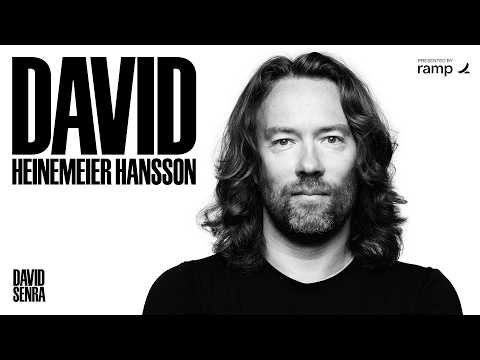
David Heinemeier Hansson (DHH), creator of Ruby on Rails and co-founder of 37Signals, draws on his 25 years of business experience to share the secrets to building a profitable company without losing control. He emphasizes that embracing constraints, pursuing simplicity, and tightly controlling costs are key to success. It also presents a critical perspective on attracting investment and operating large organizations, and introduces a method of running a business that values individual independence and freedom as the top priority. His philosophy goes beyond simply making money and shows a deep belief in having a positive impact on the world through the products and work he creates.
1. The beauty of simplicity: the wisdom of eliminating unnecessary things in software and writing
DHH says that conciseness is paramount in his writing and software development philosophy. The 2006 book "Getting Real" impressed me with its short and clear content, with most chapters lasting just over half a page or even three paragraphs. He deeply appreciates the brevity and ability to cut to the point of that time.
However, it was said that it was more difficult to maintain this conciseness when writing other books. In particular, when writing "Rework," the first manuscript submitted was 50,000 words, but Jason and DHH reportedly cut it in half to 25,000 words. The publisher was puzzled by how small the text was, but they completed the book by adding margins and illustrations. DHH says that this process of eliminating unnecessary stuff is the secret to making a book successful.
"The process of reducing from 50,000 words to 25,000 words and condensing a two-page essay into four paragraphs was really important."
He emphasizes that he wants to maintain this ability to get to the bottom of things. Because no matter how fluently you can speak for 20 minutes, that's not always the best way to do it.
Podcast host David Senra agrees with the simplicity of DHH's writing, saying he has been reading it for 15 years. However, they say that conversation has a different charm than writing. Senra recalls DHH's past lectures where he spoke frankly and outspokenly, emphasizing the importance of such deep conversations.
DHH explains that he also applies this principle of simplicity in his product development. When Basecamp launched in 2004, their slogan was "less software." Unlike complex tools like Microsoft Project, Basecamp has few features and is easy to learn. DHH emphasizes the importance of focusing on core features and making them work very well.
2. The magic of limited resources: The secret to the success of Base Camp, created in 380 hours
DHH emphasizes that limited resources become a driving force for innovation and quality. They say it has become more difficult to stick to these principles, especially these days when software development has become easier due to advances in AI technology. In the past, the constraint of lack of time naturally served to filter out unnecessary features.
He gives an example of what happened when the first version of Basecamp was being developed. We had to build everything in a very limited time frame of 10 hours a week, 380 hours in total.
"When Jason hired me in Copenhagen for $15 an hour, I could only spend 10 hours a week on development. That was a huge limitation."
DHH recalls that these strong constraints made the first version great. The limited time prevented us from focusing on or wasting unnecessary functions and allowed us to focus only on the most essential functions.
On the other hand, we warn that unlimited resources will only create huge blobs. If you invest a lot of money and manpower, you can create software with a million functions, but this ultimately leads to bloat and becomes difficult to use.
DHH supports this claim by citing the example of Microsoft. Back in 2004, people were worried that Microsoft could easily copy software like Basecamp, but DHH was convinced that Microsoft's massive organization would only produce complex software that could be produced by 50,000 people. He believed that small teams of two to four people were more threatening because they could create competitive software under similar constraints.
"It's like the 'resource curse': when you have unlimited resources, you end up with messy, complex results. If you have too much money, you don't feel the need to develop anything else."
He states frankly that he does not believe that he and his colleagues can use unlimited resources wisely. This idea also applies to the current development of AI technology. As AI accelerates software development, the risk of creating too much software and moving away from the core principle of "less software" increases. DHH emphasizes that software must still be comprehensible to the human mind.
3. The beauty of a finished product: Unchanging value and the voice of the customer
DHH talks about the value of the finished product and the customer's resistance to change. He cites his black-and-white laser printer (Brother HL2340WD) as an example, saying that once certain features are working perfectly, he no longer feels the need to upgrade.
"It just works. No firmware upgrades or any other complicated features. All you need to do is print in black, sign and scan. I hope it will work the same in 10 years."
He explains that many of Basecamp's customers use Basecamp printers like this one. Since it was a tool that once solved a problem, they don't want constant additions or changes to features. Customers think that "it's just a matter of doing what's given" and that change causes inconvenience.
But the company faces the dilemma of having to evolve its product to attract new customers. 37Signals rewrote Basecamp three times to solve this problem, but chose a unique strategy of maintaining the previous version.
"We rebuilt the product three times, but kept the previous versions. Normally, everyone would be forced to upgrade when a new version comes out, but we didn't."
The first version, released in 2004, was discontinued in 2010, but it still generates millions of dollars in revenue and is still used by many customers 16 years later. These customers are satisfied with maintenance without additional development costs and do not want new features.
"We still have customers using products that have been discontinued for 16 years. They haven't heard any of the good ideas we've had in the last 16 years, and they're still excited about the products we sell. It's amazing."
Through this experience, DHH believes that software can also be "completed" like a physical product. Just as a knife or an album does not change much once it is released, software can maintain its value for a long time without any updates if it functions perfectly.
DHH also mentions a CRM tool called High-Rise, which has also generated millions of dollars, but is no longer being developed and is being kept as a "frozen, mature software." He believes that not every product needs to constantly evolve, and that sometimes it's important to keep things the same for existing customers. 😃
4. Solitude and Independence: My own space for productivity
DHH emphasizes that solitude and an undisturbed environment are essential for productivity and creativity. He says he is an extreme introvert and prefers to spend most of his time alone.
"I spend most of my time alone, the other half with my family. I spend very little time per week interacting at length with strangers."
37Signals has about 60 employees working remotely, and they all get together twice a year to spend time together for a week. Although DHH admits that these encounters are important for human connection, he admits that at the end of the week, he wants to go back to his own space.
"No matter how much I love these people and this company, I would rather be a hermit in the woods than work together in an office 365 days a year."
He says his career took off when he was able to close the door and work alone for long periods of time without interruption. In the past, when I worked in an open office, my productivity and creativity stagnated, and I was easily bored by the people around me.
DHH cites Paul Graham's concept of 'builder mode' versus 'manager mode', explaining that a builder only needs to be interrupted a few times a day to ruin his day. For deep thinking and problem solving, you need at least 4 hours of continuous time in a "flow" state.
He hates repetitive tasks and loves trying new problems. Because of this tendency, I try to keep my work environment like a 'pure cocoon'. Having clutter on your office desk can make it hard to concentrate, so make sure you have mental space by organizing everything neatly.
DHH says that the software tools he creates, such as Ruby on Rails development, are sometimes a result of "productive procrastination". Before tackling the big task at hand, you focus on creating or improving the tools you need.
"What I really need is a table, but first I need to design a wrench from scratch so I can assemble the table."
Although this approach is time-consuming due to our perfectionistic tendencies, it ultimately produces the best product, and we believe that others will find its value.
5. AI and Linux: Forward-looking insight and personal innovation
DHH shares an experience that changed his perspective on AI through his interaction with Toby Rutke (CEO of Shopify). At first, he was skeptical about the potential of AI, and he especially disliked the AI auto-completion function that constantly intervened while coding because it felt like a 'persistent colleague'. This was because it conflicted with his solitary way of working.
"The AI autocomplete feature was like an 'interrupting colleague'. It was like saying, 'I'll write the code for you!' I wanted to think for a moment, but I felt like I was constantly being interrupted."
However, Toby had much more forward-looking insight than DHH and predicted the rapid development of AI technology. Thanks to Toby's persistent persuasion and constant sharing of information (which DHH describes as 'nerd snipe'), DHH began experiencing AI technology first-hand and eventually realized AI was going to change everything.
"Toby kept saying, 'Look at this, look at this!' He showed it to me, and in the end, I thought, 'Okay, I'll try installing Pie' and tried using AI. And I realized, 'Oh, this is really going to change everything.'"
As a current Shopify board member, DHH is impressed by Toby's foresight and has seen firsthand how Shopify is advancing AI technology. Shopify has already built and utilized internal AI tools that are far superior to commercial products, such as the customer feedback analysis tool 'Scout' and the agent-based task system 'River'.
Afterwards, DHH achieved personal innovation by switching to the Linux operating system. As a Mac user for over 20 years, he became dissatisfied with Apple's policies and began looking for alternatives. Windows wasn't right for me, but I discovered new possibilities in Linux.
I was especially inspired by Reddit's 'R Unix porn' community, where users spent hundreds of hours personalizing their Linux desktop environments, turning them into works of art.
"Thanks to a window manager called 'Hyprland' created by 'Vaxfree', a 22-year-old Polish kid, I learned that Linux can be a cooler and more efficient computer than Mac."
'Hyperland' is a tiling window manager that manages all windows using only the keyboard instead of the mouse, and DHH believed that it could achieve both productivity and aesthetics. I was fascinated by the fact that if you break away from traditional mouse-based interfaces like Apple or Windows and master keyboard shortcuts, you can use computers at a rapid pace.
Based on this experience, DHH created his own Linux distribution called 'Omachi'**, named after 'Omakase'. 'Omakase' means 'chef's special', meaning that customers trust the chef's expertise and leave everything to them. DHH was inspired by the fact that people recognize good things, but have a hard time expressing exactly what they want.
"People have a hard time saying exactly what they want, but they recognize quality immediately. I thought I would be the chef and create and provide the best Linux environment."
He spent thousands of hours building the most beautiful and efficient desktop environment based on Arch Linux and 'Hyperland'. And we've simplified it so you can install it in just 2 minutes, so we've shared it with you so others can easily use this "chef's special."
"It takes 42 minutes to set up a new Mac computer, which is ridiculous! If we could create a fully configured system in 2 minutes, we'd save trillions of man hours around the world."
DHH has a strong belief that if you create something that satisfies you, others will definitely recognize its value. He also enjoys critical feedback because it's proof that he's creating something new and different.
6. Education that surpasses competitors: 37Signals' marketing strategy
DHH explains that Kathy Sierra's philosophy of "Out-Teach Your Competition" was the core marketing strategy of 37 Signals. In the mid-2000s, 37Signals, which was short of capital, was unable to compete with giant corporations such as Microsoft on advertising dollars.
"We couldn't beat them with banner ads, but we could connect with our customers by providing better insights and sharing them."
They are constantly sharing their observations, lessons learned, experiences, software, and open source projects with the world. And I believed that among these people, a small number of people would sympathize, recognize value, and purchase the product. This strategy has been at the core of 37Signals' operating approach for the past 20 years.
DHH believes this is the way to "make the world better"**. They're only capturing a small portion of the value they create, but they're providing much greater value to the world.
Host David Senra says this strategy has also had a decisive impact on the operation of his podcast.
"Kathy Sierra's 'education beyond the competition' idea has been worth tens of millions of dollars in my life. This one idea helped me create my first podcast and my current one."
These strategies tap into the natural human need for "reciprocity"**. As Charlie Munger said, people want to repay those who have given them something. 37Signals built trust with customers by providing a lot of valuable information, and customers purchased products in return.
However, DHH points out that recent algorithm-based social media platforms are causing cracks in this mutually beneficial relationship. In the past, your followers could see everything you shared, but now, because of algorithms, if your posts don't go viral, it's hard to get exposure.
Nonetheless, DHH says he will continue to share his ideas through channels that can reach subscribers directly, such as podcasts or newsletters. He believes that if someone is exposed to his ideas or free software, they will eventually connect with 37Signals' products at some point. In fact, host David Senra proves DHH right when he starts using Basecamp to manage his podcast.
7. Freedom and Independence: Transcendent value beyond investors and customers
At DHH, personal control, independence, and freedom are the top values of life and business. He explains that the reason he keeps investors away and does not have a board of directors is to protect these values. The key is for you and Jason to make all decisions.
He says "Not having investors is freedom, and not having customers is transcendence." He explains that Omachi, which he created, is a project created for pure enjoyment without even customers. He puts thousands of hours of work into perfecting the omachi into the world at no cost, and sets certain standards for feedback on the results.
"I gave you something of tremendous value. You can ignore it or say you don't like it. It's a fair exchange. But if you take my 4,000-hour gift and then give me crappy feedback in 5 minutes, then fuck off!"
DHH has a strong aversion to unpaid feedback. They firmly say that if you want real feedback about your product, you have to pay as a customer. This means that we are willing to accept criticism only in a mutually beneficial relationship.
"When you become a customer, we enter into a different relationship. Then I will say 'thank you' and I will accept your feedback, no matter how premature it may be, because we have done a transaction and there is a mutually beneficial relationship."
But he enjoys collaborating with like-minded people on open source software. We want to create 'small clubs' with people who contribute to Omachi and send pull requests to create better things together.
DHH says he is not against capitalism, but rather a big fan of capitalism. Since he has made enough money through business, he says that after retirement, he will pursue 'retirement from capitalism' and purely enjoy creating without financial relationships with customers.
"37Signals will probably be my last business, because it's earned me the money I need to live happily for the rest of my life. When it's over, I'll continue to create and share things without any more customers."
8. Capitalism and display of wealth: the moral obligation to buy a Ferrari
DHH emphasizes that capitalism really works, and there is absolutely no shame in pursuing material success. He criticizes people in the tech industry for pretending to hate money, and he doesn't hide his expensive cars or luxurious offices.
"I think we have an obligation to show that capitalism actually works. To offer others the carrot that 'you can do it too.'"
He says that having the nice things you dreamed of as a child can be motivating, and that the desire to improve your life through material success is a good part of capitalism. Furthermore, he argues that successful people have a 'moral obligation' to return the money they earn back to the system.
"If you've successfully sold a product or service and made a lot of money, you need to put that money back into the system. Send money to Italian craftsmen to build you a beautiful Ferrari!"
By purchasing an expensive product like a Ferrari, you provide opportunities for the craftsmen, engineers and designers involved, and ultimately allow "beautiful things" to continue to exist in the world. He cites the example of children being happy to see a Ferrari and explains that the joy brought by beautiful objects is something that the community can enjoy together.
"We don't live by bread alone. We need a beautiful Ferrari, even if we don't own one. Cars are the joy of the community."
DHH acknowledges that his way of doing business is different from the Silicon Valley mainstream. 37Signals was operated without venture capital funds, working 40 hours a week, pursuing work-life balance, and pursuing profit. Instead of chasing high corporate value, this created a business model that was profitable over the long term.
"We like the phrase 'lifestyle business.' There's business and there's lifestyle. What do you have?"
He proudly states that his "lifestyle" includes a yellow Lamborghini, emphasizing that these material rewards are a legitimate result of capitalism. He especially criticizes software companies for raising large amounts of money and hiring large numbers of people as inefficient. This is because great software can be created even with a small number of people.
9. Cost Control: The Only Controllable Variable
DHH emphasizes that 'cost control' is the only part of its business operation over which it has direct control. This is the core of his business philosophy and a principle shared by great entrepreneurs such as Carnegie and Elon Musk.
Host David Senra quotes a famous quote from Andrew Carnegie.
"Revenues and prices can fluctuate due to temporary market forces, but costs can be tightly controlled. Cost savings are permanent benefits."
DHH says this is exactly what he thinks. Increasing your profits is very difficult and unpredictable, while your costs depend only on you.
"Increasing revenue is very difficult. Convincing customers to open their wallets is out of my control. But I can choose how much I spend on servers. I can also eliminate wasteful cloud services."
He finds great satisfaction in saving money, no matter how small. There's great joy and efficiency in the process of eliminating a $2,000 monthly expense or replacing it with a cheaper alternative.
DHH likens these efficient business operations to an "efficient engine" or "an efficient computer". Unnecessary costs are inefficiencies that hinder growth, and eliminating them makes the entire business run more smoothly.
"Not only do you make more money when you eliminate costs, but the company as a whole runs better. Small, talented teams are much more fun to work with."
He says many entrepreneurs miss the early days of working in small teams, and emphasizes that making small teams efficient is the way to achieve greater results.
DHH even surprises himself that he likes "spending reports". If you told my 18-year-old self that she would love expense reports in the future, she wouldn't have believed me. But now I find great joy in finding and reducing small expenses, which I believe is an important part of making my business healthier and more efficient.
10. Jeff Bezos' Insight: Early Investments and Sources of Confidence
DHH talks about the decisive impact that Jeff Bezos's initial investment had on 37Signals. In 2005, when Basecamp was just starting to take off, about 40 venture capital firms offered to invest, but DHH was skeptical about attracting VC funding due to memories of the dot-com bubble burst.
He had his own philosophy on running an efficient business, and honestly confesses that he did not trust himself to avoid being tempted by large investments.
"I didn't completely trust myself that I wouldn't be tempted by $20 million or $50 million offers. I only had $8,000 in the bank at the time."
Then Jeff Bezos approached them, and DHH and Jason thought Bezos would be no different from other VCs. They offered absurdly high investment terms that they were certain Bezos would not accept. This is because it was an unrealistically high amount compared to the value of 37 Signals at the time.
"We were presented with extremely overvalued terms that were really unpleasant. I thought, 'That's a ridiculous amount and I'll never accept it.'"
But Bezos accepted the terms, which gave 37Signals great confidence. They realized that Bezos was different from typical VCs and that he invested not just for money, but for the potential of the company and their vision. DHH said that Bezos had insight into the future, and in fact, 37 Signals returned Bezos many times the investment as dividends, proving to be a profitable investment.
"Bezos was investing in our 'promise', and by that promise we were going to draw a line and go all the way to the moon. It was a really stupid number, but he accepted it."
Bezos' investment gave 37Signals the confidence and financial stability to resist the temptations of other investors. DHH describes it as an 'unbelievable gift'**, not having to go out and look for a job every Monday.
Bezos also gave valuable advice to DHH and Jason. When they meet once a year for dinner and share business difficulties, Bezos always asks "What do you think?", and after listening to their thoughts, he encourages them by saying "That's a great idea. Do it."
"The confidence that Jeff Bezos, the king of the damn world, believes in us, that our ideas are valuable and good, is like a huge rocket booster!"
This support gave DHH and Jason confidence in their vision and approach, and gave them the courage and arrogance needed to build their business in a way that was different from the mainstream, DHH says. He feels tremendously grateful to Bezos and recalls that without his investment, 37Signals would have taken a completely different path.
"Without Bezos' support, we would have sold our independence and become miserable bastards. But that didn't happen. It's all thanks to Jeff."
11. Leadership in Crisis: The Work Culture Controversy and Mark Andreessen's Help
DHH talks about the 'woke culture' controversy that 37 Signals experienced in 2021 and the help he received from Marc Andreessen in the process. 2021 is a time when 'woke insanity' has reached its peak, with political agendas infiltrating the workplace in many companies and causing confusion.
37Signals was no exception. Within the company, a small group of employees with activist tendencies posted political statements on the company page or pressured the company to speak out on specific political issues. DHH initially viewed this move as "well-intentioned," but gradually realized that it was threatening to undermine the very essence of the company.
"By 2021, it was clear that if we didn't do anything, the entire company, its soul, could be ruined. We could end up taking on business we didn't want."
In the end, DHH and Jason decided to take hard action. They have completely banned political discussion from the company's internal communication channels. The company declared that its workspace was not a place to discuss controversial political issues such as the Palestinian issue.
"We told them that if they couldn't work for a company that wouldn't discuss Palestine during work hours, we would give them six months' salary and go somewhere else."
Because the tech industry job market was booming at the time, this offer was very attractive for many employees. Approximately 20 out of 60 employees, or nearly a third, accepted this offer and left the company.
DHH says this is "the best money we've ever spent on culture." This was not just about getting rid of people who were causing problems, but it played a critical role in restoring the health of the company culture and achieving 'piece of mind'.
"It was like not only surgically cutting out the cancerous cells, but also removing the thick tissue around them. As a result, we had a culture that was completely cured of all that madness."
When the company was in crisis with one-third of the employees leaving at once, Toby Rutke helped me connect with Mark Andreessen. Andreessen was experiencing similar issues at other portfolio companies, so he offered great comfort and support to DHH, letting him know that he was "not alone."
"When you're accused by 40,000 people on Twitter of being the worst human being on the planet, even the strongest person can think, 'Damn, the mob is coming for me.' And that's when Mark Andreessen was there."
Andreessen recommended books on the **history of 'wokeness' to DHH, helping him realize that this phenomenon did not simply appear suddenly but **had ideological roots dating back to the 1960s**. This really helped DHH understand what was going on and gave him a greater sense of purpose for his decisions.
"Once we knew where it came from, it took on much greater meaning and gave our rejection of it a greater sense of purpose. We were not rejecting it for our little corner of the world; we were engaging in a great battle of civilizations over where this country would go."
DHH is deeply appreciative of Andreessen's willingness to help in the face of this 'collective existential threat' despite his personal differences (especially his views on venture capital), which he says has given him the courage to "not bow down, apologize, or backtrack."
Conclusion
DHH's story clearly demonstrates that the secret to business success is not simply money or size. He emphasizes that pursuing simplicity and efficiency within limited resources and maintaining independence by sticking to one's own philosophy are the true paths to success. In particular, personal projects like 'Omachi' demonstrate the transcendent freedom that can be achieved through pure creative activity without even a client.
He also acknowledges the positive aspects of capitalism and argues that it is legitimate for successful entrepreneurs to create good products, contribute to society, and enjoy material rewards. At the same time, we emphasize the importance of building a waste-free business model by controlling costs and pursuing efficiency. Based on personal experience and beliefs, DHH reminds us of the important value of entrepreneurship through the experience of protecting the essence of the company without giving in to external pressures such as the 'work ideology'. Ultimately, DHH's philosophy presents a sustainable business operation model based on individual freedom and creativity and will serve as inspiration to many entrepreneurs.