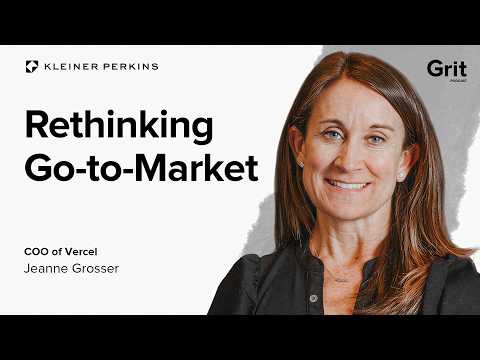
After roughly a decade each at Google and Stripe, Jeanne Grosser joined Vercel as COO to rethink GTM, or go-to-market sales and marketing operations, in the AI era. Rather than indiscriminately adding headcount, she focuses on unifying product, marketing, sales, and support into one customer experience and using AI to improve productivity. She also describes the technical founder's relationship with a second-in-command as a "professional marriage," explaining how trust, predictability, and execution develop in a rapidly growing company.
1. Working for Problem-Solving, Not Money
Host Joubin Mirzadegan asks why Grosser still works. She spent over nine years at Stripe as it grew from around 400 to 8,000 employees, became Chief Business Officer, and presumably no longer needs the money.
She compares herself to an elite athlete who keeps competing despite financial security. She has not left everything on the field and still has professional ambitions. Retirement would bore her, and leaving the rapidly changing technology industry could quickly make her irrelevant.
"I don't feel I've left everything on the field yet."
"I really love solving problems, intellectual stimulation, the people, and the things work makes me think about."
She does not romanticize every day. Sometimes she wishes Wednesday were Saturday. Work is difficult, but on average she wakes looking forward to problems to solve, even waking at 2 a.m. thinking about them.
Those concerns usually seem manageable in daylight. Sometimes she has not understood a problem's structure and studies it like chess; sometimes worries cascade into a loop that makes her whole life feel uncertain.
"In the morning, none of it seems that stressful and everything looks solvable. At 2 a.m., strangely, it doesn't."
Venture capital or advising were options, but she fundamentally considers herself a doer. She wants to point at week's end to a result that would not exist without her work.
"My satisfaction is tied to whether I actually moved something forward today."
She took only three days off after Stripe and began at Vercel on Monday. Having advised Vercel while at Stripe, she had about 18 months to understand the company and founder Guillermo Rauch before joining fully.
2. Hypergrowth's Cost and Early Changes at Vercel
Joubin says people underestimate the physical and mental cost of sustained hypergrowth. After over nine intense years at Stripe, Grosser boarded another fast-moving train at Vercel.
Much needed changing. Driving major changes as a newcomer was hard, and at times she felt she was expending more energy than ever without having rested enough.
Yet on the day changes were announced, she slept better than she had in a year. She had understood the problems, chosen changes, aligned people, and reached the first stage of implementation.
"It felt like we'd figured out what was wrong, how to change it, and how to make the change with people."
Hypergrowth is not constant misery. Product launches and major projects can make her leap from bed; other weeks are draining. She describes repeating highs and lows, with recovery after difficult stretches.
Her responsibilities cover effectively all GTM: marketing, sales, field engineering, support, and partnerships.
"If it touches customers or makes money, you can say it's my job."
3. Test Product and GTM Problems Together
Technical founders may assume a sufficiently good product sells itself. Joubin says this makes it easy to blame sales or marketing for weak growth, helping explain short CRO tenures. Product is tied to the founder's identity, making its shortcomings hard to admit.
Grosser agrees. The recurring question is:
"Is this a Product-Market Fit problem, or a GTM problem?"
At Vercel, people believed the product was ready and GTM execution was the issue. She brought a product manager and lead engineer to ten consecutive enterprise-customer conversations so everyone heard feedback and identified patterns together.
They concluded that enterprise customers existed, but complete enterprise PMF did not. Product improvements were needed to make selling easier.
"After ten conversations, we all agreed enterprise Product-Market Fit wasn't complete."
Some purchases do not prove the product is sufficient. Visionary early adopters tolerate friction. Product and GTM teams need to hear the same customers and face the same reality.
After sales meetings, she asks Guillermo how her pitch went. She learns from the founder's product explanation; product leaders and engineers should likewise observe the objections sales faces.
Vercel uses AI to extract objections from transcripts and evaluate how they were handled. If a product gap, rather than sales skill, prevented resolution, the system creates a product request. Customer conversations become an automated product-improvement feedback loop. 🤖
4. Test Founder Optimism With an Operating Model
Joubin warns early sales leaders against inheriting a founder's revenue forecast unquestioningly. Founders are optimistic and accustomed to selling investors a dream. Without pipeline, staffing, conversion, and deal-status evidence, a large number is not an execution plan.
He recalls a CRO targeting growth from $1 million to $10 million without clearly knowing the current pipeline. Forecasting revenue from an unlaunched self-service product or an enterprise deal after one meeting is especially risky.
"You're inheriting the founder's forecast. Founders are optimistic, and forecasting usually isn't their core skill."
"You're likely to get fired before the product leader."
Grosser entered both Stripe and Vercel with a different view of existing forecasts. Her first task is an operating model: a mathematical account of what must be true to reach the revenue target.
Vercel calls this its lead-to-revenue model, connecting geography, segments, pipeline, conversions, deal sizes, and the whole funnel. Even with imperfect data, reasonable assumptions show feasibility and reveal where reality differs from expectations.
At Stripe, existing-customer revenue was relatively predictable. New-customer revenue had to fill the gap between that and the ambitious total target. Calculation revealed insufficient pipeline; determination alone could not close it. Strategic options became clear:
- Invest in marketing to expand the top of the funnel.
- Invest in outbound sales.
- Move upmarket for larger deals.
- Adjust the target or timing.
At her first Vercel board meeting, only weeks after joining, she said the current trajectory would miss the annual target. The first two quarters looked fine, but insufficient pipeline would bend growth downward later.
"Instead of feeling reassured by two good quarters and then falling off a cliff, the math let us predict the risk at the start of the year."
This made hiring a CMO the first priority: marketing pipeline and the top of the funnel were the biggest bottlenecks. Hiring within 90 days and adjusting the levers helped Vercel finish just above its annual target.
5. Why She Made Major Changes Within Four Months
A new leader challenging plans and making major changes can unsettle the founder and organization. Eighteen months of prior trust with Guillermo helped. Before joining, she reviewed board materials and interviewed more than 12 people to understand strengths and problems.
She evaluated the company on a ten-year horizon. Guillermo wanted a long-term partner capable of change, not an executive to replace after a year. They discussed expectations and concerns openly, an "open kimono" approach.
"They hired me because they wanted me to come and change things."
She did not immediately change the target. She exposed its risks early and implemented what reaching it required. GTM changes affect individual quotas and compensation, so cannot happen on any random Tuesday. Year or half-year boundaries allow existing sales plans to close before new ones begin.
Vercel implemented many changes about four and a half months after she joined. She might otherwise have moved more slowly, but waiting six months meant landing mid-third-quarter. Leadership accepted a possible short-term dip to accelerate afterward.
"We agreed to make the bet now, even if there's a trough, so we can come out the other side and accelerate."
Six months after the changes, she was again sleeping poorly. No design predicts every variable; unexpected issues appear during execution. A few weeks later she regained confidence in the direction. Operations means learning and adjusting quickly through imperfect implementation, not perfect design.
6. Three Criteria for a Company Worth Ten Years
After around ten years at Google, she joined a Series B startup that was not a perfect fit. She had understood why she left Google without sufficiently asking why she had stayed ten years.
For the next move she defined three criteria:
- Clear values actually used in decisions
- A sufficiently large market and natural expansion opportunities
- Real technologists eager to solve hard problems
Values must live in onboarding, all-hands meetings, reviews, and everyday language, not just wall posters. They must also fit her own standards.
A large market and adjacent opportunities should provide interesting challenges for ten years, rather than confine the company to one narrow product.
The third criterion may seem unusual for GTM. She prefers engineers wanting to accomplish difficult things over teams implementing average features. Having experienced Gmail surprising the market with 1 GB of storage, she wants people willing to break through walls to build hard things.
"I wanted people who would build difficult things."
These criteria led her to nearly a decade at Stripe and later Vercel. Vercel's values were clear and embedded in onboarding and performance management. Its broad market could expand into CDN, security, and AI.
"Given enough time, I felt every pixel on the internet could theoretically be built on Vercel."
Its open-source roots and developers making tools for developers should keep her on the right side of innovation.
7. Choosing to Be a Strong Number Two Rather Than CEO
Joubin observes that many executives want to become CEOs, much as engineers want to become founders. Grosser was explicit that she wanted to be a technical founder's strong right hand: number two.
She enjoys turning technical vision into something people buy, translating it into markets, customers, and revenue more than pursuing the CEO title.
"I like turning a technical vision into something people buy."
The scope must be broad enough that revenue depends on her execution rather than another team's actions. Separate marketing, sales, and support can blame one another; owning all GTM makes both pipeline shortages and broken customer journeys her responsibility.
Human customer interactions are part of the product. Yet companies split functions among executives, producing inconsistent experiences: support and sales use different segmentation, or marketing spending does not match sales staffing.
"You can't create an integrated customer experience if marketing, sales, and support operate separately."
Owning all these functions is a burden, but lets her design the entire journey as one system.
8. The Founder Relationship as a Professional Marriage
Joubin says the founder relationship can matter ten times more than other factors when evaluating an executive role. Grosser agrees. She and Guillermo called it a "professional marriage" from the start.
"We'll spend a lot of time together. We need productive conversations and the ability to disagree."
First, they need regular time together. Some founders dislike recurring one-on-ones, but with over nine hours of customer meetings daily, she cannot rely on hallway encounters. She explicitly requested regular meetings upon joining.
Dinners were another turning point. A 30-minute one-on-one can become transactional; two hours over dinner allows important but nonurgent topics, personal context, and long-term concerns.
Vercel's candid, nonpolitical, mutually supportive executive team also helped. Executives can compare founder-feedback patterns and learn from one another's relationships and context.
Joubin admits he dislikes recurring one-on-ones and thinks people should simply contact him when needed. Grosser says dropping complex issues into Slack can be inefficient.
"When you drop something complex into Slack, I have to build the context explaining why what you thought was reasonable isn't. About half those conversations don't belong in Slack."
Handle urgent issues immediately, but give strategic questions requiring context and thought a separate conversation space.
9. Founder Detail Bombs: Distinguish Signal From Noise
Founders often keep inspecting details after delegating. Joubin says their desire for control makes them check whether others care about even small things they value.
They may abruptly message about titles on all-hands slides, email grammar, or document formatting. One casual observation to the sender may sound to the recipient like an angry demand to stop everything.
"The sender's tone and the recipient's perceived tone are usually different."
Grosser sometimes must respond immediately like a chief of staff. Yet her real job is building a multibillion-dollar business, so she cannot chase every detail. She must distinguish signal from noise.
"I'm trying to figure out the difference between signal and noise."
Three grammar comments in two weeks may indicate a company-wide writing problem, not a comma. Repeated founder comments may reveal a deeply held standard. Discuss priority differences directly when the founder sees P0 and she sees P2.
She also gives feedback and cannot eliminate it. But she tries to remain predictable: people should know what Jeanne consistently cares about, rather than receive unpredictable feedback bombs based on daily mood.
"An operator's job is building systems that produce predictable outcomes. In my case, the outcome is revenue."
Operators must judge whether an irritation is truly a top priority or helps advance the system. Laughing, she admits she personally struggles not to fix commas in documents. 😄
10. AI Sloppification and Human Judgment
Joubin calls the proliferation of similar, superficial AI documents and slides "sloppification." Excessive em dashes once signaled AI prose; generated decks now share visual and verbal patterns too.
He warns against salespeople summarizing complex source material with Claude and forwarding it unchanged. Sales requires judgment and synthesis about what matters, not mere summarization.
"This is what we pay you for: synthesizing what's actually important. That's sales."
"If I don't want to read it, the customer certainly won't."
Grosser notes unnatural tones in AI briefing documents, such as declaring exactly what kind of call an executive meeting is and ordering "Do not sell." It does not sound like something a colleague would write.
"You can give me context and points to emphasize. But if I want to sell, I'll sell."
The message is not to exclude AI. Research, repetitive tasks, organization, and analysis can be delegated, but not human judgment and responsibility for understanding customers and choosing what to communicate.
11. Execution Culture and Recursive Founder Mode
Joubin says the founder cannot be the sole engine. Executives need founder-level intensity, autonomy, and execution, connecting this to Vercel's recursive founder mode.
Grosser says Vercel has long favored action. "You can just ship things" is a slogan; anyone can initiate execution. New hires are expected to ship during their first week.
"When you join Vercel, you're expected to ship something in your first week."
Open-source roots make work public. People see each other's projects, comment, and must accept feedback. Autonomy comes with responsibility.
"If it doesn't work, you clean it up. But trying and iterating is better than sitting around thinking for a month."
This connects to Iterate to Greatness: act, observe, and improve instead of waiting for perfection.
12. Efficiency Is Leverage, but Excessive Austerity Has Costs
Vercel had about 600 employees when she joined and over 800 roughly 18 months later, with triple-digit revenue growth. She has repeatedly chosen companies where revenue grows rapidly while staffing grows more linearly.
Stripe once had the value "Efficiency is leverage": stay lean, avoid throwing people at problems, and accomplish more with less.
Stripe reviewed values about every 18 months, because a principle useful at one stage could impede the next.
"What got you here may not get you there."
Efficiency forces priorities, automation, data, and process improvements. Yet excessive leanness can bottleneck growth. She acknowledges Stripe could at times have grown revenue faster with more people.
Joubin contrasts Rubrik's approach: aggressively hire business development representatives, or BDRs, early, producing enough demand and pipeline to test how explosively the market can grow. Becoming relevant comes first, even with subsequent disorder and adjustment.
Grosser also sees overhiring's costs: blurred roles, overlapping responsibilities, coordination, and too many newcomers slowing everyone. She leans toward leanness but consciously pushes herself not to miss opportunities.
Vercel considers each GTM function's theoretical eventual staffing structure. Some teams may stay at ten; some may add two annually; others may grow nonlinearly with revenue. Do not assume staffing is fixed to growth: ask how to change the curve's shape.
13. Headcount Is an Input, Not a Success Metric
Hiring is tempting. "We grew headcount sevenfold" sounds successful, and larger organizations bring managerial complexity and satisfaction. But headcount, like valuation, risks becoming a proxy disconnected from real performance.
"Check whether great PMF is driving growth, or whether you're using headcount as a proxy to feel successful."
Grosser expects AI to change leadership status. Building an empire of 500 or 1,000 reports once signaled leadership. Revenue, impact, and customer value will matter more.
"People are an input. We may ask about revenue per employee rather than whether you managed 1,000 people."
Some leadership roles may need only one strong individual contributor using AI, without a team underneath. When someone wants to do more, she asks:
"Can you be the highest-performing team with the fewest people?"
This is the harder growth challenge. Hiring can be easy; designing a small team to deliver more requires deeper thinking.
14. What Breaks in Hypergrowth: Segmentation and Expertise
Asked what breaks during nonlinear revenue growth, Grosser says generic selling becomes insufficient as companies enter new markets.
Early Stripe had perhaps two segments and a simple organization of account executives, or AEs, and account managers, or AMs, with few field engineers or BDRs. Moving upmarket brought technical conversations about migration, regulated industries, and industry-specific needs requiring different skills and approaches.
"As you grow, generalist sales stops being suitable for the new markets opening up."
At Stripe she aimed for a GTM evolution every six months: gradual specialization for the market's next requirements rather than abrupt reorganizations, such as industry verticals or technical roles.
Vercel recently created an ecommerce vertical because selling to ecommerce differs greatly from selling to technology companies. Growth requires more sophisticated segmentation and specialization, not more generic sales.
15. Smaller Teams, More Advanced Roles
Vercel applies AI across GTM, enabling leaner BDR, support, and revenue operations, or RevOps, teams.
Agents resolve 91% of support inquiries, qualify inbound leads, and assist much outbound work.
"We resolve 91% of Vercel support inquiries with agents."
Remaining support staff now identify actual product issues, work closely with engineers, and sometimes submit pull requests themselves.
"Instead of processing tickets constantly, support finds real product problems and solves them with engineering."
BDRs move beyond repetitive outreach into complex enterprise prospecting and testing messaging and sales-play hypotheses. Data-science agents streamline RevOps; Grosser directly asks them questions she once brought to that team.
Sales productivity also rises. She does not attribute all quota increases to AI: product maturity and market readiness contribute. But Vercel raises quotas each half-year and meaningfully improves revenue per employee.
Previously, another $10 million meant hiring ten salespeople with $1 million quotas. Raising individual productivity from $1 million to $1.5 million reduces the additional staffing required.
"For another $10 million, we can now raise per-person productivity from $1 million to $1.5 million and add fewer people."
Not every salesperson welcomes quota increases. But she believes people join Vercel to build a generational company and write AI-era GTM practices, not simply find a stable job.
"A major reason I'm at Vercel is that I want to write this era's GTM playbook."
16. Hiring and Talent in the AI Era
Although AI changes structure, Grosser says not every role's talent profile is completely different. Vercel hires many former founders into GTM, including technically experienced ex-founders as BDRs.
Some discovered after failed startups that they enjoyed customer discovery and conversations, then moved into sales. BDRs can become AEs or use technical skills as solutions architects. In one internal program, as many became architects as AEs.
This illustrates multidisciplinary problem-solvers who understand customers and cross between technology and business, rather than perform repetition.
Joubin criticizes elaborate cognitive tests and puzzles in sales hiring. Estimating marbles in a jar may have no relationship, or even a negative one, with sales performance. Grosser agrees, while noting candidates joining engineering-centered companies should understand their culture and expectations.
17. Closing: Grit Is the Ability to Endure Pain
Asked what "grit" means, Grosser answers:
"The ability to endure pain."
That captures the interview. Growth is not indiscriminate hiring or following founder optimism. It means sharing product and customer reality, exposing risk through numbers, executing difficult changes, and using AI to remove repetition so humans tackle harder problems.
Vercel seeks more than an efficient GTM organization: an operating system in which small teams deliver greater outcomes, iterate through action and learning, and turn technical vision into real market value.