The Start of a New Era: The Meaning of AI
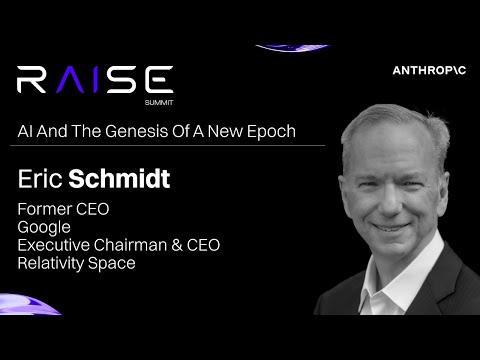
This video covers a session featuring Eric Schmidt on "AI and the Genesis of a New Epoch," offering a deep dive into the changes AI will bring to humanity. The moderator references the book Genesis: AI and the Opening of the Human Mind, which Schmidt co-authored with the late Henry Kissinger and Microsoft's Greg Mundie, emphasizing that AI marks the beginning of a new era.
"I'm truly convinced this is the beginning of a new epoch. Henry compared it to the Enlightenment. In the Enlightenment, humans transitioned from direct belief in God to rational thought. Now we're facing the arrival of a new intelligence -- not human -- an AGI with reasoning capabilities superior to humans."
Eric Schmidt points out that AI is advancing very rapidly, and many people are not prepared for it.
"When I talk to governments, I always emphasize two things: first, today's AI is completely different from two years ago; and second, you are not prepared. You must reorganize to meet this change."
What Is the San Francisco Consensus?
The moderator asks Schmidt to explain the term "San Francisco Consensus" he recently coined. Schmidt responds:
"My colleagues in San Francisco are convinced that the world will completely change within 2-4 years, averaging about 3. Their logic goes like this:"
- Stage 1: Language-to-language conversion (LLMs, e.g., ChatGPT) already showing outstanding results
- Stage 2: "Memory" is introduced into systems, launching the "agent revolution"
- Stage 3: Multiple agents collaborate to automate complex tasks (e.g., each agent handling a different aspect of building a house)
- Stage 4: These changes apply to all businesses, governments, and human activities
"When the agent revolution combines with the reasoning revolution, the way humans work will completely change. That's why the San Francisco Consensus is so powerful."
On the reasoning revolution in particular:
"Look at ChatGPT-4's o3 version -- watching it reason back and forth is truly remarkable. At Google, math models have already reached the top 10% of math graduate students. When these systems are deployed at scale, the magnitude of change will be enormous."
AGI, ACI, and Self-Improving AI
The moderator asks about the difference between AGI (Artificial General Intelligence) and ACI (Artificial Capable Intelligence), and the control problem when AI reaches the stage of "recursive self-improvement."
Schmidt explains:
- AGI: General intelligence -- the ability to learn with free will and pursue goals, like humans
- ACI: The stage where AI learns and improves itself (recursive self-improvement)
"Recursive self-improvement means the system learns from itself. Self-learning has already begun in some agent solutions, and by the end of this year, you'll experience systems that learn while you use them."
"AGI doesn't yet have strategic intelligence with free will, but I expect we'll reach it within 4-6 years. The next step is superintelligence -- AI smarter than all human intelligence combined."
On the standard for superintelligence:
"The test for superintelligence is simple: it can prove something we know to be true, but no human can understand the proof. Henry said that when people see that, they might be so frightened they'd fight back against AI."
AI Competition, Network Effects, and the Gap Between Nations
Schmidt explains AI competition and network effects:
"In industries with strong network effects, once one side gets ahead, the other may never catch up. For example, we hire 1,000 AI researchers, and one day computers start doing AI research -- suddenly we can deploy a million at once. The pace of innovation accelerates exponentially."
In such a scenario, the gap between nations in AI could widen, affecting national security, politics, democracy, and all aspects of human experience.
"Many people ask, 'Can democracy survive the AGI era?' The arrival of AI is posing fundamental questions for humanity."
AI Infrastructure, Hardware, and the Bubble Debate
The moderator asks about recent AI infrastructure investment and the "bubble" debate. Schmidt responds:
- Industry leaders say "This is an era of overinvestment, but I'll be fine and others will fail" (classic bubble logic)
- However, the emergence of LLMs and foundation models is a historically significant discovery, and hardware investment has always been consumed by software
"I don't think this is a bubble. It's closer to an entirely new industrial structure emerging."
Data, Mathematics, Software, and AI's Expansion
Schmidt explains how AI is expanding:
- Some believe data has reached its limits, but mathematics and software are "scale-free" (infinitely expandable) domains
- For example, in math, AI will generate new structures and proofs on its own; in software, the era is coming where you tell AI what you want and it writes the code
"I asked a programmer, 'What language do you code in?' and he said, 'Who cares? It's a new world now.'"
- This also means cyberattacks could be automated, amplifying both positive and negative impacts
"Mathematics and software will scale infinitely, followed by biology, chemistry, and physics, which need more data. This is the basis for the explosive growth of infrastructure."
Global AI Competition and Open Source
The moderator asks about the semiconductor race and China's AI catch-up. Schmidt responds:
- The US builds massive data centers and powerful services with enormous capital (closed-source)
- China actively develops open-source and open-weight models (with government support)
- Open-source models can achieve broader global adoption, especially in countries with less economic power
"Even if the US and the West are technologically ahead, the majority of actual AI usage could end up being Chinese open-source models. We haven't fully grasped the geopolitical implications of this."
Lessons from the Mobile Revolution and AI Era Strategy
Finally, the moderator asks about mistakes made during the mobile revolution as Google CEO and what companies should watch out for in the AI era. Schmidt emphasizes the importance of timing.
"Every mistake I made as CEO came down to time. Google succeeded with Android, but we should have moved faster. This market has too many players and too much capital -- hesitate and you'll quickly fall behind."
"If you want to do something in this space, start right now and move very fast. Focus on building great products."
Conclusion
Eric Schmidt's conversation strongly emphasizes the speed and scope of change AI will bring, and the need to prepare for it. He warns that AI's advancement will transform every domain of human life, while advising that fast execution and innovation are paramount in this era where opportunity and risk coexist.
"The session isn't over yet. An amazing founder is about to take the stage."
Key Concepts:
- The arrival of the AI era
- San Francisco Consensus
- Agent revolution & reasoning revolution
- AGI, ACI, superintelligence
- Network effects and national competition
- AI infrastructure and hardware investment
- Scale-free (mathematics, software)
- Open-source vs. closed-source models
- The importance of timing and fast execution