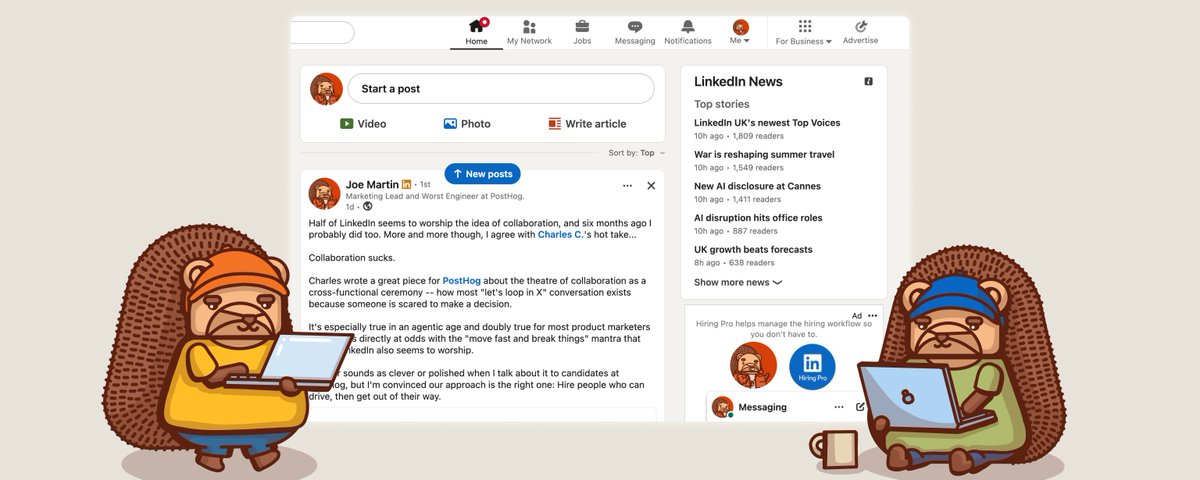
This article is a detailed guide to finding product engineer roles. It starts with a definition of product engineers, then explains what kinds of companies are likely to offer this kind of role and how candidates can stand out in the application process. Product engineers are developers who participate in product decisions, deeply understand user needs, and think in terms of outcomes.
1. Who Is a Product Engineer?
At PostHog, a product engineer is more than someone who simply writes code. Product engineers are deeply involved in every aspect of the product and think like they are running their own business.
Product engineers tend to have the following traits:
- They have product decision-making authority and take responsibility for it.
- They talk with users and deeply empathize with their needs.
- They care more about outcomes than perfect code.
- They have strong opinions about what should be built and can support those opinions with convincing reasoning.
- They understand the business impact of their work.
- They test, iterate, and improve in production with real users.
- They are strongest when given the autonomy to build every part of the product themselves.
Developers who work this way perform better, ship faster, delight customers, and feel more satisfied with their work. PostHog describes this approach as a kind of superpower.
2. Where Can You Find Product Engineer Jobs?
The good news is that the product engineer role is very important. The bad news is that finding and landing these jobs is harder than it looks. Searching Google for "companies hiring product engineers" or asking ChatGPT may not give good answers. But there are useful signals to look for.
2.1. Types of Companies Where Product Engineers Can Thrive
What kinds of companies provide a good environment for product engineers?
- Companies with engineer founders: If at least one founder is an engineer, the company is more likely to preserve a product engineering culture. Companies whose original founders have moved on are less likely to have that culture.
- Early-stage and growth-stage startups: Startups are one of the best places to find product-engineering-style roles. Large companies such as GitHub or Intercom can also offer good environments.
- High engineer ratio: Companies with a high ratio of engineers are more likely to give engineers autonomy in decision-making, especially product decisions.
Source: LinkedIn, July 14, 2025. "Engineers" combines the "Engineering" and "Information Technology" categories to avoid undercounting.
- Product-led companies: These companies offer free tiers, care deeply about users, and grow through product usage. Supabase, Lemon Squeezy, Tailscale, Notion, and Vercel are examples. Because they put users first, they are often excellent environments for product engineers.
- Bootstrapped companies: Self-funded companies value efficiency and people with ownership. Bootstrapped open-source companies are especially worth watching.
- Low-meeting culture: Early-stage companies usually have fewer meetings. Explicit no-meeting days or a preference for asynchronous communication are good signs. During interviews, dig into how decisions are actually made.
2.2. Types of Companies to Avoid
Some companies are less suitable for product engineers.
- Companies with no engineer founders: They may treat engineering as a cost center that needs to be optimized.
- Companies reducing headcount: A company that recently cut staff may not be healthy, and it may not be a good environment for engineers seeking autonomy.
- Companies with a strong enterprise feel: White-and-blue websites, hidden pricing, and only a "request demo" button often indicate a sales-led company. These companies focus on large contracts, which may not suit product engineers.
2.3. Job Search Tips
These companies may be difficult to find on general job sites such as Indeed.
- Y Combinator's Work at a Startup: YC's culture is product-engineer-friendly, and it is the largest and best-known startup accelerator.
- Filter roles by engineering.
- Filter company stage by seed, Series A, and growth.
- Select the option to show founder details. This is important.
- Optionally filter by company size.
- Use search terms such as "product engineer," "product-minded," "autonomy," "open source," and "ownership."
- Look for company profiles that explain the founders, product, tech stack, and what kind of company they want to build. That information shows how much the company values product engineering culture.
Dart, from the W22 batch, is a good example of the detailed information you are looking for.
- Hacker News: A good place to find engineering-led startups.
- BuiltWith: Useful for finding newly emerging companies.
- GitHub Explore: Helpful for identifying growing open-source startups.
- Built In: Makes it easier to search postings from hiring systems such as Greenhouse, Lever, and Ashby.
- VC job boards: Use job boards from venture firms such as Andreessen Horowitz and Sequoia Capital.
- LinkedIn alerts: AI search can work well with prompts such as "companies where engineers decide what to build."
- Key Values: You can filter roles by values such as "engineers decide what to build" and "high engineer ratio."
3. How to Find the "Real" Product Engineer Roles in Job Postings
Because "product engineer" is not yet a universally used or understood term, the absence of the term in a job posting does not mean the role is not product engineering. Conversely, the presence of the term does not guarantee the role matches what you expect. You need to read for hidden signals.
3.1. Look for Hidden Signals
Pay close attention to what the company's website and careers page emphasize.
-
Railway example: A "Senior Staff Engineer" role may not use the words "product engineer," but the website and job ad contain strong signals.
- In the "About the role" section, notice this line:
"You will write engineering requirements documents that own everything from idea to defined work, implementation, and success monitoring." This perfectly summarizes a product engineer's role: owning the path from idea to execution and success.
- The "About you" section also emphasizes leading autonomously and working mostly asynchronously.
Source: Railway's Senior Full-Stack Engineer job description.
- In the "About the role" section, notice this line:
-
Supabase example: Supabase uses the title "Product Engineer" and highlights the right themes.
- It especially emphasizes customer interaction and the ability to navigate ambiguity, both essential qualities for product engineers.
Source: Supabase's Product Engineer job description.
- It especially emphasizes customer interaction and the ability to navigate ambiguity, both essential qualities for product engineers.
-
Intercom example: Even though Intercom is no longer an early-stage startup, its engineering principles emphasize shipping quickly, ownership, autonomy, and full ownership of what the team builds from beginning to end.
-
Vercel example: Vercel uses the "product engineer" title, but its postings often focus heavily on technical requirements. In cases like this, it helps to investigate the company culture through sites such as Glassdoor and Levels.fyi.
3.2. Questions to Ask in Interviews
In larger companies, culture can differ by team, so it is important to ask directly during the interview process.
- "What are the company's or team's values, and why?"
- "Can you give specific examples of how those values are actually followed?"
- "How are new ideas evaluated and implemented?"
- "What does a typical workday look like?"
- "What behaviors or factors would cause someone in this role to fail?"
4. How to Prepare Applications and Interviews
How can your application stand out among many candidates? PostHog says it spends about one minute reviewing each application. Your goal is to become the candidate whose application gets five to ten minutes of real attention.
4.1. Cover Letter Tips
- Be specific: Explain why you are interested in the role in 5-10 concise sentences. It does not need to be an essay.
- Do not repeat your resume: Do not simply restate what is already in the resume.
- Do not use ChatGPT: "It is really obvious."
- Show understanding of the company: Understand what the company values and explain how you can help.
- Share motivation: Be honest about what excites and motivates you.
- Submit it when asked: If a company asks for a cover letter and you do not submit one, you give the recruiter an easy reason to ignore you.
This is what a real cover letter looks like.
4.2. Resume Tips
- Prioritize clarity: Clarity of content matters more than design.
- Do not use a profile photo: This is not social media.
- Keep LinkedIn updated: Large inconsistencies between your LinkedIn profile and resume can raise suspicion.
- Explain career gaps: If you have a gap, mention it honestly. The gap itself is usually not the problem. An unexplained gap is more concerning.
4.3. Stand Out Through Personal Effort
These are ways to make your application receive 10 minutes of attention.
- Side projects: Building something people actually pay for is excellent. It gives you real "war stories" about decisions, user interactions, and lessons learned. It proves you can do the work product engineers need to do.
- Share your experience: A personal website where you write about what you built, what you learned, what tools and technologies you chose, and why, adds depth to your application. You do not need to go viral on Hacker News. The habit of writing alone can create stories that lead to interviews.
- Start a company: This may be a bigger goal, but former technical founders often become excellent product engineers. PostHog especially looks for people like this.
- Contribute to open source: Strong open-source contributions help your resume and may even directly lead to a job, especially at early-stage companies. Fixing a typo in documentation does not count as meaningful contribution.
The more of these efforts you make, the more likely your application is to receive 10 minutes of focused attention rather than 10 seconds.
Conclusion
A product engineer is more than a developer. It is someone with ownership and deep understanding of a product's success. To find and win this kind of role, you need more than simple job-board searches. You need to understand a company's culture and values in depth, then present your own experience effectively. Use these tips to find the right environment and show that you can own the product, not just the code.