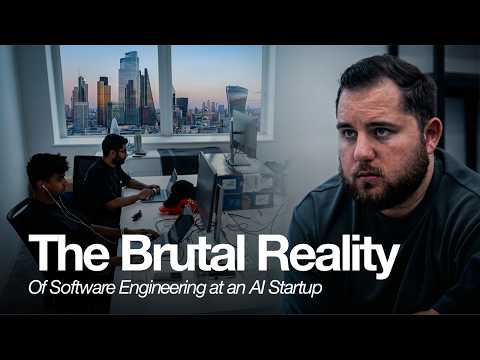
This video shows what the engineering team at AI startup Tano actually does in 2026. The team is creating AI agents that automate influencer marketing, solving database problems and measuring customer outcomes while leveraging AI coding tools to rapidly develop products. The biggest change is that engineers are changing to a role closer to 'architects', designing and reviewing AI-generated results, rather than writing all the code themselves as before.
1. A day at a startup that started with a database error
The video begins by showing the everyday atmosphere of Tano's office with music. However, the atmosphere soon changes as the team members discover a database error. Someone said, "It doesn't work," and the database was throwing an error called statement timeout, i.e. the database command was canceled because it did not finish within the time limit.
"I'm seeing an error now."
"I'm seeing errors too."
The cause of the problem was that some of the team was searching the database in the process of finding influencers, and the queries were taking too long. This database contained information and achievements of influencers with whom Tano had collaborated so far. For example, work was in progress to send gift codes or gift codes to influencers who would promote products in the Shopify store, and to build its own influencer database.
This database stores information such as each influencer's response speed, sales generated, and past collaboration performance. This data can be Tano's primary data that cannot be easily obtained by other companies.
"We are creating our own database based on all the influencers we have worked with so far. We are gathering primary data such as how quickly they responded and how much sales they made. This is information that is not available anywhere else."
Although the data size is hundreds of thousands of rows, engineers explain that it is not a very large database. The host is surprised to hear that the database has hundreds of thousands of rows, but the engineer says this is typical. This scene shows that even a seemingly simple influencer search function actually requires a significant amount of data and complex systems.
2. Founding Engineer Nathan and Tano's AI Agent
The following video introduces Tano's founding engineer Nathan Banji. Nathan jokes that he is working in front of the camera differently than usual, and that the atmosphere is like the car racing documentary Drive to Survive.
"I'm Nathan Banji, founding engineer at Tano."
Nathan's core responsibility is to create AI agents that talk to influencers on behalf of brands. These agents are designed to contact influencers, coordinate collaboration terms, close paid content contracts, and even run affiliate programs.
Previously, these tasks were performed directly by people from advertising agencies or internal marketing teams. People were needed for the entire process of searching for influencers, contacting them, waiting for their response, negotiating terms, and tracking the results. Tano seeks to replace this repetitive, manual process with an AI agent.
"We are creating an AI agent that can talk to influencers on behalf of brands, establish collaborations, create paid content, and even run affiliate programs."
"Instead of using traditional human teams like agencies do, we replace that work with AI agents."
Team members sometimes jokingly ask each other who is the best software engineer. Each person points out the other, and one person jokingly replies "Claude". This reveals an atmosphere within the team where AI tools are already so deeply involved in work that they feel like real colleagues. 😄
3. Recruitment and Tano's business vision
The office also reviews the job application submitted by an applicant. Applicants were introducing their experience working with influencers and UGC creators, their social media marketing experience at a fintech unicorn company, and their experience growing their personal YouTube channel to more than 18,000 people.
The host is impressed by the content and expression of the application.
"This application is really great. It has a lot of ideas and a lot of experience."
Next, Tano co-founder Will introduces the company. Tano was founded about 16 months ago when the video was filmed. The purpose of the startup was to solve the problem that existing influencer campaigns were overly inefficient and dependent on manual work.
"We founded Tano about 16 months ago because we wanted to solve influencer campaigns that were too inefficient and manual."
Tano's long-term vision does not stop at influencer marketing. Ultimately, we want to automate all manual marketing tasks for all companies. Influencer marketing is the first entry point toward that grand goal.
"In the long term, our goal is to solve the manual marketing tasks of all companies around the world. Influencer marketing is our starting point toward that goal."
Tano's biggest problem right now isn't attracting new customers. Since there are already many companies that want to work with us, it is more important to be able to provide sufficiently good results to customers as they increase.
"The biggest problem right now is not bringing in new customers. It's whether we can support them in the best way and actually deliver the best results."
The company is hiring for positions such as influencer operations staff, and needs not only technical staff but also people to run actual marketing campaigns.
4. Capital for startup growth and greater challenges
In between work, there is also talk about SpaceX's stock price and Elon Musk's Mars exploration. The story goes that SpaceX stock rose from $135 to $224 per share, and one team member says he made about 275 pounds. However, he regrets that the stock price could have risen further.
"How much did you earn?"
"275 pounds."
"That's not that bad."
"It could have gone up even higher."
They talk about whether SpaceX will be able to reach Mars while Elon Musk is alive. There is also a joke that if Mars cannot be reached at that time, Musk may go on a rocket himself. 🚀
This conversation soon leads to the connection between software startups and the space industry. Among those who started large technology companies or space-related businesses, such as SpaceX's Elon Musk, Blue Origin's Jeff Bezos, and the founder of Boom Supersonic, which develops supersonic passenger aircraft, there are many who first succeeded in the software business.
The reason is that realistically, a very large amount of funds is needed. If you come up with an idea that is too radical from the beginning, it will be difficult to persuade investors. So, he explains that it is possible to first create a business that people can understand and invest in, and then take on bolder challenges based on the capital and experience gained from that business.
"No one invests in a crazy idea from the beginning. You have to do something that seems somewhat possible first, and then you start doing something really bold with your own money."
Sam Altman also mentions the case that OpenAI was not his first startup. The experience and success gained from previous businesses helped create OpenAI. In the end, the story is that a realistic first business can be a stepping stone to realizing a bigger dream.
5. The most difficult aspect of AI agent development
Will explains the biggest engineering challenge Tano faces. The key is that you have to deal with two different non-deterministic systems simultaneously.
The first is an AI agent. AI may not always respond or act in the same way, even in the same situation. The second is an influencer who is a real person. It is also difficult for people to predict when they will respond, how they will react, and what conditions they will present.
"We are dealing with two non-deterministic systems together: one is an AI agent and the other is a real person."
Unexpected situations constantly arise during conversations between AI and people. The influencer may ask the wrong questions, change the terms during negotiations, or not reply at all. There is also a possibility that AI may make incorrect decisions in certain situations.
Therefore, for Tano to achieve full automation, it must handle numerous exceptions and edge cases.
"If you want to create an automated system, you have to deal with all these exceptions."
Simply having AI converse naturally is not enough. You must be able to close actual transactions, adhere to brand requirements, and respond safely when problems arise. This is why deploying AI agents in real businesses is much more difficult than creating a simple chatbot.
6. Solving slow database queries and timeouts
The cause of the database error that occurred earlier is also explained in detail. One query was running too slowly.
A query is a command sent to the database to request desired information. A simple search can be completed quickly, but if you need to scan a lot of data or apply complex conditions, it can take a long time.
"A query is a command that sends data to the database. However, if the command is too complex or requires looking at too much data, it may take a long time to return the results."
Tano's system restricts database queries from running longer than a certain amount of time. For example, if there are no results after one minute, the database automatically stops the request. This is timeout.
"A timeout occurs for queries that take longer than 1 minute. When time runs out, requests that do not produce results are failed."
These restrictions may seem inconvenient, but they are necessary to protect the entire database. If long-running queries continue to pile up, the database may be overloaded with requests to be processed, creating a huge queue. Some operations may lock the database while reading or modifying data, which slows down other requests as more operations occur.
"If you have a lot of long-running queries, everything slows down. If the requests keep piling up and the database gets locked up, the whole system can eventually come to a halt."
Therefore, rather than simply eliminating error messages, engineers must find out which queries are slow and improve queries and database structures to efficiently retrieve only the necessary data. This scene shows that the work of an AI startup is not only done by developing grand AI models, but also relies heavily on basic engineering tasks such as optimizing database performance.
7. What is important in influencer marketing is 'suitability' and measurement.
The conversation then turns to the influencer marketing problem Tano is trying to solve. There is a scene that checks whether the influencer shared a link to the story and whether the inflow actually occurred through that link.
Will explains that the important thing in marketing today is not simply recruiting famous creators. First, you need to know where your target audience is and find the creator who can speak most persuasively to that audience.
"We need to know clearly where our customers are and who can speak to them most persuasively."
Creators are a very powerful channel to sell products, but if you choose an influencer that doesn't fit your brand, it becomes less effective. You need to deliver the right message to the right people, at the right place and time.
"The key is to deliver the right message with the right creators and connect them so that the message feels authentic to the creators."
In the end, what matters is authenticity, relevance to the target audience, accuracy of the message, and performance measurement. You cannot judge a campaign as a good one simply because it has a high number of views. You need to check how many customers you actually brought in and how much sales you made.
8. Measure campaign performance with CAC and CPM
The Tano team was analyzing the various costs of influencer campaigns to provide better reporting to its clients. Based on this, we want to calculate CAC, or customer acquisition cost, and CPM, or cost per 1,000 ad impressions.
"You want to look at all the costs that go into running an influencer channel and calculate your customer acquisition cost and CPM."
Tano's goal is to create campaigns that are more efficient than existing advertising platforms.
"We want to create lower CPMs than Meta's paid ads."
Will summarizes the biggest problems with influencer marketing into two points.
- There is a lot of friction in the process of running a campaign.
- It is difficult to measure the performance of the campaign.
Large advertising platforms such as Meta have a relatively simple advertising production and execution process, and can precisely measure various indicators such as the number of clicks, conversion rate, and purchase amount. Influencer marketing, on the other hand, involves a complex process of finding people, contacting them, negotiating, reviewing content, and tracking performance.
"There are two big problems with influencer marketing: one is that there is too much friction, and the other is that it is very difficult to measure."
If Tano solves both of these problems, we believe it can turn influencer marketing into a programmatic marketing channel, an advertising channel that can be operated at scale based on data and automation.
"If we solve both of these, we can turn influencer marketing into a programmatic marketing channel. That's the ultimate goal."
9. The Creator Economy and the $100 Billion Opportunity
Will explains the huge imbalance that exists in the influencer marketing market. Although a significant portion of the attention and content viewed by consumers around the world is focused on creators, actual advertising budgets are not distributed accordingly.
According to his explanation, creators account for about 80% of consumer attention, but only about 5% of the global marketing budget is devoted to creators.
"Creators receive about 80% of consumer attention, but only about 5% of marketing budgets."
The reason why interest is focused on creators but budgets cannot keep up is because influencer marketing is difficult and difficult to expand. From a company's perspective, it is too cumbersome to find and manage numerous creators and measure the performance of each.
Tano seeks to solve this problem through Agentic AI. If the proportion of the budget devoted to creator marketing can be increased from 5% to 20%, it is predicted that approximately $100 billion worth of additional spending could be moved to this market.
"If we increased influencer marketing budgets from 5% to 20%, approximately $100 billion in spending would shift to this industry."
Tano aims to capture as much value as possible from that huge market. In other words, the goal is not to simply create a service that creates messages using AI, but to create a platform that automates the entire campaign, from finding influencers to negotiating, content creation, and performance analysis.
10. The first steps needed for coding beginners
During a brief break, Nathan is shown drinking coffee. He makes a simple iced coffee with ice and milk and drinks it.
"Do you like coffee?"
"I like it. Especially iced coffee. Just add coffee granules and milk and stir."
Afterwards, the host asks Nathan, as a beginner who knows nothing about coding, what he should do to become a software engineer. Nathan recommends CS50, Harvard University's online introductory course, although there is no single right answer.
"If you're a complete beginner, I think watching Harvard's CS50 course would be a good starting point."
CS50 is a lecture that broadly covers the basic concepts of computer science, and because the entire lecture is long, it can be watched in several stages. However, taking CS50 alone does not mean you will completely understand all the basics of computer science.
Nathan says even people with a computer science background still have a lot to learn. Neil also studied mathematics and computing, but says that completing his degree does not mean he understands all the basic principles of computing.
"There is so much to learn in computing. If you say you understand all the basics, you're either lying or you're a very good scholar."
The host jokes by introducing himself as a "non-professional engineer" even though he did not major in computer science. This conversation shows that software engineering is not a field that can be completed with just one lecture or degree, but rather an area that requires continuous learning and mastery.
11. Software engineering before and after AI
The key topic in the second half of the video is how AI has changed the work of software engineers. Nathan explains that just a year or two ago, in traditional agile teams, engineers wrote their own code.
At the time, development tools had an auto-completion feature, but it was limited to predicting the function name or next few lines the developer was about to enter. Developers still had to write the code themselves and think about how each function worked one by one.
"Previously, team members worked together and wrote their own code. Although IDEs provided autocompletion, they didn't write code for developers."
Since then, with the advent of tools such as GitHub Copilot and Cursor, the level of autocompletion has increased significantly. AI now suggests multiple lines of code instead of just one, and developers can quickly accept the suggestions by pressing the Tab key on the keyboard.
"Now it predicts multiple lines of code instead of just one. We can now hit the Tab key and accept suggestions rather than writing all the code ourselves."
And with the advent of agent-type coding tools such as Claude Code, the change became even greater. When a developer requests a task in natural language, AI can now perform long tasks that can take several hours and even implement an entire function.
"Now you can ask Claude Code to do a job, and it can take hours to do the work, and actually create an entire feature."
As a result, the role of a software engineer is changing from someone who writes all code by hand to an architect who designs the system and instructs AI to do the appropriate work.
"We are moving from people who make everything by hand to becoming a kind of architect."
12. Engineers write less code but judge more
Nathan says he almost never writes his own code these days.
"I barely write any code anymore. It's amazing."
This does not mean that engineers' jobs have become easier. Rather, it has become more important to evaluate the plans made by AI, review the code created by AI, and look at multiple pull requests. In the past, many engineers considered code review to be a tedious task, but now code review is becoming a core part of their work.
"Now it's about judging plans and reviewing more PRs."
"In the past, many software engineers hated PR reviews, but now it's practically a big part of their job."
AI-generated code is not always correct. AI can produce very plausible code, but it may lose the context of the overall system or contain unexpected errors. Therefore, engineers should not unconditionally accept the results of AI, but should understand and verify why the code works the way it does.
Nathan likens AI models to a very smart next-generation autocomplete. The explanation is that AI produces amazing results because it learns from enormous amounts of data, but it does not have intrinsic intelligence or understanding like humans.
"These models are very smart, but they are not inherently intelligent."
"You could say it's a very smart next word predictor that has been trained on a huge amount of data. It's kind of like autocomplete on steroids."
Therefore, it remains important for developers to be able to determine how to design a system, what principles to apply, and whether AI-generated code meets actual requirements.
"If we can't understand the code, it's not good code for us."
Ultimately, the amount of code engineers write may decrease, but design skills, problem definition skills, code review skills, and the ability to understand the system become more important.
13. The future of software engineers in the AI era
The video ends by emphasizing that AI is completely changing the direction of software engineering. Even compared to just two years ago, the way developers work has changed significantly. Instead of reducing the time to write code line by line, the method is changing to using multiple AI agents to create larger functions and control the results.
"We are going in a completely different direction than we were two years ago."
However, AI does not take over everything. Evaluating AI-generated code still requires solid programming knowledge and system design skills. Using AI without understanding its results can create new errors and security issues.
Therefore, it is highly likely that future engineers will not simply be people who quickly enter code, but will perform the following roles:
- A person who accurately defines the problem
- A person who assigns appropriate tasks to AI agents
- A person who designs the overall structure of the system
- A person who reviews and modifies code written by AI.
- A person who determines whether it meets actual user and business requirements
At the end of the video, the host tells viewers that he hopes the story about software engineering and the startup building process was helpful, and asks them to subscribe and like.
"I hope you learned a lot about software engineering and how to build a startup through this video."
Finish
Tano's day is very varied, from troubleshooting database errors to designing AI agents, measuring the performance of influencer marketing, and discussing recruiting and business strategies. The biggest change this video shows is AI is not eliminating engineers, but changing the role of engineers.
Engineers now spend more time designing and verifying AI-generated results than writing code themselves. In the end, even in the AI era, what is important is not how much code you write, but the ability to understand what needs to be created, guide AI in the right direction, and take responsibility for the results.