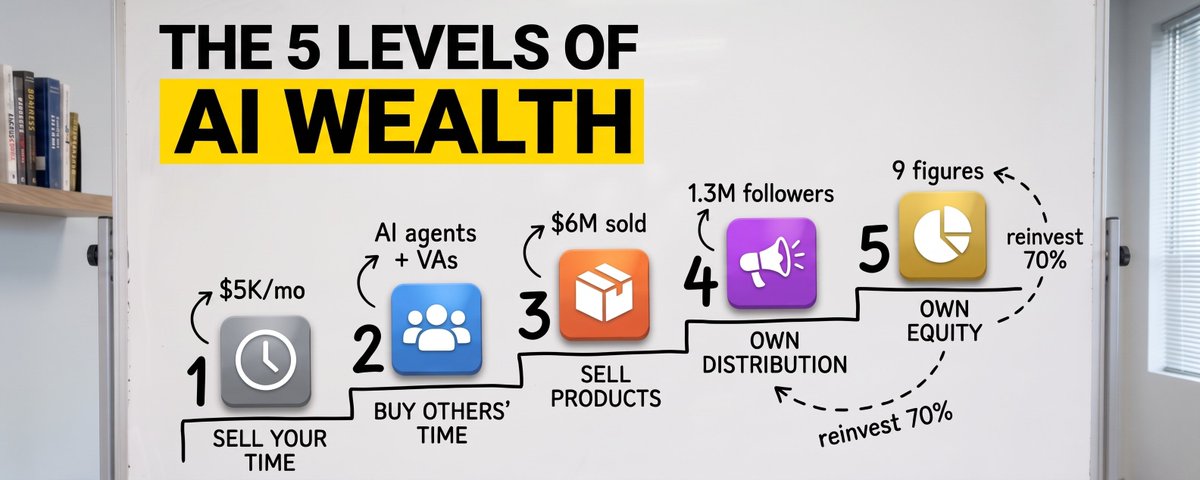
The author describes building wealth through AI-era opportunities in five stages: selling time, using other people's time, selling products, owning distribution, and allocating capital. The key is to reinvest the earnings and experience from each stage into growth at the next. He emphasizes actively using AI alongside human judgment and capabilities, ultimately owning distribution and converting cash flow into ownership of assets.
1. The Overall Path and Starting Point
The author sees this as the largest wealth transfer in a generation. He argues that people who make good use of it could build more wealth over the next five years than many earn in a lifetime. He says he began making money online as a crypto analyst paid $5,000 a month and now runs a $30-million-plus AI media and technology business.
"The goal of this article is simple: not to show you just one business model, but the entire path. Once you know the destination, you can understand why each preceding stage matters."
His five stages are:
- Earn money by selling your own time.
- Expand the business using other people's time.
- Build products and sell them repeatedly.
- Own the distribution that connects products with customers.
- Reinvest capital to increase ownership and influence.
2. Level 1: Sell Your Time to Earn Your First Revenue
The author says the fundamentals of earning your first money have not changed in the AI era: do work, provide a service, and get paid. What has changed is that AI can now act as part of the team, handling manual tasks that were previously difficult because of limited time or staff. Examples include building landing pages, rapidly developing custom research tools, and collecting and analyzing information online.
He uses AI tools such as Grok Bot and Claude and also runs a developer team building content-automation tools. Yet he employs more than 30 people and believes combining people and AI is the competitive advantage of this era.
"It has never been easier to automate digital work."
His first online income was a $5,000 monthly retainer for providing crypto research to a company. He says even earning your first $100 online can change how you see the world, because small earnings create a feedback loop that motivates the next action.
For him, creating content built distribution, distribution brought opportunities, and those opportunities led to consulting and then an agency. As results accumulated, he wanted to do more. This, he explains, is how motivation develops.
"I often hear people say, 'I'm not motivated,' or 'I'm not a hardworking person.' I don't necessarily believe that. They just haven't found their own feedback loop yet."
What to Do When Starting Out
If you do not have much money available, he advises using your time and ability to learn to turn that time into income and resources. If starting again, he would do two things:
- Start an AI concierge service. Many founders and business owners do not know how to use AI well. Spend two weeks learning one AI tool deeply, then offer tailored setup and adoption to local business owners who know less about it. You are selling time, but a short period of learning can become a cash-generating business.
- Create content on X. Share thoughts and experience through client results, posts, threads, videos, and other formats to create an inbound channel through which prospects find you.
The service businesses he considers promising to start in 2026 are writing services excluding low-quality AI-generated writing, growth and content services, AI consulting, and custom business automation.
3. Level 2: Scale Through Other People and AI
After making your first money online, you need to consider how to grow. The source leaves blank the specific monthly revenue threshold the author mentions, so that amount cannot be confirmed, but he says that once you reach a certain level, you should think about scaling operations. In his view, most business models can grow to $100,000 a month through hiring, documenting standard operating procedures (SOPs), and delegating work.
He takes advantage of being a remote company by hiring virtual assistants (VAs) in lower-cost regions and having them manage multiple agents to increase output. He also uses AI for recruiting, process design, and sales. Specifically, he uses AI tools as a head of talent acquisition, and Claude to create SOPs and task skills for delegating work such as scriptwriting and YouTube management. In business development, multiple agents handle sponsorship pipelines, customer outreach, and research before meetings.
He introduces the 10/80/10 rule as an important principle: even when AI does most of the work, a person must review and approve the result. We do not know whether AI will eventually handle everything perfectly, and without human checks, clients may receive poor work.
"One of the biggest bottlenecks in AI-powered businesses right now is approving AI's work."
He says a structured recruiting system, virtual assistants, business-development staff, and salespeople helped grow his agency's revenue from $5 million to more than $30 million. He stresses hiring good people and the central role of the team. For those earning roughly $20,000 a month or more, he recommends considering expansion as a major way to invest in themselves.
"I'm a huge advocate of bringing in great people. The team is everything."
4. Level 3: Build Products to Sell Repeatedly
At the third stage, you combine your time, knowledge, and team's capabilities into repeatable systems and build products: create something once and sell it many times. The author says he has earned more than $6 million from digital information products and argues that their growth ceiling is no lower than that of service businesses such as agencies. A product's potential ultimately depends on its quality.
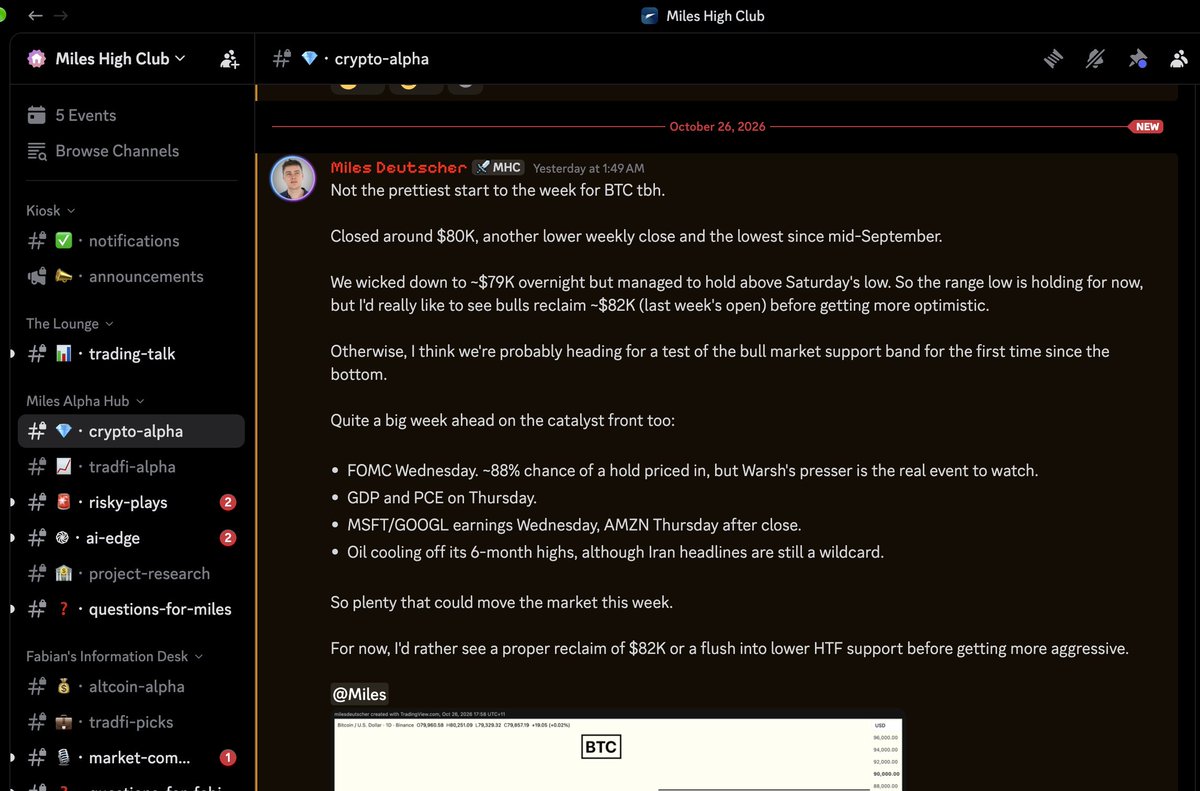
He sees many opportunities in the AI era to build tailored products that solve small, specific problems. His example is a trading bot. He is interested in automating research, investing, and trading, but says consumer products that smoothly cover the entire path from research to trades are still lacking. Existing tools solve only parts of it, while asking Claude to trade produces many mistakes and lacks built-in tools. He is therefore building his own trading-bot terminal and says he plans to release it soon.
A product does not have to remain relevant forever. Grok Bot templates, for example, are in high demand now, but it is unclear whether that demand will last. n8n templates were also popular for a time, and people who earned money then could reinvest in their businesses and move to the next opportunity. A competitive edge lasting only one or two years can still be valuable.
"Build a product where market demand overlaps with your own unfair advantage."
5. Level 4: Own the Distribution That Brings Products to People
Many business models may become commoditized in the AI era, but the author argues that owning distribution is difficult to replace. Distribution means more than social media accounts. It includes a personal brand or media company; a product or platform with an existing customer base; influence in the algorithms of social media, search engine optimization (SEO), job boards, and AI networking apps; brands and accounts that provide distribution; and scalable systems that outperform competitors.
He says it is important to consider how the product built at Level 3 will reach people and to invest earnings from earlier stages in distribution. Examples include building an internal media team, running paid ads, and acquiring other brands. Securing distribution first can enable partnerships with world-class companies, higher prices, and access to top-tier opportunities.
For those moving from Level 3 to Level 4, he advises documenting and sharing what you have actually done. Even earning a few dollars online is a worthwhile experience to share.
He says he consistently posted thoughts about crypto research on X for months without much initial response. But he became comfortable sharing ideas publicly and later expanded to YouTube. Building distribution is a long process, he explains, and requires staying ahead of changes in media.
"My advice is to share what you have actually experienced."
6. Level 5: Reinvest Capital to Secure Ownership
The final stage is about allocating capital to create a greater competitive advantage. Once you earn money, it is easy to focus only on increasing net worth, but the author says to first consider how reinvesting in the business could create a bigger advantage.
In his view, if you run a business reasonably well, investing in it may offer a higher expected return than stocks or property. He owns both stocks and property but says he reinvests most of his assets in his businesses.
His allocation is roughly 70% to the business and 30% to himself. Most of his personal share is also invested. Business spending goes toward people skilled in AI and spotting market gaps; AI usage; distribution costs such as account acquisitions, content editing, and paid ads; business development through conferences, networking, and in-person gatherings; investments in early-stage AI companies; and a fund to be launched under AI Edge.
He encourages moving beyond the idea that money is a finite resource. Not every investment has succeeded, but he says more reinvestment has produced greater returns. Above all, major companies, funds, and creators grow by converting distribution into ownership.
"The principle I follow is this: cash flow should always lead to ownership."
The ultimate goal, then, is not simply income but ownership of businesses, brands, platforms, or company equity that can grow in value over time.
7. The Five Stages at a Glance
The author's overall path is:
- Sell time to create initial capital. Work with AI to accomplish more.
- Use other people's time and AI. Scale operations through hiring and SOPs.
- Build and sell products. Use AI to create products that can be sold repeatedly.
- Own distribution. Build the foundation for continuously connecting products with customers.
- Invest capital in ownership. Turn cash flow into long-term assets.
He presents this as his complete business playbook and his plan to grow his net worth into nine figures or more. He adds that each week he covers AI tools, systems, and research with practical benefits for finances, business, and AI-tool use, inviting readers to follow him on X and other channels and learn tools in his free Skool community.