
This document outlines the practical strategies GitHub used to drive a people-centered transformation toward becoming an AI-first organization. It emphasizes that successful AI adoption requires organically connecting multiple pillars -- not just technology, but change management, policy, community, education, and performance measurement. The guide is organized around 8 practical pillars and step-by-step execution plans that help an entire organization naturally absorb AI into their work.
1. Why GitHub's AI Adoption Didn't End in Failure
Many companies invest heavily in AI tools only to see adoption limited to a small group of early adopters. As a result, the expected productivity gains and innovations never materialize, and the return on investment remains minimal. GitHub realized that the key to change is not 'installing' software but redesigning the way people work, and built a people-based change strategy.
"The difference between success and failure isn't whether you purchased licenses, but whether you changed how employees think and how work flows."
Therefore, AI adoption should be approached not as a 'technology' problem but as a 'change management' problem.
2. The 8 Core Pillars for Successful AI Adoption
GitHub's AI adoption model is distinctive in that it creates an 'ecosystem' of 8 mutually reinforcing components.
- Executive support
- Policies and guardrails
- AI Advocates
- Learning & Development
- Metrics
- Responsible Individual
- Right-fit tooling
- Communities of practice
Executive leadership and clear policies form the foundation, while advocate programs, communities, and L&D drive grassroots adoption and organic spread. A dedicated responsible individual coordinates everything, and performance data continuously improves the program.
3. The Role of Executives: Casting the Vision and Alleviating Anxiety
The success of AI adoption starts with executives providing authentic explanations of 'why we are pursuing this change.' Clear goals and realistic expectations must be consistently communicated to employees. Rather than a defensive posture like "Your jobs are safe," leaders should honestly communicate the real changes and the support being offered.
Bad example: "Your jobs are safe."
Recommended example: "The way we work will change like this, and we will provide the support and training opportunities you need to develop the required new skills."
Additionally, managers and team leads are asked to redesign workflows and team goals, while senior individual contributors are asked to serve as mentors who not only use AI themselves but spread it across the organization.
4. Clear Policies and Right-Fit Tool Deployment
Employees become reluctant to experiment when there's uncertainty about what's allowed and when they can use AI. Therefore:
- Clear, easy-to-understand policy documents must be easily accessible to all employees
- Policies should be designed robustly in collaboration with IT, HR, security, legal, and other departments
- AI tools should be classified into two simple tiers: 'vetted tools (can use with company/customer data)' vs '**unvetted tools **(only public data allowed)' so anyone can make an instant judgment.
"If a tool isn't on the 'fully vetted list,' use it only with public data."
This enables responsible and safe experimentation to scale across the organization.
5. AI Advocates: Seeds of Internal Innovation
The driving force of innovation is peer influence and experience sharing. The advocate program empowers self-nominated employees interested in AI (no formal position posting required) to lead positive change.
Advocate Responsibilities
- Field experts and go-to consultants for questions
- Spread real success stories and specific use cases within their teams
- Channel field 'voices' back to the central program:
"We can show concretely how AI actually helped with specific tasks on our team."
- Co-lead customized training sessions tailored to regional/departmental contexts
Support System
- Dedicated communication channels exclusively for the advocate community
- Direct support from leadership
- 'Train-the-trainer' focused support (advocates lead workshops and mentoring themselves)
6. Communities of Practice: The Engine for Spreading Experience and Knowledge
Rather than a single channel, diverse online communities organized by purpose and audience are created and operated.
- Examples:
- General Q&A and announcements:
#how-do-i-ai - Developer-focused practical tips:
#copilot-users - Department-specific communities:
#ai-for-sales, etc.
- General Q&A and announcements:
For this, each channel needs a clear purpose and designated moderators (typically selected from advocates). Regular internal success stories and fresh shared content keep channels vibrant.
"As more and more colleagues share their AI usage tips in the community, the learning curve accelerates."
This structure creates a system where organization-wide AI capabilities grow 'organically.'
7. Learning & L&D: Closing the AI Gap, Opening Paths for Growth
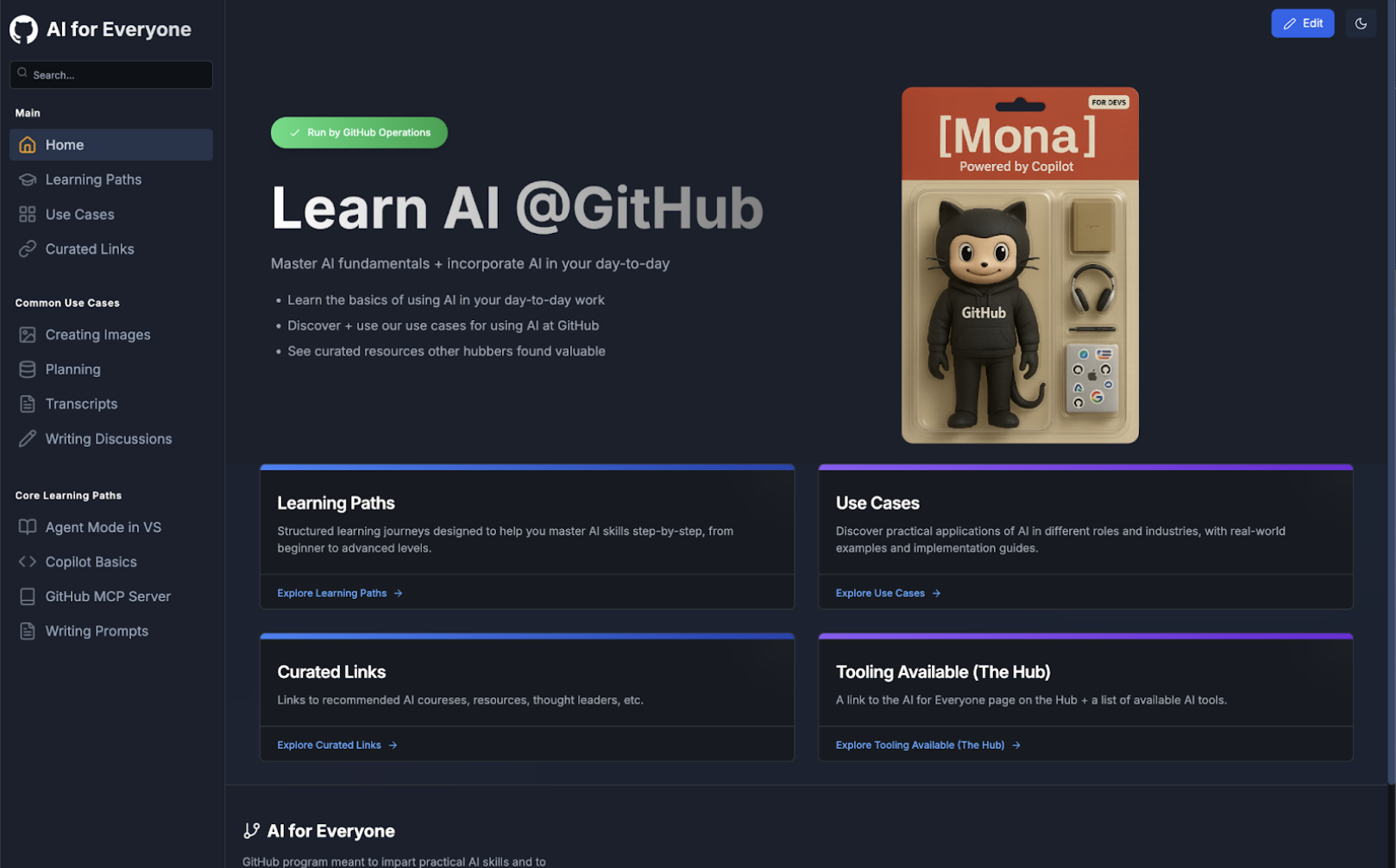
Going beyond just showing how to use AI tools, customized growth paths are created. GitHub maintains an L&D portal curating the best internal and external courses and resources.
Key Strategies
- Clear learning tracks from 'basics to hands-on practice' accessible to beginners
- Actively leverage external high-quality, up-to-date courses (rather than developing content in-house):
"AI technology changes so rapidly that curating external resources is more effective than building your own."
- Introduce practical, reusable templates and workflows for technical roles
- Include AI training as a mandatory part of new employee onboarding (making it part of company culture)
8. The Directly Responsible Individual (DRI): The Hub of Change, the Heart of the Program
At the center connecting all of this is an actively engaged 'Directly Responsible Individual (DRI).' GitHub assembled a team of a program director and managers to plan and operate the 'AI for Everyone' initiative.
What the DRI Does
- Design and operate short- and long-term strategy and priority roadmaps
- Lead change management, smooth adoption, and overall communications
- Provide 1:1 consultations and hands-on problem-solving support for employees
- Identify and promote internal innovation stories
- Lead tool procurement, policy management, and new tool discovery/validation/deployment processes
- Monitor performance metrics (usage rates, business impact) in real time and drive improvements
"The essence of the DRI's role is 'growing people' -- removing obstacles and providing support so that change spreads across the organization."
9. Data-Driven Performance Measurement & Improvement
When results and impact are visible, AI programs become far more sustainable. GitHub operates a 3-tier measurement framework that goes beyond simply assigning licenses.
Tier 1: Understanding Adoption Scale
- MAU (Monthly Active Users), MEU (Monthly Engaged Users)
"Distinguishing between someone who used it even once (MAU) and someone who uses it habitually (MEU) lets you measure the real extent of adoption."
Tier 2: Understanding Integration Depth
- User segmentation based on usage frequency:
- 'Power users (10+ days/month)'
- 'Occasional (2-9 days/month)'
- 'Initial trial (1 day/month)'
- Total AI usage events (number of touchpoints such as prompt entries and code completions)
Tier 3: Measuring Ultimate Business Impact
- Linking to core productivity and quality metrics (e.g., reduced lead time, code quality, developer satisfaction)
- Qualitative surveys on workflow changes and satisfaction driven by AI adoption
GitHub also actively uses its Engineering Systems Scorecard Playbook (ESSP).
10. Practical Checklist: Step-by-Step Operations
Phase 1 (Within 30 Days)
- Secure C-level sponsorship and leadership declaration
- Designate a DRI (with organization-wide authority)
- Rapidly establish v1 usage policy (tier-based)
- Build an initial metrics dashboard
- Company-wide announcement and vision sharing
Phase 2 (Within 90 Days)
- Recruit and onboard advocates, open dedicated channels
- Establish topic-specific and audience-targeted communities
- Open a centralized resource hub
- Actively build consensus around early success stories
- Integrate AI modules into new employee onboarding
Ongoing
- Formalize advocate 'train-the-trainer' programs
- Build a business ROI dashboard
- Track qualitative changes through regular surveys
11. In Closing
There is no 'silver bullet' where AI technology solves everything. The organic combination of executive sponsorship, clear policies, field-level internalization, hands-on education, and performance measurement is the key to long-term AI innovation. GitHub's know-how lies in designing a system where the organizational culture itself becomes AI-friendly, not just the hardware. Only consistent data-driven improvement and substantive change management can build true organization-wide AI capabilities.
"Buying AI tools alone won't create change. Remember that a consistent, multifaceted framework is what ultimately enables high performance, innovation, and real value in work."