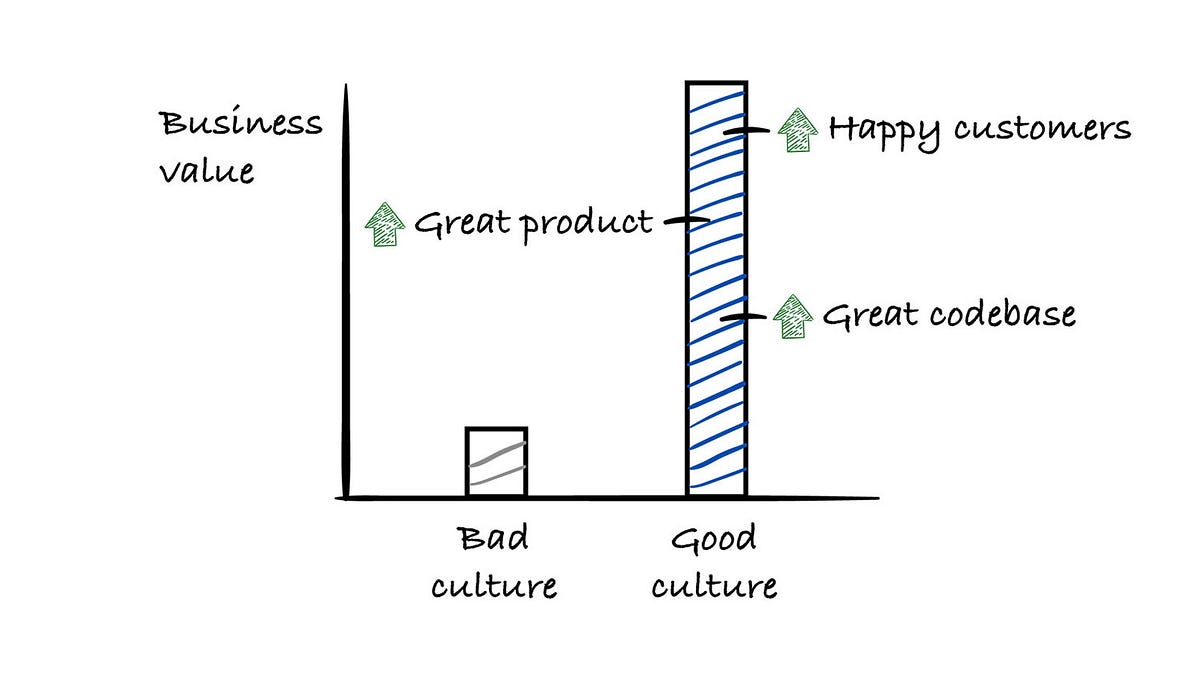
This article argues that organizational culture is a more fundamental determinant of productivity than AI tools themselves. AI amplifies results in an organization with a healthy culture, clear structure, and collaboration. In one marked by distrust, blame, and ambiguous responsibility, it merely accelerates existing problems. The central leadership question should therefore not be, "How do we make everyone use AI?" but "How do we create an organization where exceptional people can do their best work, then amplify it with AI?"
1. Sponsor Note and the Context Problem for AI Agents
The newsletter first introduces a free webinar from its sponsor, Unblocked. AI agents can generate code, it explains, but teaching them each company's system architecture, team conventions, and historical decisions is a separate and difficult problem. Adding more MCP integrations, rules, or context-window capacity does not by itself make an agent understand the information.
Unblocked proposes a context layer that gives an agent precisely the information required for each task. The webinar covers where teams become stuck at different levels of AI-adoption maturity, why common solutions fail, how a context layer improves quality, efficiency, and cost, and a comparison of the same coding task performed with and without such a layer.
2. The Importance of Culture Lost Amid the AI Frenzy
The author says nearly every conversation now revolves around AI, AI tools, and AI productivity. The messages are relentless: use this AI tool, adopt this AI workflow, and expect engineers to become two, five, or ten times more productive with AI.
He acknowledges that AI is changing software development and that he uses AI tools every day. But organizations are focusing too heavily on the tools and not enough on the environment in which they are used.
"We focus too much on AI tools and not enough on the environment in which those tools are used. Something matters far more than AI tools: a great culture."
Across more than thirteen years in engineering, he has seen both the destructive results of bad cultures and the positive outcomes of good ones. As an engineer and engineering manager, he experienced departments spending all day blaming one another when something went wrong. These experiences convinced him that good culture is the starting point for everything.
It is especially dangerous when executives invoke AI in messages that threaten people's roles or necessity. A specific offending sentence is missing from the source, but the author explains that claims implying "people matter less because we have AI" tell employees that their work is unimportant. The damage is greater when the message comes from a CEO, CPO, CTO, or another senior leader.
The result is a decline in psychological safety. People begin worrying whether they will remain necessary and lose the motivation to speak freely, challenge assumptions, or collaborate.
"There is no better productivity hack than a great culture. No AI tool will deliver a larger productivity gain."
3. Bad Culture Appears Directly in the Product
The author heard repeated claims in 2025 and early 2026 that AI would replace people or automatically produce enormous productivity gains. He feels the rhetoric has improved somewhat this year, but the belief can still damage organizations.
To explain why, he introduces Conway's Law: systems produced by an organization eventually resemble its communication structure.
"Organizations that design systems are constrained to produce designs that copy the communication structures of those organizations."
Communication and collaboration are therefore more than internal atmosphere. They appear directly in productivity, product architecture, and final output. A bad culture impedes communication and collaboration, making a bad product more likely. A good culture enables better teamwork and increases the likelihood of good output.
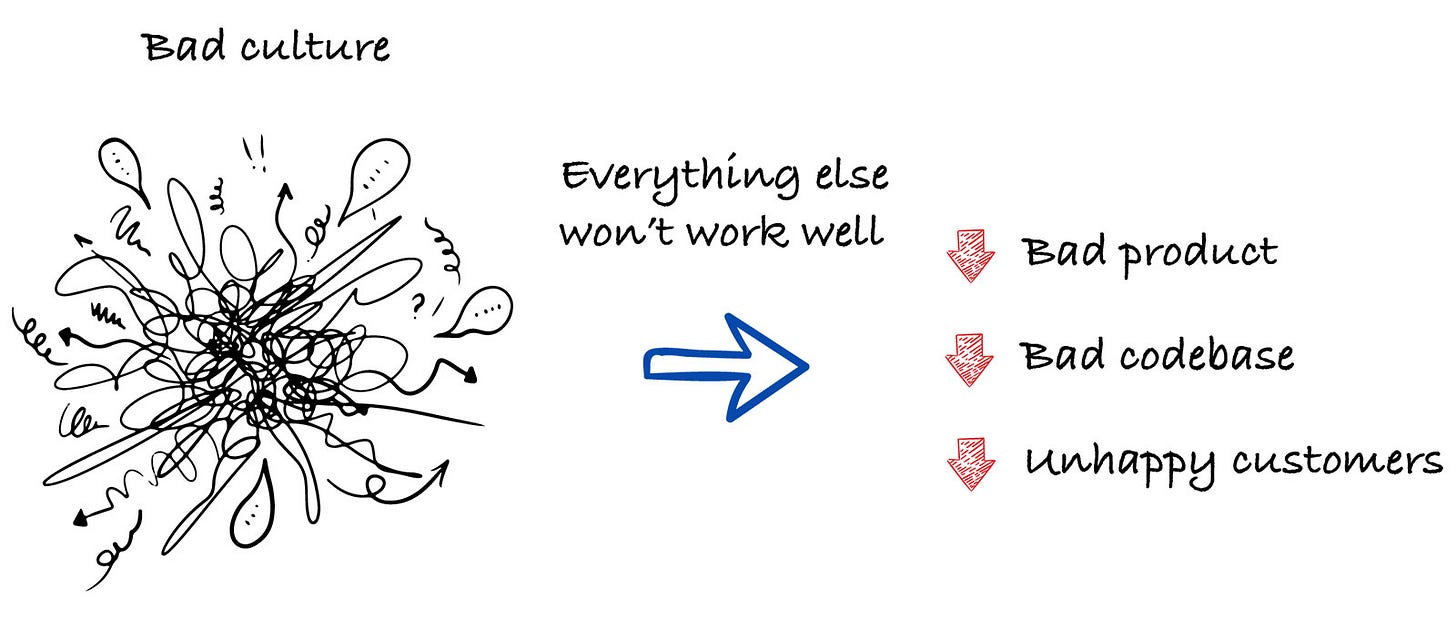
The author compares culture to human health. Poor health makes everything else harder; likewise, if organizational culture is unhealthy, improvements in strategy, tools, or structure will not work as well as expected. Culture must be treated as a prerequisite for every other improvement.
4. Do Not Be Driven by Competitor Fear or Claims of 10x Productivity
Many CEOs and executives grow anxious when they see a competitor claim tenfold productivity from a particular AI tool. They succumb to FOMO, then pressure or blame people around them by asking why their own organization is not equally productive.
That blame tells employees, "You are not doing your work well," and, "I do not trust your judgment." Engineers and engineering leaders expected to drive AI adoption bear the greatest burden.
The author also warns that many reports of "10x productivity with AI" may be marketing for a specific AI product or partnership. Leaders reacting hastily to the number can damage their culture instead.
"Whenever someone says something, always examine the incentives behind the claim. That alone tells you a great deal about whether it is true."
This does not mean dismissing every external success. It means asking who is reporting the productivity figure, why, and under what conditions. Instead of copying another company, first examine your own culture, ways of working, architecture, and workforce.
5. AI Amplifies Both an Organization's Strengths and Weaknesses
The author's central principle is simple: AI amplifies what already exists inside an organization. AI and a good culture work extremely well together, but AI will not repair a bad culture automatically.
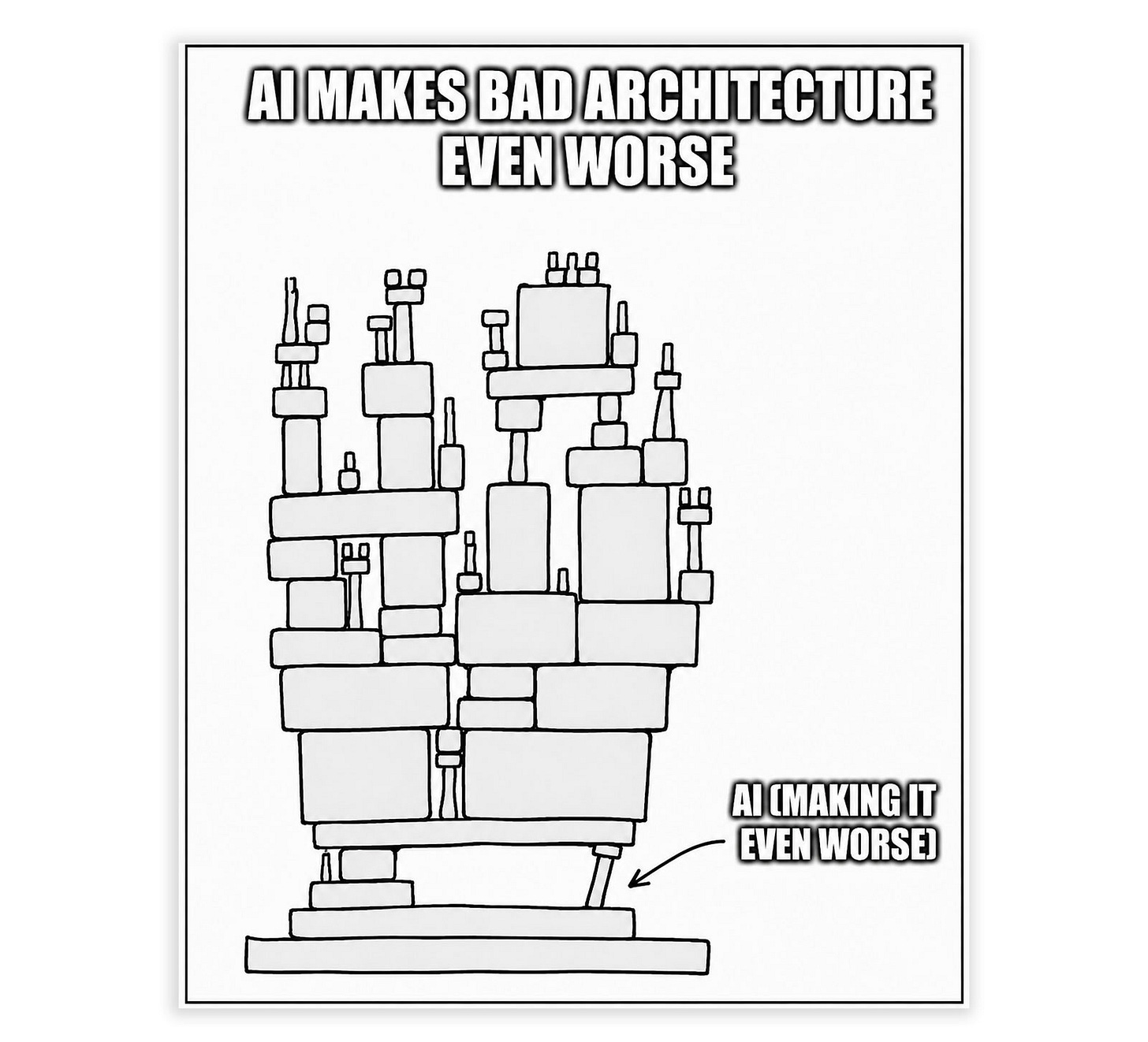
In a poor communication environment, AI turns false assumptions and ambiguous requirements into code and documents more quickly, compounding confusion. In an organization with weak architecture, AI produces more code on top of a bad structure, increasing complexity and technical debt. Deploying AI everywhere without clear processes or teamwork merely makes people run faster in the wrong direction.
"If you do not have good processes and architecture, and people do not work together as a team, using AI for everything will only make the situation worse."
With a good culture and sound architecture, people help one another and exchange knowledge. AI also receives a better blueprint—consistent structures and clear standards—making it more likely to produce work at the expected level.
6. Questions for Evaluating a Healthy Engineering Culture
The author recommends answering the following questions to judge the health of a team or organization's culture. If most answers are yes, you are on the path toward a good culture. 😊
- Do people know what they are responsible for?
- Can they make decisions independently without unnecessary approval?
- Do they feel safe disagreeing with leadership?
- Do teams trust one another?
- Are priorities clear?
- Can people resolve disagreement constructively?
- Do you reward outcomes and results rather than process or activity volume?
- Do people understand why they are building something?
- When failure occurs, do you learn, or search for someone to blame?
These questions show that culture is not simply friendliness or satisfaction. A good culture embeds clear ownership, autonomous decisions, psychological safety, inter-team trust, aligned priorities, and learning from failure into the actual way work happens.
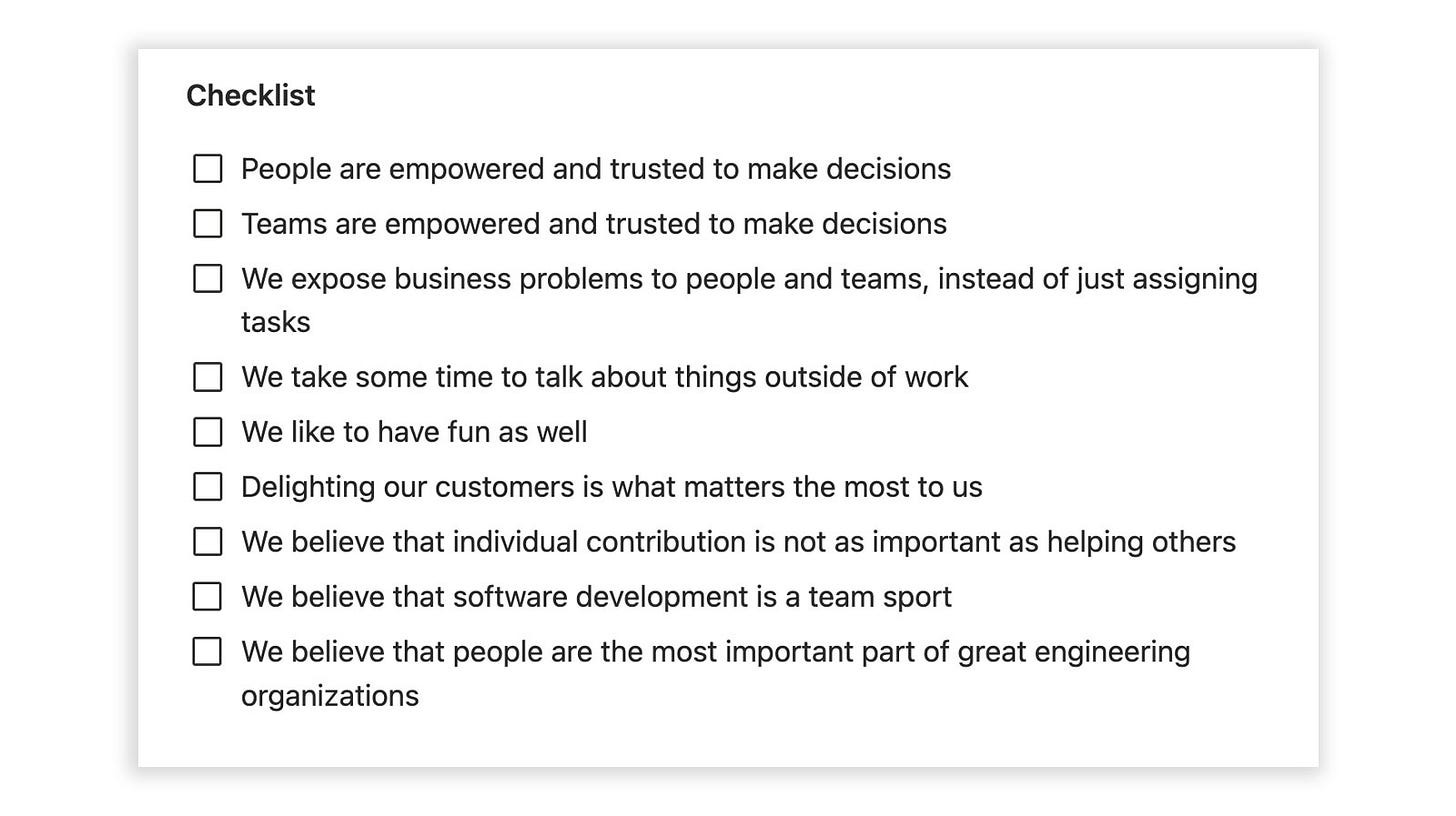
The author also introduces a separate checklist he uses to assess engineering culture. It can apply to large organizations with many teams, small organizations, or an individual team inside a larger company. The goal is an excellent engineering organization where everyone can grow and perform.
7. Frame AI Adoption as Empowerment, Not Replacement
How leaders communicate AI adoption directly shapes culture. The message the author has found most effective is that excellent engineers and engineering leaders have always learned and used tools that help them work better, and AI is one more such tool.
"Great engineers and engineering leaders learn and use a variety of helpful tools to do their work better. That has never changed."
"AI is like the other tools that have emerged over the years. Use it to help your team, organization, and business. That is what great engineers and leaders have always done, and the AI era does not change it."
Never say that AI will replace people or that they no longer matter. Such messages destroy morale and damage culture at its foundation.
The author also argues that adoption should spread from the bottom up rather than by top-down mandate. The AI landscape changes too quickly, with new tools appearing daily, so practitioners need to experiment, learn from one another, and exchange knowledge continuously. Mandating usage produces resistance, performative compliance, and poor results.
"AI adoption is not a tooling problem. It is a leadership problem."
AI usage itself is also the wrong objective. More important than how frequently employees use AI is business success and overall outcomes. AI is not the goal; it is a means to better products, customer experiences, and organizational performance.
8. The AI Era Still Requires More Engineers and Faster Execution
The author says his July 2025 argument that companies should hire more engineers in the AI era is even more correct now. The best companies will secure more engineers rather than reduce them, producing productivity growth that is far greater than linear.
This still depends on good culture. If culture collapses, adding people increases collaboration cost, coordination failure, duplicate work, and avoidance of responsibility. Within a healthy culture, however, more excellent people generate more ideas, experiments, and execution.
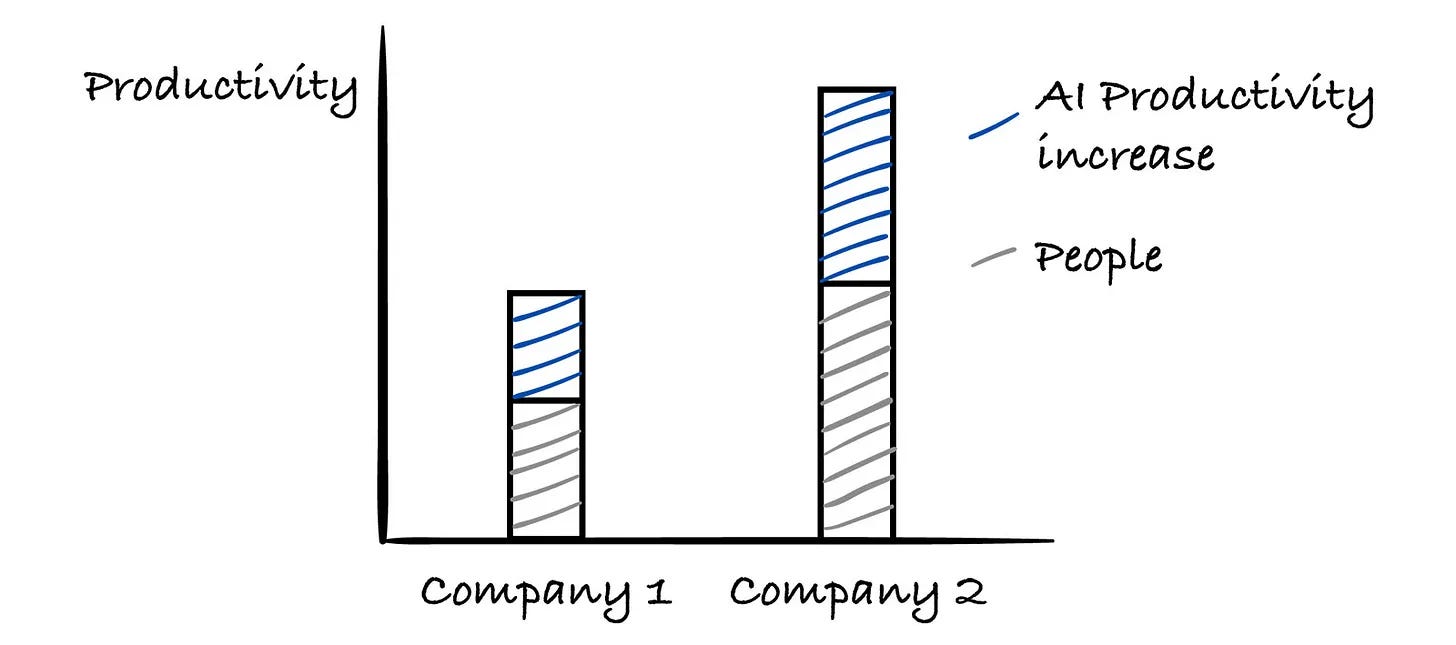
The metric the author considers especially important is time to market (TTM). Change moves much faster in the AI era, so industry leaders are likely to be companies that respond to market needs most quickly, adjust rapidly, and deliver better experiences to users.
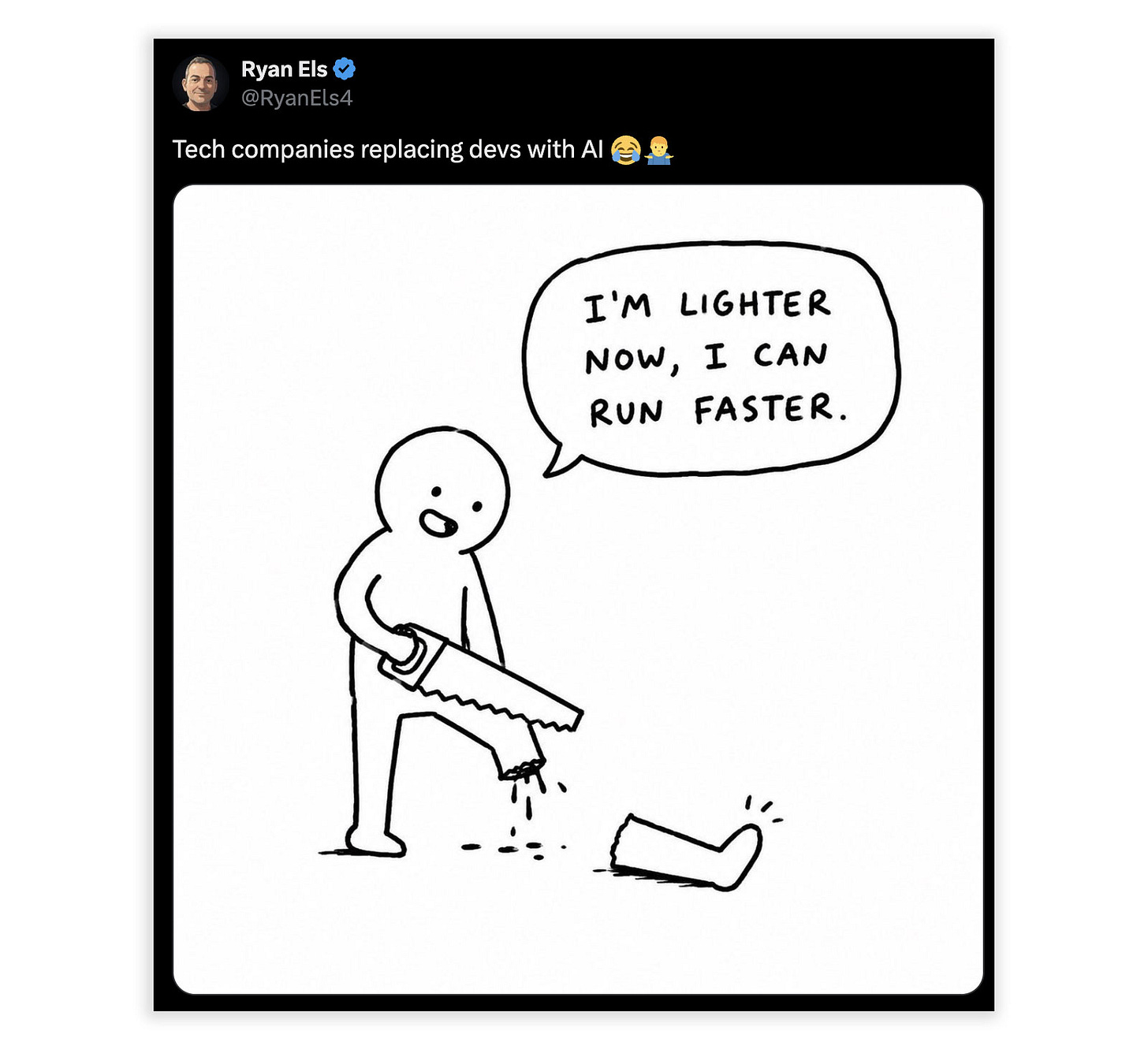
This mattered before AI and is more decisive now. If you can use more ability and talent to move faster, there is no reason to constrain both productivity and talent by saying, "We have AI, so let's reduce headcount."
"Knowing this, why would you choose to limit yourself to lower productivity and less talent?"
Remaining at low productivity when much greater performance is possible creates a major burden and risk that can erode market share over time. Replacing engineers with AI may weaken a company rather than strengthen it.
9. Closing: Enable People to Do Their Best Work, Not Maximize AI Usage
The conclusion is not that companies should reject AI. They should use it actively, but first create an environment in which people collaborate autonomously in a climate of trust and exercise sound judgment.
The first question leaders ask should not be, "How do we make everyone use AI?"
"How do we create an organization where great people can do their best work, and then amplify them with AI?"
Ultimately, great culture is the biggest productivity hack. AI cannot replace it, but when built on top of a good culture, AI can powerfully expand the capabilities of individuals and teams.